On these chilly, wintry nights there’s nothing better than a bowl of dhal, the Indian subcontinent’s beloved lentil-based comfort food, to warm you up. We’ve added some chunks of roasted pumpkin that blend perfectly with the red lentils, whilst adding a hint of sweetness to the rich, spicy blend.
KCC’s pumpkin enriched red lentil dhal
In Sri Lanka, where Knidos Cookery Club has just been on a foodie fact-finding mission, dhal (also spelt dal or daal) is a mainstay of the island’s signature curry and rice dish. It’s served any time of the day – it was particularly good served with string hoppers, little nests of steamed rice noodles, and coconut sambol (grated coconut with chillies and lime juice) – a popular breakfast on the island.
Breakfast Sri Lankan style – string hoppers with coconut sambol and red lentil dhal in the background
Dhal can be a meal on its own when served with rice or flatbreads, or try it alongside a selection of your favourite vegetable curries. It’s a dish that tastes even better the next day when the spices have been left over night, allowing the different flavours to mix and mingle.
Ingredients (makes 4-6 servings)
125 g red lentils
200 g roasted pumpkin
250 ml water or vegetable stock
50 ml coconut milk
200 g tomatoes
One medium onion
One teaspoon each of mustard seeds, cumin seeds, coriander seeds, cloves and chilli flakes
Two teaspoons turmeric
1 cm knob of ginger
One garlic clove
One cinnamon stick
One star anise
One bunch fresh coriander
50 ml olive oil
Method
Roast the chunks of pumpkin in a hot oven at 200 c for 20 minutes. While the pumpkin is cooking, heat the oil in a heavy based pan and add the mustard seeds. When the seeds begin to pop, turn the heat down and add the chopped onions, ginger and garlic and the other spices and stir well. Cook for 10 minutes over a medium heat.
Wash the lentils until the water runs clear and then add them to the onion mix with the vegetable stock and chopped tomatoes, stir and cook until all the liquid is absorbed. Add the pumpkin chunks and coconut milk. Cook over a low heat until it starts to bubble. When cooked, remove the cinnamon stick and star anise. Garnish with the chopped coriander and serve with rice and/or a flat bread such as chapati or pita.
Seasoned greetings from Knidos Cookery Club – we’d just like to take this opportunity to thank all our readers, old and new, in 2019 and wish you a great holiday season and all the best for the New Year.
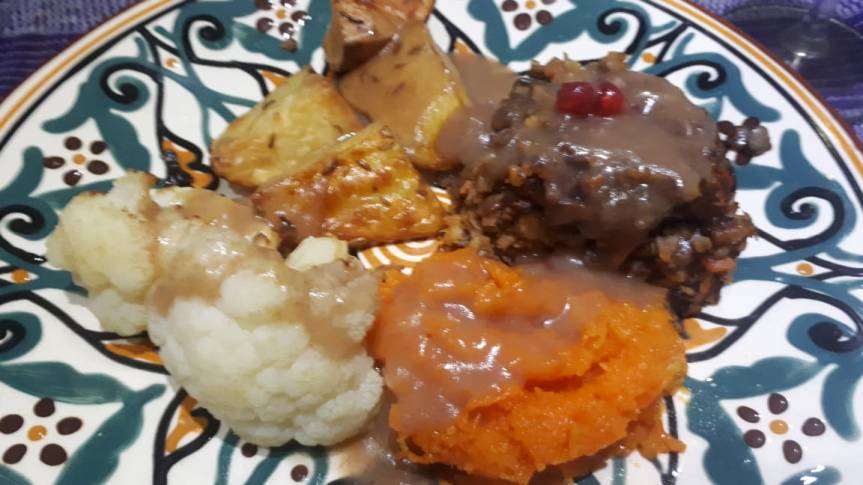
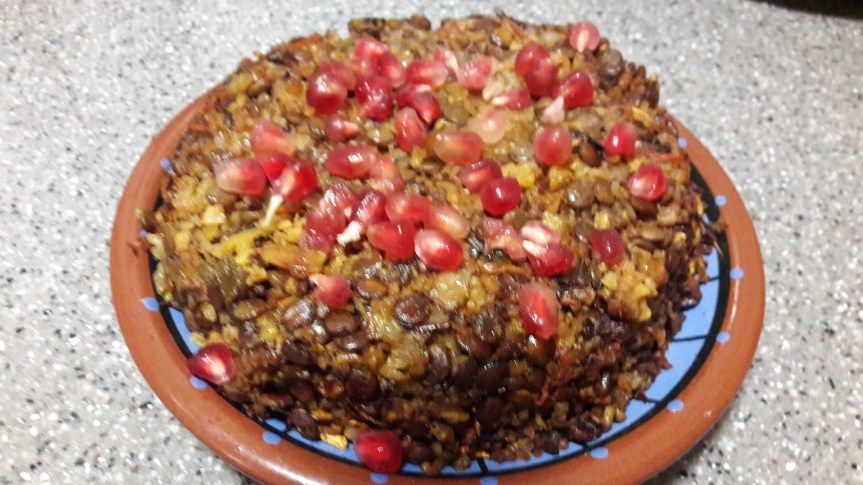
With the winter solstice, Hanukkah, Christmas and New Year all upon us, we’d like to share this nutty lentil bake recipe with you. It makes a great centrepiece for a festive feast.
We served it with roast potatoes, charred cauliflower and smashed pumpkin and then poured a rich pomegranate sauce over everything.
Ingredients (for 6 servings)
150 g green lentils
One carrot
One medium-sized onion
One stick of celery
75 g walnuts
75 g coarse bulgur
Two tablespoons tomato paste
Two teaspoons cumin seeds
One teaspoon coriander seeds
One teaspoon chilli powder
Half a teaspoon cloves
50 ml olive oil
250 ml vegetable stock
25 g chickpea flour
Pomegranate seeds
Method
Cook the lentils in the vegetable stock until most of the liquid has been soaked up. The lentils should still be firm, not mushy. Stir in the bulgur and leave to stand for 30 minutes.
Heat the olive oil in a heavy based pan and add the spices. Cook for a few minutes and then add the chopped onions, grated carrot and thin slices of celery and cook for 10 minutes, stirring regularly.
Combine the vegetable mix with the lentils. Stir in the tomaro paste. Toast the chopped walnuts for 5 minutes then add to the lentil mix. Finally add the chickpea flour to thicken the mix.
Pack the mix into a greased baking dish and cook for 30 minutes in an oven pre-heated to 180 c. Garnish with pomegranate seeds and then cut the loaf into 6 slices and serve.
Over the last few days, we’ve been experimenting with perfecting a batter to make pakora – a deep-fried snack from the Indian sub-continent. After testing a few recipes we’ve hit on a formula that can be used to coat a variety of vegetables from cauliflowers to carrots, parsnips to peas, and also cheese!
Halloumi pakora with potato wedges and peas
While on a recent visit to the UK, we came across battered halloumi on many menus – the squeaky cheese from Cyprus that stays firm when cooked. We’ve discovered that it makes a perfect partner for our pakora batter when deep-fried. We recommend you try it with this spicy Yemini sauce, zhug.
But you’ll need to be quick, as halloumi has been a victim of its own success. Severe global shortages of this versatile cheese are predicted as demand far outstrips supply. Luckily for us here in Kazakhstan, a local producer has started making a version of this cheese. We’re pleased to report that it tastes pretty good, so for now the crisis has been averted in our winter base.
Ingredients (makes enough batter for a sliced up 250 g block of halloumi)
100 g chickpea flour (also known as gram flour or besan)
One small onion
1 cm knob of ginger
One garlic clove
One teaspoon red chilli flakes
One tablespoon of fresh coriander
50-100 ml cold water
Method
Mix all the ingredients together with a fork or a whisk, adding water until you get a smooth consistency that is neither too runny not too thick with no lumps. Cover the batter with clingfilm and let it stand for an hour or so before using.
Heat a litre of cooking oil, we used sunflower oil but any will do, in a heavy-based pan over a medium heat until it reaches 180 c. To test the temperature, dip a chopstick or the handle of a wooden spoon in the oil – if the oil starts to bubble vigorously, then it is at the right temperature.
Slice a 250 g block of halloumi into eight pieces. Coat the halloumi slices in the pakora batter and drop into the oil. When the pakora rise to the surface and are a golden-brown colour, remove with a slotted metal spoon and drain on kitchen towel.
Serve hot with potato wedges or roast potatoes and minted peas. The pakora goes well with a coriander and coconut chutney – this site has a good recipe for this sauce, or with our zhugsauce.
On a recent flying visit to Glasgow, KCC dropped into Ox and Finchin the city’s West End for a bite to eat. This Sauchiehall Street eatery offers a range of tapas-style sharing plates – we opted for the giant couscous with grilled halloumi, a plate of braised leeks, beetroot hummus, grilled baby gem lettuce and, with this being Glasgow, chips of course.
A spicy bowl of zhug sauce
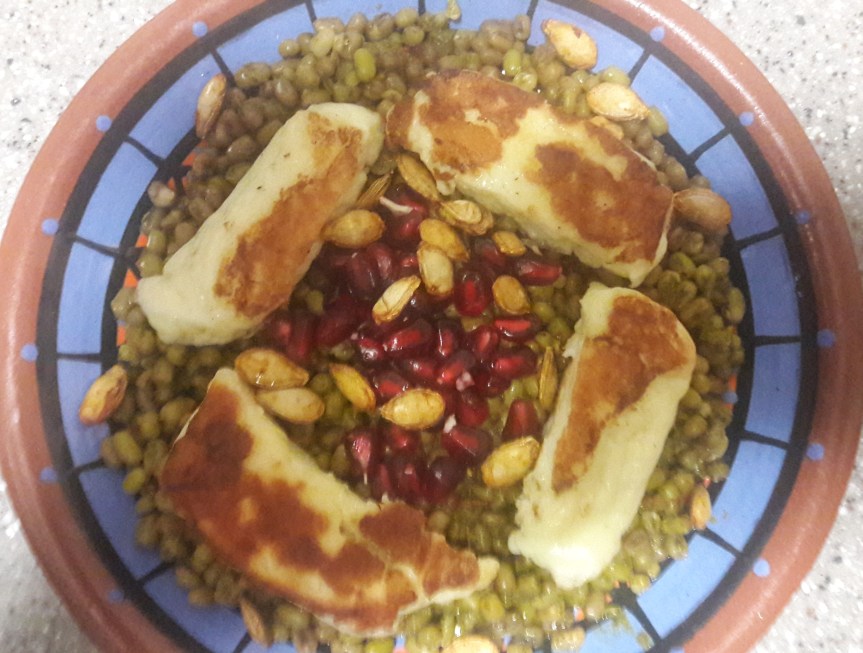
This time round, we’ll be recreating the giant couscous dish, made with ptitim, toasted pearls of wheat and semolina, first cooked up in Israel in the 1950’s when rice was in short supply in the early days of the Israeli state. This couscous relative was dubbed Ben-Gurion rice after Israel’s first prime minister. After scouring our local supermarkets, ptitim proved to be in short supply so we’ve replaced them with mung beans!
Mung beans, zhug, halloumi, pomegranate and pumpkin seeds
Key to this salad is the dressing, a piquant sauce called zhug, which was brought to Israel by emigrées fleeing persecution in Yemen in the late 1940s. This spicy cousin of Italy’s milder pesto and Mexico’s equally fiery salsa verde, is served often alongside falafel and hummus. The name is said to be derived from mas-chag, the name of the grinding stone traditionally used to crush the spices and herbs into a paste.
Ingredients (serves 2-4)
100 g mung beans
125 g halloumi
Sprinkling of pomegranate seeds
Sprinkling of roasted pumpkin seeds
For the zhug sauce:
One bunch fresh coriander
One bunch fresh parsley
One garlic clove
Two teaspoons red chilli flakes
One teaspoon black peppercorns
One teaspoon cumin seeds
One teaspoon coriander seeds
One teaspoon cardamom seeds
Juice of half a lemon
25 ml olive oil
Method
To make the zhug sauce, put all the ingredients except for the olive oil in a blender and give it quick blitz. Don’t overdo the blending as you want a slightly chunky texture. Now slowly add the olive oil, blitzing until it is mixed in with the other ingredients. Put in a glass jar – it should keep for a couple of weeks in the fridge.
Cook the mung beans until tender. While the mung beans are cooling, grill the halloumi until a golden-brown colour. Then mix the cooled mung beans with a tablespoon of zhug, arrange the grilled halloumi on top, sprinkle with pumpkin and pomegranate seeds and serve with a selection of your favourite meze dishes.
With Nikol Pashinyan, leader of the largest political protests in Armenia’s post-Soviet history, looking likely to become this impoverished Caucasus Mountains nation’s next prime minister, Knidos Cookery Club is celebrating this momentous event with an Armenian recipe cooked up by our friend Bagila.
Bagila’s Armenian (Revolutionary) Peppers take centre stage
This mountainous, landlocked country sandwiched between Turkey, Iran, Azerbaijan and Georgia, has a rich cuisine that draws on an array of fresh vegetables such as aubergines and peppers, pulses and beans and fruits and nuts.
Bagila’s recipe uses red peppers that are fried and then marinated overnight in her signature marinade and they taste amazing served alongside a platter of other dips and salads as in the picture above.
Ingredients (serves 4-6)
500 gr red peppers, cut lengthwise in quarters
50 ml olive oil
For the marinade:
2 fresh tomatoes, skinned and grated
5 crushed/mashed garlic cloves
75 ml of lemon juice
1 bunch of fresh coriander, chopped
1 bunch of fresh parsley, chopped
1.5 tablespoons of sugar
a little less than 1 tablespoon spoon of salt
black pepper to taste;
oil left over from frying
Method
Fry the quartered peppers in hot olive oil until soft and then set aside. While they’re cooking, mix all the marinade ingredients together in a bowl.
Combine it all together: a layer of peppers, followed with a layer of marinade and so on.
Put something heavy on top for pressure (a saucer with a stone on top, or a jar of honey (jam), or whatever you can think of), and keep in the fridge for at least several hours (better one night/day) before eating. Enjoy!
Happy Lunar New Year to all our readers – wishing you all many culinary adventures in the Year of the Dog!
With both South and North Korea back in the headlines with the Winter Olympics in full swing in Pyeongchangand the ongoing tensions on the Korean peninsula, this week Knidos Cookery Club will be making a dish that has become a hit in the former Soviet Union and beyond – spicy Korean carrots.
Spicy Korean Carrots
It’s a dish that’s not really from Korea, north or south – largely unknown outside of the countries of the former Soviet Union until recently, this simple dish has now gone full circle and can now be found on tables in South Korea.
It originated with the Koryo-saram, Korean people, who were deported en masse from the borderlands of Russia’s far east to Central Asia in the late 1930s. Fearing a Japanese fifth column in the Soviet Union via this Korean community, Stalin ordered the mass deportations in 1937.
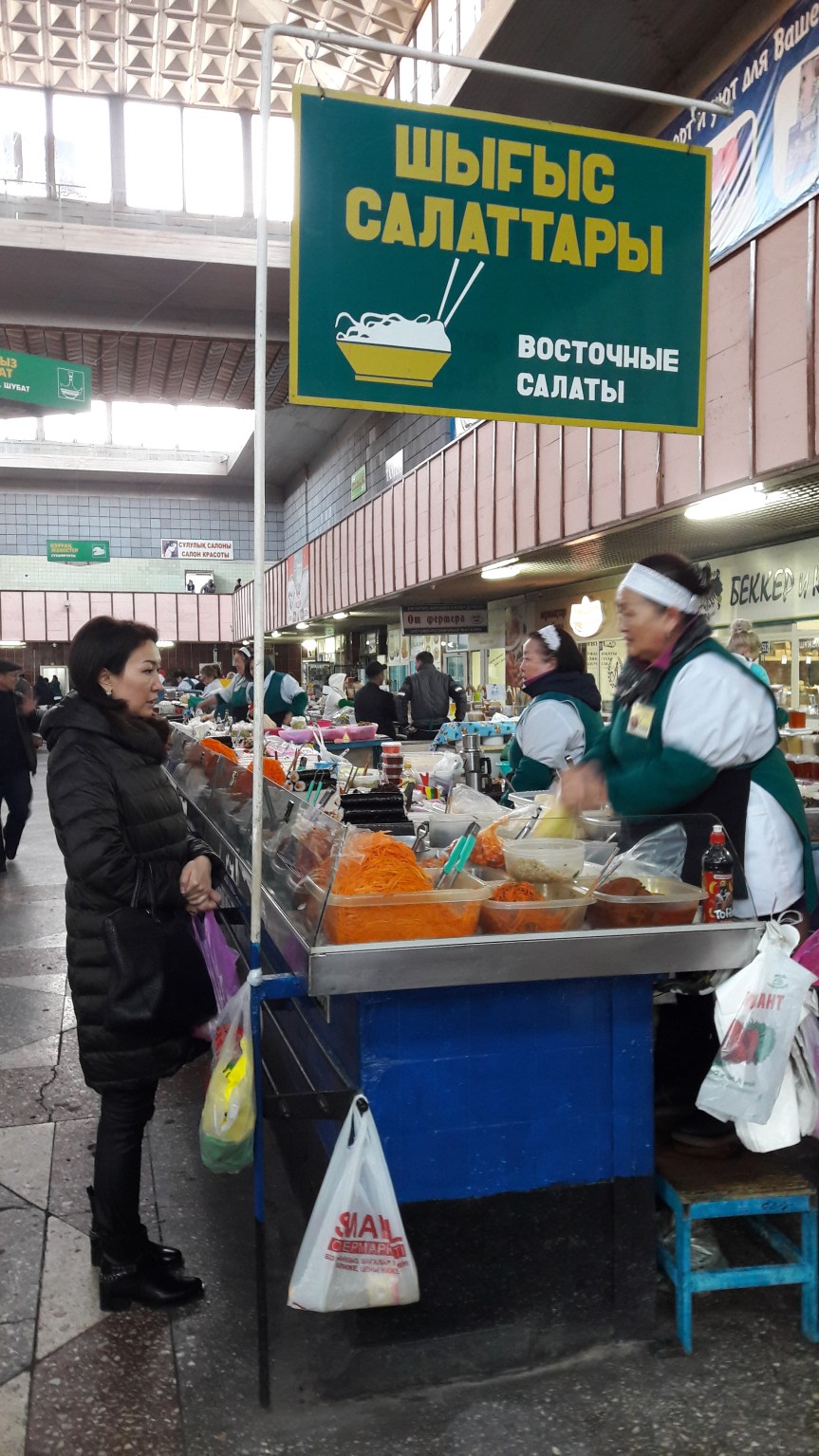
Korean carrots and other salads on sale in Almaty’s Green Bazaar, Kazakhstan
The deportees adapted their cuisine to local conditions and replaced traditional ingredients with carrots to create a spicy, coriander-rich side dish and it remains a popular choice on dinner tables in Central Asian countries such as Uzbekistan, Kazakhstan and Kyrgyzstan, which are still home to around 300,000 ethnic Koreans, descendants of the deportees from the 1930s.
There’s a Turkish connection with the Koreas as well. With Turkey on a war footing once again, wading into battle against the Kurds in northern Syria, a recent film has brought a mostly forgotten war involving Turkey from the 1950s back into the spotlight. Can Ulkay’s “Ayla: The Daughter of War” tells the story of a Turkish soldier who saves a young Korean girl during the Korean War of 1950-53.
Turkey sent troops as part of a United Nations led brigade to defend South Korea against North Korea in the war. The soldier finds himself unable to take the orphan back to Turkey so the pair lose touch after the war, but in a fairytale ending are reunited 60 years later. Put your feet up and enjoy the movie with a bowl of spicy Korean carrots!
Ingredients (serves around 4)
200 g carrots peeled into thin slices – use a julienne peeler or a sharp knife
One garlic clove minced
One small onion minced
One teaspoon crushed coriander seeds
Half teaspoon red chilli flakes
Dash of olive oil
Two teaspoons cider vinegar
Half teaspoon honey
Pinch of salt
One teaspoon sesame seeds
Method
Mix the julienned carrots with the garlic and leave to marinate in a container with a tight-fitting lid (this carrot salad can get quite pungent, so this is important!).
Heat the olive oil and fry the onion until just beginning to brown. Mix the vinegar with the honey and salt and then pour over the carrots, add the coriander and chilli and the fried onions and mix well.
Leave the carrots to marinate in the air tight container in the fridge for at least four hours, the longer the better, to allow the flavours to blend fully.
Sprinkle with sesame seeds and serve as a side dish with fritters such as our mücver.
“April is the cruellest month” as TS Eliot put it, but I’ve always thought there’s a case for February to be considered crueller. As winter drags on interminably in the northern hemisphere – we’re still six months away from August and the height of summer – those long, lazy days all seem so far away, especially with the mercury plunging into serious minus territory as in Knidos Cookery Club’s winter HQ in Almaty, Kazakhstan.
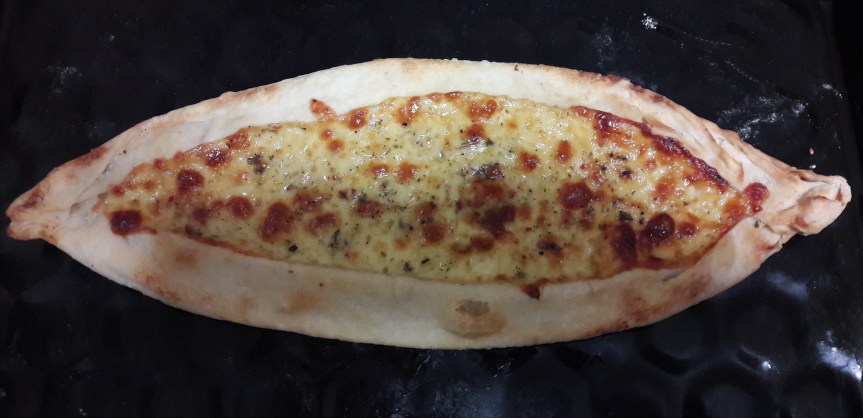
Yum yum – Kaşarlı Pide
So, thoughts have been turning to warmer times and to distant memories of eating pide, Turkey’s take on pizza, under the shade of mandarin trees in Datça.
or maybe Otlu Pide?
With KCC’s new oven up and running in Almaty, it’s high time for a Great Turkish Bake Off as we take on the pide challenge and bring a slice of the Turkish summer into the winter gloom of Kazakhstan.
Stage one – ready to shape
Stage two – first fold
Stage three – final fold
We’ll be making a standard Kaşarlı Pide, an open one made with a yellow cheese such as cheddar – See the three stages for assembling this pide above.
And here is an Otlu Pide, a covered one made with various greens such as spinach and parsley and a ricotta-like cheese called lor as seen above.
Ingredients (Makes four pides)
For the base:
300 g flour
One teaspoon dried, instant yeast
125 ml cold water
30 ml olive oil
For the filling:
KaşarlıPide (makes 2)
200 g grated yellow cheese such as a mild cheddar
Pinch of red chilli flakes
Pinch of dried thyme
Pinch of freshly ground black pepper
Otlu Pide (makes 2)
One small onion
125 g spinach
25 ml olive oil
One bunch fresh parsley (around 25 g)
One bunch fresh coriander (around 25 g)
100 g ricotta cheese (or similar)
One teaspoon cumin seeds
One teaspoon red chilli flakes
Pinch of dried thyme
Pinch of freshly ground black pepper
Sprinkling of sesame seeds (or black, nigella seeds if you can find them)
Method:
Sieve the flour into a large, ceramic bowl, add the dried yeast, make a well in the middle and pour in the olive oil and slowly add the water and mix well so that all the flour is used up.
Knead for ten minutes or so until you have a stretchy, elastic dough. Put in an oiled bowl and cover with a tea towel and then leave it to rise in a warm place for 30 minutes or so until it is doubled in size.
While the dough is rising, prepare the filling for the Otlu Pide. Heat the olive oil in a frying pan and add the cumin seeds, chilli flakes, dried thyme and black pepper and then add the finely chopped onion. Cook for five minutes and then add the chopped spinach, parsley and coriander and cook until it all begins to wilt. Allow to cool and then stir in the lor (ricotta) cheese.
Divide the dough into four and roll each ball into a 30 cm by 20 cm oblong about 1 mm thick on a lightly floured surface. For the Kaşarlı Pide, spread the grated cheese over the middle leaving 2 cm around the edges and season with thyme, chilli flakes and black pepper. Fold the edges over and then fold again and pinch the ends together to make a boat shape. Glaze the dough with olive oil.
For the Otlu Pide, place half the filling in the bottom half of the rolled out dough then fold the top over and make into a parcel shape (as in the picture above). Glaze with olive oil and sprinkle with sesame seeds.
Bake the pides in an oven pre-heated to 200 c for 20-30 minutes or so until the cheese bubbles and is starting to go brown and the dough is also starting to go a golden-brown colour. Serve straight from the oven with a salad of your choice.
Knidos Cookery Club would like to say a big thank you to all its readers who voted for the site in the 2017 Saveur Food Blog awards!
This time round we’re looking once again to Turkey’s north-eastern neighbour Georgia for some culinary inspiration. Adjapsandali, a popular dish in this mountainous former Soviet country, is Georgia’s spicier take on ratatouille.
Adjapsandali with green beans and potato
This summer stew relies on a holy trinity of aubergine, tomato and peppers with whatever else is in season thrown into the mix. We’ve added some green beans and some potato to give the dish a heartier edge, but these can be omitted and other seasonal veggies like courgettes and carrots can be used – there’s no hard and fast rules, it’s up to you!
The adjapsandali ingredients in the raw
It can be served up with all the veggies collapsing into a sublime sauce-rich stew or the veggies can be left on the firmer side, as in our example. Served with rice, it makes a meal on its own, but it is also great with salads and other Georgian staples such as pkhali.
Ingredients (makes 4 generous servings)
300 g potatoes
300 g aubergines
250 g tomatoes
2 red peppers
200 g green beans
1 onion
2 garlic cloves
50 ml olive oil
1 teaspoon coriander
1 teaspoon red chili flakes
2 teaspoons fresh basil
3 bayleaves
Method
Roughly chop up all the vegetables and throw them into a large, heavy-based pan. Pour the olive oil over the vegetables, add the herbs and spices and cook over a medium heat for 10 minutes or so stirring occasionally. Turn the heat down to low and cook for another 20-30 minutes until all the vegetables are cooked and beginning to break up.
Sprinkle with fresh basil and serve with crusty bread or rice and a selection of salads such as tomato, cucumber and onion with a walnut dressing and starters such as pkhali.
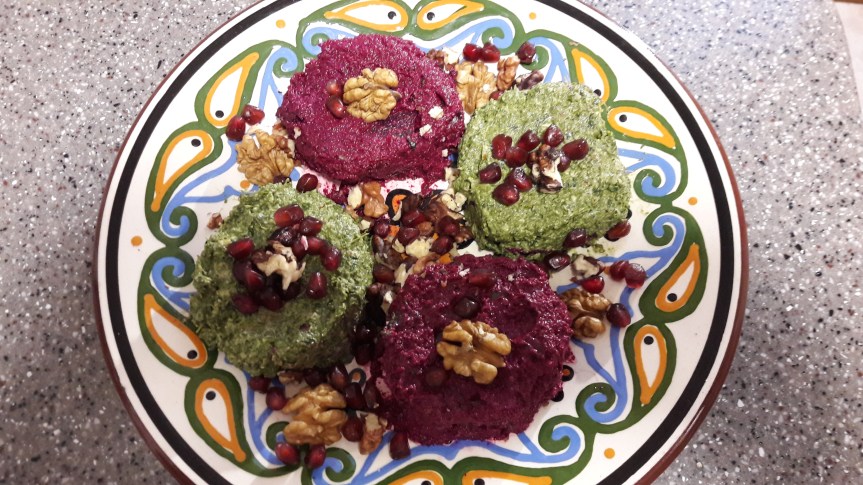
This time round on Knidos Cookery Club we’re returning to Georgia for some culinary inspiration in the form of pkhali, a type of starter made from walnuts, herbs, spices and whatever vegetable happens to be in season, such as spinach, beetroot, aubergine, cabbage or carrot.
Walnuts are widely used in Georgian cooking – besides pkhali, they can be turned into satsivi, a thick paste similar to hummus, and bazhe, a saucemade with the holy trinity of Georgian herbs – blue fenugreek, ground coriander (cilantro) and crushed marigold flowers. These combos can be mixed with fresh cucumbers and tomatoes as a salad dressing or stuffed into tongues of fried aubergine (eggplant).
Staying on the walnut theme, on a recent visit to the former home of famous Kazakh writer Mukhtar Auezov in Almaty, Kazakhstan, the guide gave me a handful of walnuts from the gnarled old tree in the garden of the writer’s house. These nuts were used in the making of today’s pkhali recipe.
Auezov was famous in Soviet times for writing The Path of Abai, an epic historical novel based on the life and teachings of Kazakhstan’s most famous poet and composer Abai Qunanbayuli, who had been a neighbour and friend of Auezov’s grandfather.
It was said in the Soviet era that all were equal, but some were more equal than others – and this was certainly the case for Auezov after he won the Lenin Prize in 1959 for his four-volume epic novel about Abai.
The prize came with a sackful of roubles which he invested in a two-storey house, which is now a museum dedicated to his life and work. The house was lavish by the standards of the time and was designed by the architect who designed Almaty’s Abai Opera Theatre.
Ingredients (Makes around four generous servings of each pkhali – see photo above)
For the beetroot pkhali
300 g cooked beetroot
100 g walnuts
One garlic clove
5 g fresh parsley
5 g fresh coriander
One teaspoon blue fenugreek powder
One teaspoon black pepper
20 ml wine vinegar
A scattering of pomegranate seeds and walnuts
For the spinach pkhali
250 g fresh spinach
100 g walnuts
One small onion (around 75 g)
One garlic clove
5 g fresh parsley
5 g fresh coriander
One teaspoon blue fenugreek powder
One teaspoon black pepper
20 ml wine vinegar
A scattering of pomegranate seeds and walnuts
Method
For the beetroot pkhali:
Boil the beetroot for 30 minutes or so until you can pierce it with a knife easily.
Leave to cool and then peel and chop into small chunks.
Toast the walnuts over a low heat for 5-10 minutes and then add to the garlic and herbs and spices in a bowl. Add the vinegar and use a blender to make a smooth paste. Add the beetroot chunks and keep blending until you have a gloopy mixture.
Leave overnight in the fridge and then serve with a scattering of pomegranate seeds and walnuts.
Method
For the spinach pkhali:
Cook the spinach in boiling water for 5 minutes until it begins to wilt. Remove and place in cold water and then drain.
Finely chop the onion and put it in a mixing bowl with the garlic, herbs and spices. Toast the walnuts over a low heat for 5-10 minutes and then add to the bowl. Add the vinegar and use a blender to make a smooth paste. Add the spinach and keep blending until you have a gloopy mixture.
Leave overnight in the fridge and then serve with a scattering of pomegranate seeds and walnuts.
To celebrate this spring equinox festival, we’ll be serving up kok samsa, deep-fried pies filled with a selection of spring greens.
Seven tastes of spring: parsley, spinach, coriander, celeriac leaves, spring onion, garlic and mint
Originating in Persia some 3,000 years ago, Nowruz, or New Day, is a celebration of the end of winter and the start of a new year on the date when day and night are equal in the Northern Hemisphere. This date usually falls on or around 21 March.
The holiday is still widely celebrated in Iran and Iraq, across Central Asia, Russia, Afghanistan, Albania, Azerbaijan, in eastern Turkey and in parts of Syria, India, Pakistan and China. Food plays an important role in these celebrations – in Iran the table is set with seven items, as explained in this article from Iran Wire:
A few weeks before Nowruz, Iranians begin setting up their haft sin, or “seven Ss,” a ceremonial display of symbolic items whose names begin with the Persian letter “sin” or “s.” They include “sabzeh,” or green sprouts grown from lentils, which symbolize rebirth; “samanu,” a sweet pudding that represents affluence, “senjed,” or dried wild olives, which symbolize love; “seer,” or garlic, which symbolizes medicine; “seeb,” an apple, which represents health; “somaq” or sumac fruit, which symbolizes the color of sunrise, and “serkeh,” or vinegar, which symbolises maturity.
Kok samsa, a close relative of India’s samosa, are prepared in Uzbekistan, where the holiday is called Navruz. These tasty pies are filled with fresh spring greens.
We’ve developed our own take on the kok samsa using the Iranian magic number of seven ingredients: parsley, spinach, coriander, celeriac leaves, spring onion, garlic and mint. As fully signed-up members of Dillwatch, we omitted that scurrilous weed, dill, from this recipe.
KCC’s Kok samsa with seven spring herbs inside
Ingredients (makes 8-10 pies)
For the Pastry
300 g plain flour
75 ml olive oil
Pinch of salt
Up to 75 ml cold water
Two – three teaspoons of sesame seeds
2. For the Filling
150 g spring onions
2 garlic cloves
50 g fresh coriander
50 g fresh parsley
150 g spinach
25 g the leafy bits from the top of a celeriac
15 g fresh mint
Two teaspoons of cumin seeds
25 ml olive oil
3. For Deep Frying
1 litre sunflower oil (for deep frying)
Method
1.For the Pastry
Pour the flour into a large mixing bowl and add the salt. Pour in the olive oil and stir with a fork. The mixture should form into small clumps of flour and oil. Pour some of the cold water and continue mixing. Continue adding water until the mixture forms into a large ball shape. Cover with cling film and leave in the fridge until you’re ready to use it.
2. For the Filling
Heat the olive oil in a heavy-based pan and add the chopped spring onions and minced garlic. Fry for five minutes over a medium heat, stirring occasionally. Add the coriander and parsley and cumin and fry for two to three minutes. Add the torn up spinach leaves, chopped celeriac leaves and mint and continue cooking until the spinach has wilted, about 10 more minutes or so, stirring every now and then.
3. For Deep Frying
Heat the sunflower oil in a heavy-based pan. For deep frying you need to get the oil to around 180 c – to check the temperature use this tip from Delishably:
When the oil has preheated, dip the handle of a wooden spoon or a chopstick into the oil. If the oil starts steadily bubbling, then the oil is hot enough for frying. If the oil bubbles very very vigorously, then the oil is too hot and needs to cool off a touch. If no or very few bubbles pop up, then it’s not hot enough.
While the oil is heating, prepare the pies. Form the pastry into 8-10 walnut-sized balls. Put the pastry ball onto a lightly floured surface and roll out into a 1 mm thick circle. Sprinkle with sesame seeds and turn the circle over.
Place three teaspoons of filling on half of the pastry round and then close the other half over the top of the filling. Use a fork to mould the edges of the pie together. Prick the pie’s top to allow air to escape.
Place two or three pies at a time in the hot oil and fry for around 8 minutes or until the pie is golden brown in colour. Remove with a slotted spoon and drain on kitchen roll. Serve the kok samsa either hot or cold.











 Knidos Cookery Club