With autumn upon us once again, it’s time for pumpkin to make a return to the table. This versatile memeber of the squash family makes for perfect comfort food for the longer, chillier nights. KCC’s back catalogue features a number of pumpkin dishes – try this cousin of lasagne made with chickpeas and mixed greens and this roasted pumpkin with halloumi for starters.
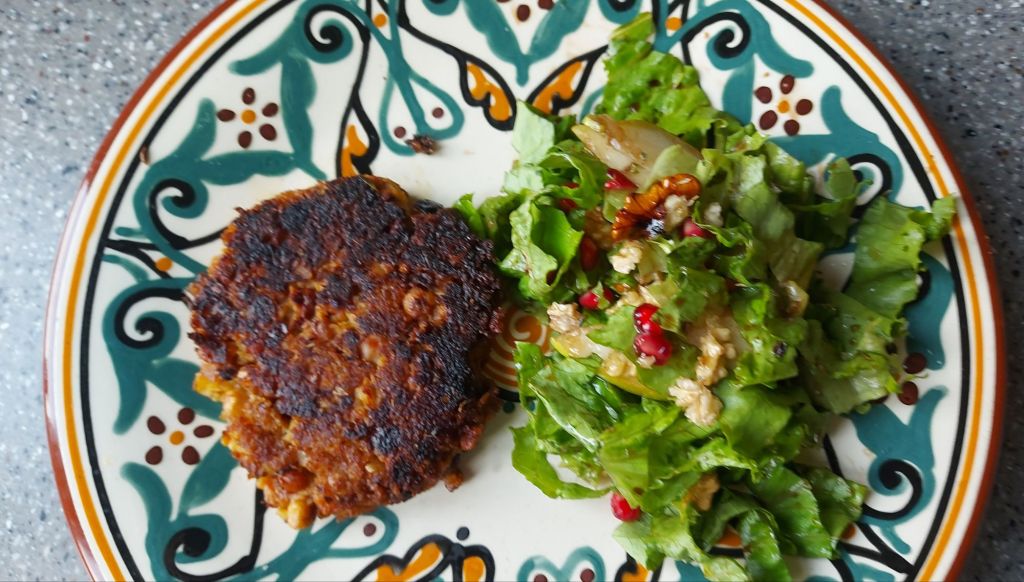
A nutty chickpea and pumpkin fritter served with a lettuce, pear, pomegranate and walnut salad
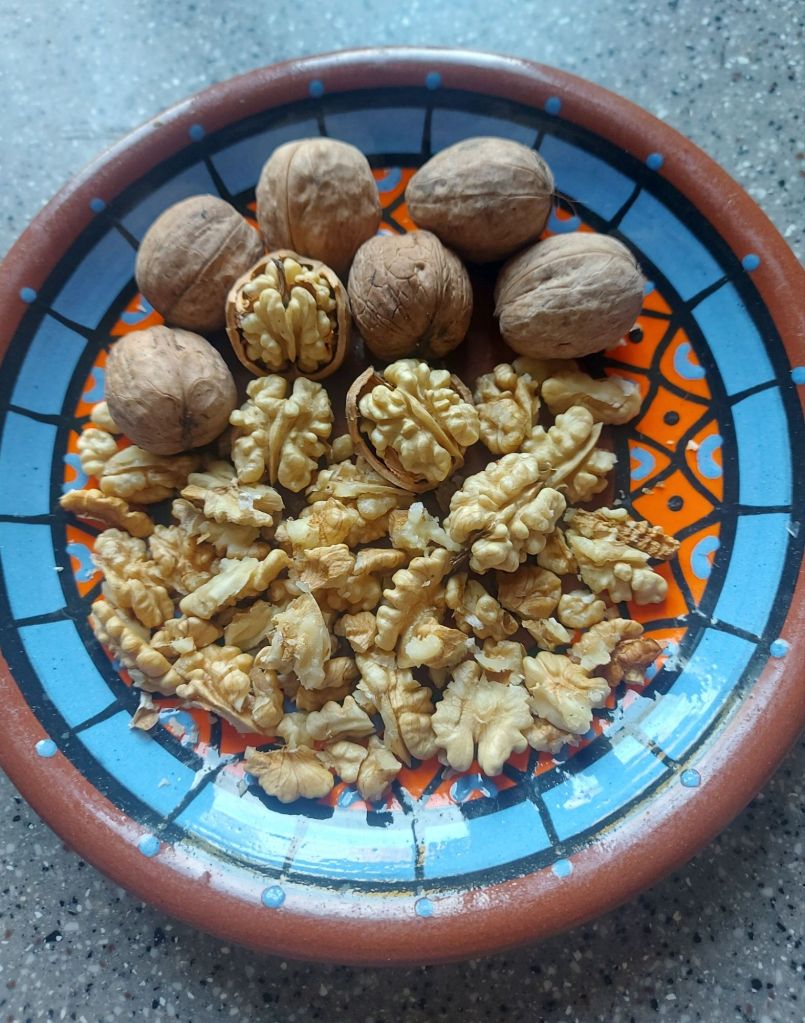
This time, we’re using the pumpkin in a fritter made with chickpeas and fine bulgur wheat. Recently, we recieved some walnuts from a friend of a friend’s dacha outside Almaty, here in Kazakhstan, which are ideal for adding a nutty edge to these chickpea and pumpkin fritters. We also added some walnuts to a fruity salad made with lettuce, pear and pomegranate seeds to accompany the fritters. Dress it with equal parts of balsamic vinegar and extra virgin olive oil.
This year’s walnuts fresh from the dacha in Almaty, Kazakhstan
As 2023 draws to a close, let’s take a look at some striking winter salads to liven up the end-of-year table. To complement our perennial favourite, our Olivier (with an Edge) salad, we’re looking to a coleslaw variation to add some colour to the New Year’s Eve spread. With the new year just around the corner, KCC wishes all its readers a prosperous and peaceful 2024, full with culinary adventures and many more mouth-watering meals!
This winter has been a strange one here in Kazakhstan. We should be in the depths of winter now, but the snow didn’t arrive until the first week of December. Then there was a week or so of freezing weather with the temperature dipping to -28c, but now, as we approach the end of December, there’s very little snow on the ground in Almaty – it’s even been raining, which is really unusual at this time of the year.
KCC’s coleslaw variation with pear and rocket
The purple hues of red cabbage pair so well with the orange of carrots and the green of rocket. For a bit of bite, we’ve added some grated radish (we used green radishes, but you can use red radishes or mouli if you can’t find green ones), along with some grated pear and pomegranate seeds for a sweet and tart note. Add in some pumpkin and sunflower seeds and raisins before dressing with tahini and pomegranate sauce.
Ingredients (serves 3-4)
100 g shredded red cabbage
100 g grated carrot
50 g chopped rocket
50 g grated green radish
50 g grated pear
25 g pomegranate seeds
25 g raisins
1 teaspoon dried oregano
2 teaspoons pumpkin seeds
2 teaspoons sunflower seeds
1 tablespoon tahini
1 tablespoon pomegranate sauce
a slice of fresh lime
Method
In a large bowl mix the red cabbage, carrot, rocket, green radish, pear and pomegranate seeds together. Add the raisins, oregano, pumpkin seeds and sunflower seeds. Make a dressing with equal parts pf tahini and pomegranate sauce and thin with a bit of hot water to obtain a smooth consistency. Pour over the salad, stir well, give it a squeeze of lime and serve.
As the first snow falls here in Almaty, it’s time for some heartier fare. This recipe started out life as courgette soup, but the sudden drop in temperature called for something with a bit more oomph so we added some mung beans and dried coconut to give it a more stew-like consistency. To add a bit of colour, we sprinkled some pomegranate seeds on top and gave it a drizzle of pomegranate sauce before serving.
KCC’s Courgette, Coconut and Mung Bean Mash Up
The delicate, thin courgettes of the summer are giving way to the robust, denser marrows of autumn – perfect for making into a soup. Mung beans are a versatile store cupboard basic – they can be added to stews or grown into bean sprouts for stir fries and salads – check out more recipe ideas here. They’re a staple in home-cooked meals in Uzbekistan, where they’re known as mash, hence the “mash up” in the name of this dish.
Winter is coming to Almaty…
Ingredients (makes four servings)
1 kilo courgette
One celery stick
One medium onion
Bunch of radish leaves
200 g dried mung beans (soaked overnight)
50 g desiccated coconut
50 ml olive oil
Two teaspoons dried thyme
Two teaspoons cumin seeds
1.5 litres vegetable stock
Pomegranate seeds and Pomegranate sauce to garnish
Method
Heat the olive oil in a heavy-based pan and fry the cumin seeds until starting to crackle and then add the diced onion and cook for five minutes over a medium heat. Next add the diced celery, lower the heat and and cook for another five minutes, stirring occasionally. Cut the courgette into four pieces lengthwise and then slice into 1 cm thick chunks. Add to the pan along with the thyme and stir fry for ten minutes. Add one litre of vegetable stock and the chopped radish leaves and simmer over a low heat for twenty minutes.
While the soup is simmering, cook the mung beans in a separate pan with 500 ml vegetable stock and the coconut. Cook for twenty – thirty minutes or so until the beans are softening or until all the liquid is absorbed.
Remove around 25% of the courgette mix and blend the rest to a smooth consistency with a stick blender. Add these blended courgettes to the cooked mung beans and stir well. Bring to a boil and then add the reserved courgette mix. Pour into soup bowls, garnish with a few pomegranate seeds and a drizzle of pomegranate sauce and serve immediately.
It’s that in-between time of year as the nights grow longer and thoughts turn towards more substantial meals after a long summer of salads and lighter fare. The last of the seasonal vegetables such as tomatoes and courgettes are perfect for stuffing and baking in the oven, making a bridge between summery salads and the heartier soups and stews of winter that are coming up.
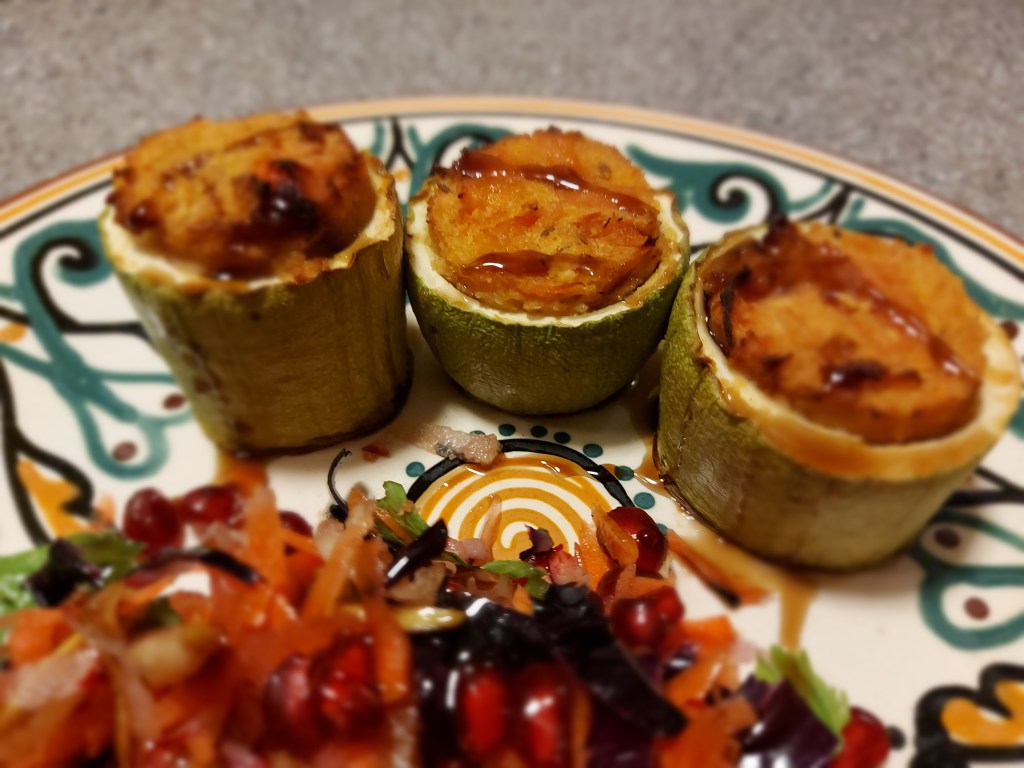
Apricot and lentil courgette roundels drizzled with pomegranate sauce and served with a seasonal salad
We stuffed some courgettes with a mixture of red lentils, apricots, tomato, onion, bulgur wheat and lemon juice to make a versatile roundel that can be served as part of a main course or eaten on its own as a meze, a fully vegan alternative to the sausage roll!
Apricot and lentil courgette roundel – a vegan alternative to the sausage roll?
The autumn fruit is at its best at the moment, and we’ve added some pear and pomegranate to an autumnal red cabbage, carrot, celery and radish salad to accompany these apricot and lentil courgette roundels to make a great lunch or supper. By adding a jacket potato, you can make it into a more filling main course.
Ingredients (makes enough mixture for 10-12 roundels)
Three medium sized courgettes
100 g red lentils
50 g dried apricots (or four fresh apricots if available)
One small red onion (approx 75 g)
One medium tomato (approx 100 g)
50 g fine bulgur wheat
25 ml olive oil
200 ml vegetable stock
Juice of half a lemon
One teaspoon cumin seeds
One teaspoon red chilli flakes
Black pepper to taste
Method
Cut the dried apricots into eight pieces and soak in hot water for at least 30 minutes. While the apricots are soaking, heat the oil in a heavy based pan and add the cumin seeds. When they start to sizzle, add the finely chopped onion and fry over a medium heat until they start to soften. Grate the tomato into the fried onion and cook over a low heat for five minutes or so, stirring occasionally.
Now add the washed lentils, pour in the stock and stir. Cook over a low heat for 15-20 minutes until most of the water has been absorbed. Add the fine bulgur wheat, mix it in well and leave covered for 15 minutes. Drain the apricots and stir them into the mixture. Add the lemon juice, chilli flakes and black pepper to taste and mix well.
While the lentils are cooking, start to prepare the courgettes by slicing off the ends to make them flat. Cut into 3 cm slices. Gouge out the seeds with a small spoon, leaving a little bit of flesh at the bottom of the roundel.
Pre-heat the oven to 180 c. When the lentil mix is cool, pack it into the courgette roundels and stand them on a baking tray with the filling topmost. Bake at 180 c for 30 minutes or so – the courgette should still be firm and not too squidgy and the lentil mix should rise slightly and be beginning to brown on top.
Serve alongside a salad of red cabbage, carrot, celery, radish, pear and pomegranate and a jacket potato, drizzling pomegranate sauce over the roundels or allow to cool and serve the roundels as a snack on their own.
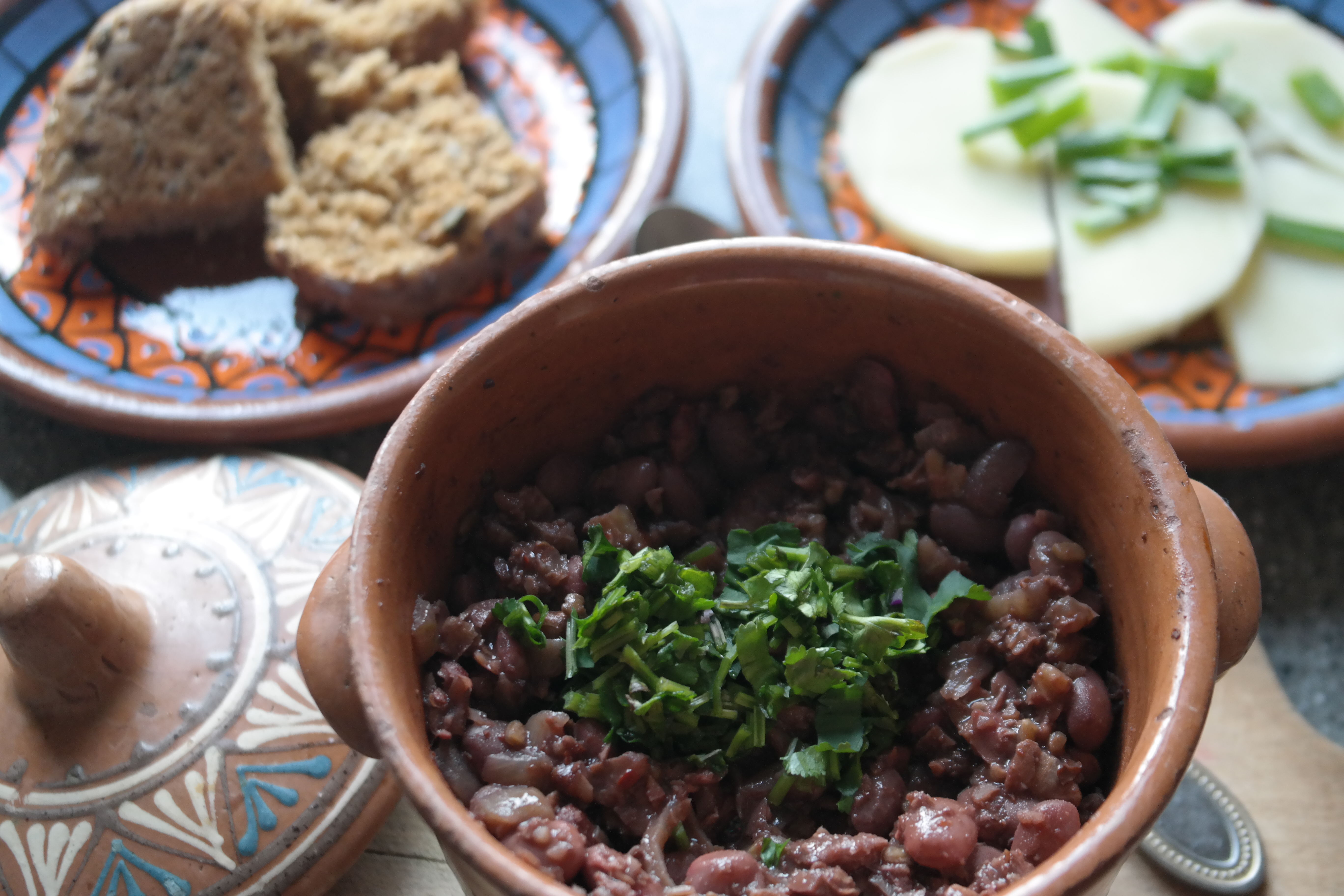
For this week’s lockdown lunch we had a root around the cupboards and came up with some dried red beans, last autumn’s walnuts and a bottle of Turkish pomegranate sauce (Nar Ekşili Sos) – perfect ingredients for taking us on a culinary away day to Tbilisi for a bowl of lobio, Georgia’s signature bean dish.
Take a trip to Georgia with KCC’s Lobio lockdown lunch
Lobio can be more like a soup, a stew, a salad or even re-fried beans depending on which region of Georgia it’s prepared in – we’ve gone for lobio nigvzit which is somewhere between a soup and a stew. Serve the lobio in a clay pot with white cheese and a hunk of fresh mchadi (corn bread – recipe link here) or any other bread for an authentic taste of Georgia.
To help pass the time during lockdown, here’s something on the etymology of lobio from @thomas_wier on twitter:
Weekly Georgian Etymology: ლობიო lobio, kidney bean stew w/ herbs & spices. From Persian لوبیا lôbiyâ, < Anc Greek λόβια, pl of λόβιον cowpea, < Akkadian 𒇻𒂠𒊬 lubbu, < Sumerian 𒇻𒂠𒊬 lub cowpea. Now a central part of Georgian cuisine, it's not attested until the 17th century. pic.twitter.com/Bhirdwz4FC
One teaspoon blue fenugreek (use fenugreek or cumin seeds if you can’t find this)
One teaspoon red chilli flakes
One small bunch fresh coriander
Three bay leaves
50 ml cooking oil
50 ml pomegranate sauce
250 ml water the beans were cooked in or vegetable stock
Method
If cooking dried beans, then soak 250 g of beans overnight. Change water and cook for one hour or so until the beans are just cooked but not yet falling apart. Remove from the heat and allow to cool.
Heat the oil in a heavy-based pan and add the coriander seeds and blue fenugreek. Cook for a few minutes and then add the diced onions, mashed garlic and chilli flakes. Cook for ten minutes over a low heat and then add the crushed walnuts and the pomegranate sauce. Cook for another five minutes.
Now add the drained beans, bay leaves and reserved cooking water. Leave to simmer until most of the liquid is absorbed. Stir frequently with a wooden spoon – don’t worry if the beans start to fall apart – they taste better like this and absorb more sauce.
Add the chopped fresh coriander and serve hot with bread and white cheese. It tastes even better if left overnight and reheated, but only add the fresh coriander after re-heating the mix.
On a recent flying visit to Glasgow, KCC dropped into Ox and Finchin the city’s West End for a bite to eat. This Sauchiehall Street eatery offers a range of tapas-style sharing plates – we opted for the giant couscous with grilled halloumi, a plate of braised leeks, beetroot hummus, grilled baby gem lettuce and, with this being Glasgow, chips of course.
A spicy bowl of zhug sauce
This time round, we’ll be recreating the giant couscous dish, made with ptitim, toasted pearls of wheat and semolina, first cooked up in Israel in the 1950’s when rice was in short supply in the early days of the Israeli state. This couscous relative was dubbed Ben-Gurion rice after Israel’s first prime minister. After scouring our local supermarkets, ptitim proved to be in short supply so we’ve replaced them with mung beans!
Mung beans, zhug, halloumi, pomegranate and pumpkin seeds
Key to this salad is the dressing, a piquant sauce called zhug, which was brought to Israel by emigrées fleeing persecution in Yemen in the late 1940s. This spicy cousin of Italy’s milder pesto and Mexico’s equally fiery salsa verde, is served often alongside falafel and hummus. The name is said to be derived from mas-chag, the name of the grinding stone traditionally used to crush the spices and herbs into a paste.
Ingredients (serves 2-4)
100 g mung beans
125 g halloumi
Sprinkling of pomegranate seeds
Sprinkling of roasted pumpkin seeds
For the zhug sauce:
One bunch fresh coriander
One bunch fresh parsley
One garlic clove
Two teaspoons red chilli flakes
One teaspoon black peppercorns
One teaspoon cumin seeds
One teaspoon coriander seeds
One teaspoon cardamom seeds
Juice of half a lemon
25 ml olive oil
Method
To make the zhug sauce, put all the ingredients except for the olive oil in a blender and give it quick blitz. Don’t overdo the blending as you want a slightly chunky texture. Now slowly add the olive oil, blitzing until it is mixed in with the other ingredients. Put in a glass jar – it should keep for a couple of weeks in the fridge.
Cook the mung beans until tender. While the mung beans are cooling, grill the halloumi until a golden-brown colour. Then mix the cooled mung beans with a tablespoon of zhug, arrange the grilled halloumi on top, sprinkle with pumpkin and pomegranate seeds and serve with a selection of your favourite meze dishes.
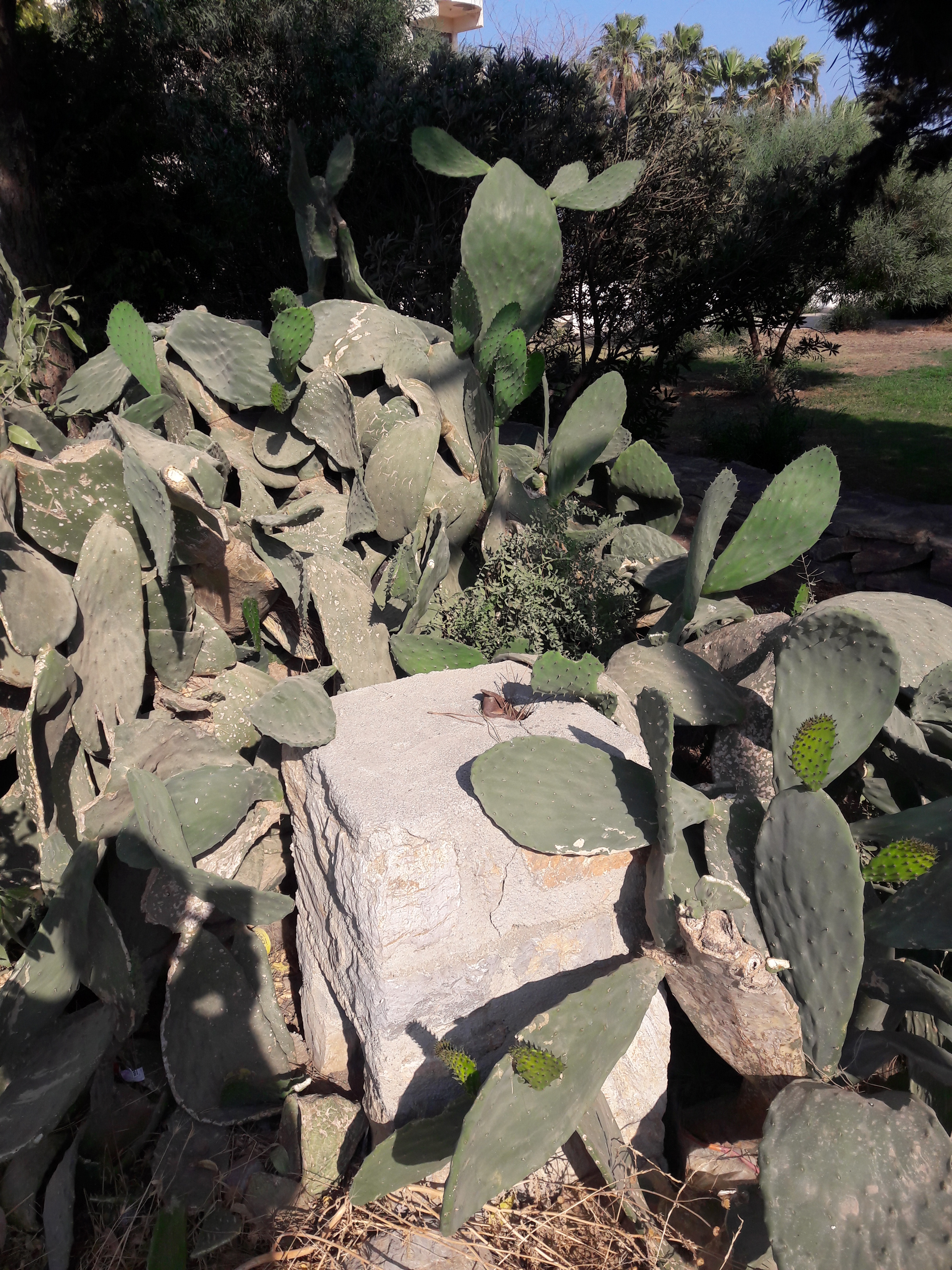
This week we’re cooking up a cactus salad with the main ingredient foraged from some wild prickly pear bushes in Turkey. In an earlier post we reported on some of the similarities between Turkish and Mexican cooking – they both love hot chilli peppers in their food, there’s plenty of beans used, fresh white cheese is a key ingredient and wrapping food in flat bread is popular.
A prickly pear cactus growing wild in Datça, Turkey
A key area of difference is the use of cacti, a staple of Mexican cuisine. In Mexico the prickly pear paddles, known as nopales or napolitoes (from the Spanish for cactus), are used in a variety of dishes. They can be found in salads, as a taco or tortilla filling, simply grilled or scrambled up with eggs. They have a crunchy taste similar to green beans.
Kaktuslu acili ezme
Whilst the prickly pear cactus grows all over southern Turkey, only the fruit – the prickly pears, are usually eaten and sometimes used in cocktails! We’re about to change all that with the first of one of our irregular ventures into the world of Turk-Mex cuisine…
How to deal with a thorny problem…
This slideshow requires JavaScript.
We harvested a few cactus paddles from a secret location in Datça, Turkey. After harvesting, we put on our marigolds and removed the thorns with a sharp knife, sliced the pads up and then boiled them. Next we mixed then in with a spicy tomato sauce, aka acili ezme, to create this Crazy Cactus Salad.
Ingredients (serves 3-4)
Four prickly pear cactus paddles (roughly hand-sized)
For the sauce:
One medium-sized onion
Three medium-sized plum tomatoes
One medium-sized green pepper
One garlic clove
One teaspoon capers
One bunch of parsley
One teaspoon dried mint
Three teaspoons red chilli flakes
Two teaspoons sumac
One teaspoon flavoured vinegar (such as apple or fig)
Three teaspoons pomegranate sauce
Method
Remove all the thorns from the pads with a sharp knife. Slice into 1 cm strips and then cut into 2 cm pieces. Boil in salted water for 8-10 minutes until cooked but still crunchy – cook them too long and they can go a bit slimy. Drain and rinse in cold water and then mix with the acili ezme salad (instructions below).
For the sauce:
Peel the tomatoes and de-seed (to peel: plunge the tomatoes into boiling water for 30 seconds then place in cold water – the skin should now come off easily). Chop the tomatoes, green pepper, onion, garlic and parsley as finely as you can.
Put all the ingredients into a bowl, add the herbs and spices, vinegar and pomegranate sauce and mix well. Leave to chill in the fridge for at least two hours before serving.
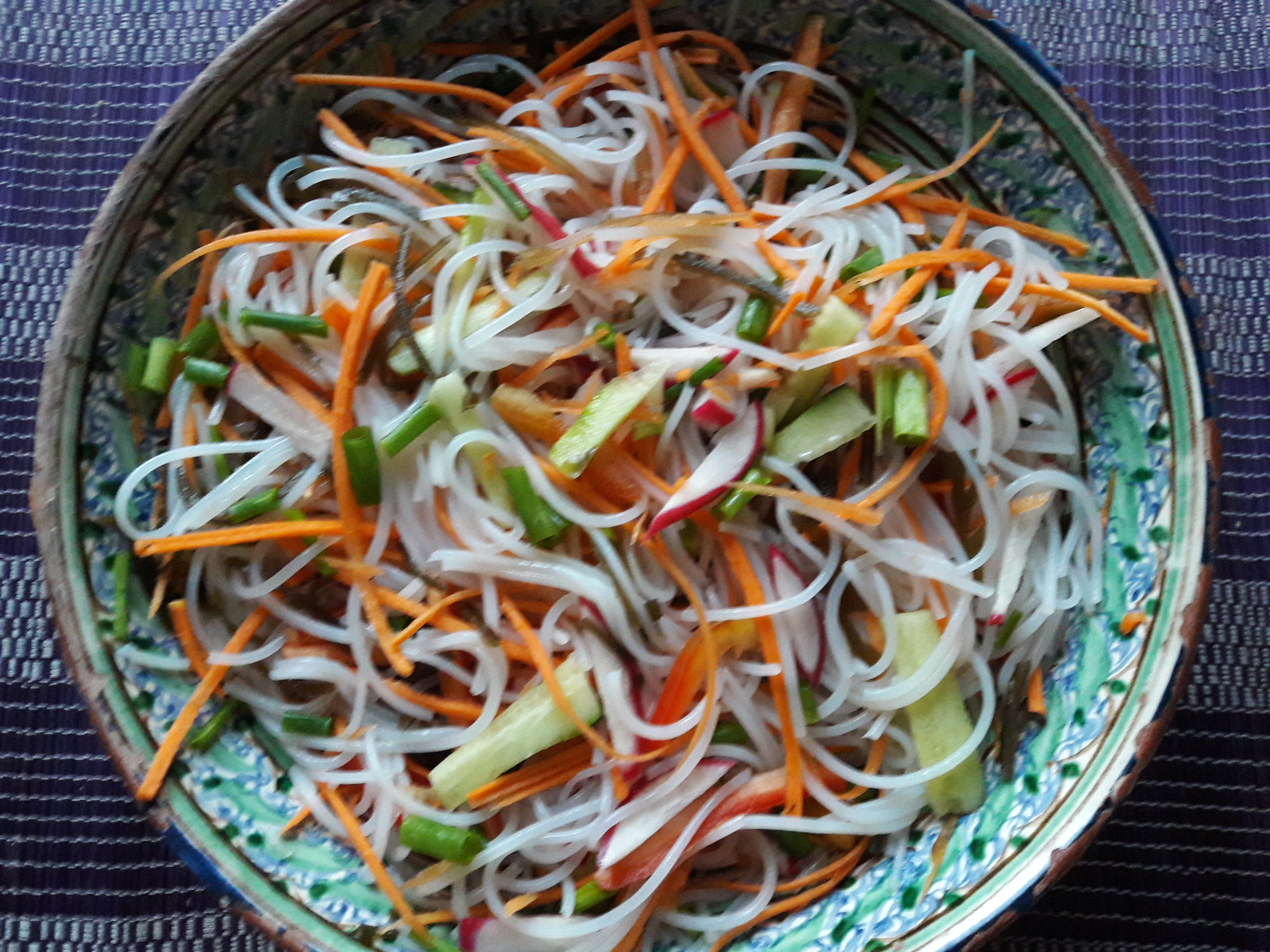
This time round on Knidos Cookery Club we’re looking at some ways to beat the heatwave with a noodle-based salad that can be whipped up with the minimum of fuss.
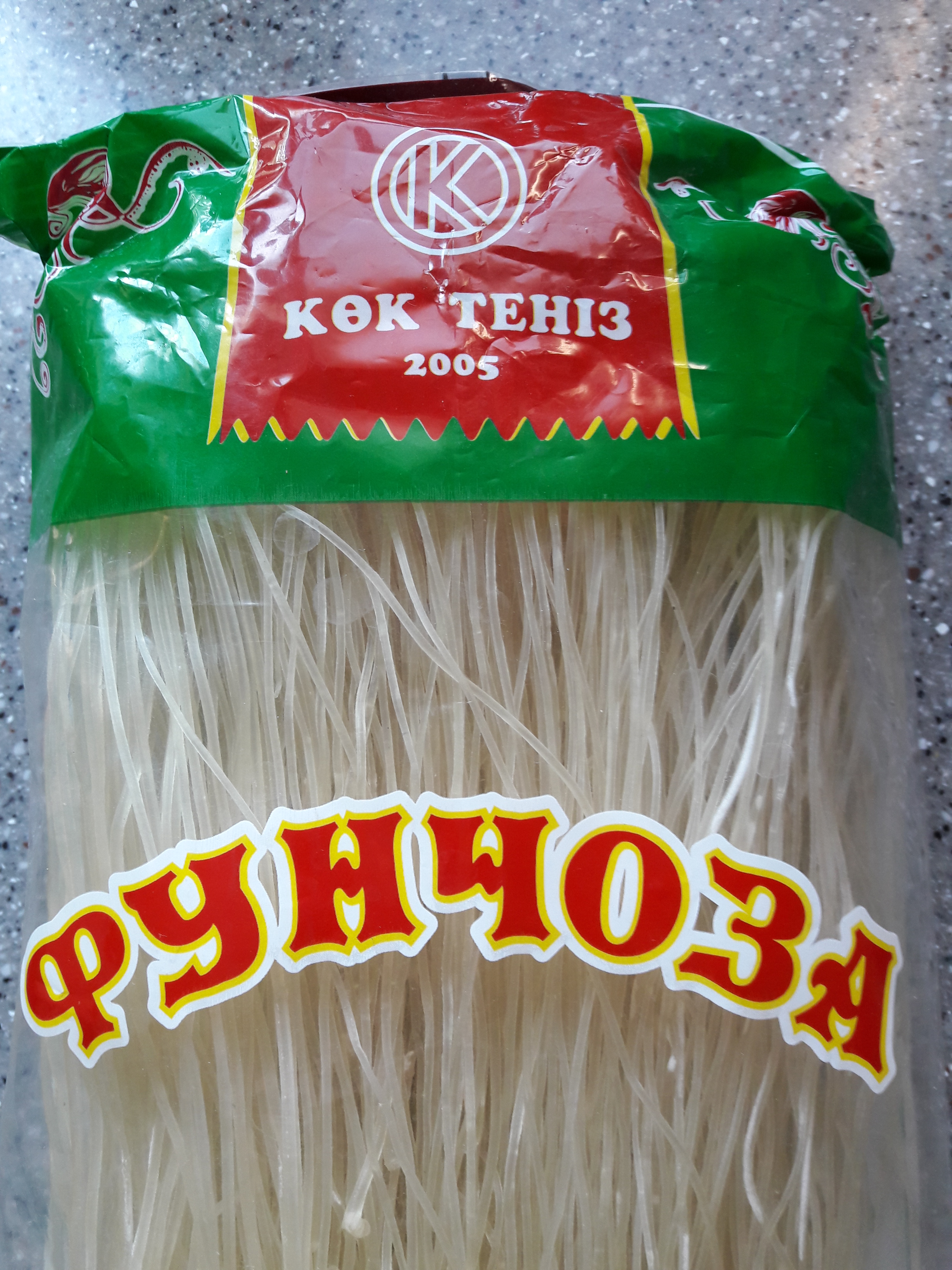
Funchoza is a popular salad across Central Asia that combines glass noodles, which can be produced from various forms of starch such as rice or mung bean, with julienned raw vegetables and a spicy dressing. The noodles just need to be cooked in boiling water for a few minutes so it’s a cinch to prepare on a hot summer’s day.
These noodles are a staple of Uighur cuisine, but have been adopted by the Central Asia’s Korean community who have made funchoza famous to a wider audience across the former Soviet Union and beyond.
The Uighurs are Turkic-speaking muslims living mainly in Xinjiang, an autonomous territory in northwest China, where they face increasing persecution by the Chinese authorities, under the pretext of a crackdown on terrorism.
To this end, thousands of Uighurs, Kazakhs, Kyrgyz and Chinese muslims have been interred in ‘re-education’ camps and, as the Guardian put it in a recent editorial, “Those who are nominally free in fact exist in a digital gulag of constant surveillance.”
Earlier this month, 22 states – including Britain, Canada, France, Germany, Australia and Japan – signed a letter to UN human rights officials in condemnation of China’s treatment of Uighur and other minorities there.
Ingredients (makes 3-4 servings)
150 g dried glass noodles
10 g dried seaweed
2 small cucumbers
2 radishes
8 spring onions
2 red peppers
2 carrots
Coriander seeds
For the dressing:
4 teaspoons tahini
2 tablespoons apple vinegar
2 tablespoons soy sauce
2 tablespoons pomegranate sauce (Nar Eksisi)
2 teaspoons chilli powder
Method
Bring a large pan of water to the boil and cook the noodles in the water according to the pack instructions. Remove and put in a pan of cold water until needed.
Soak the dried seaweed in cold water for 15 minutes, drain the water. While the seaweed is soaking, cut the spring onions into 1 cm slices, remove the seeds for the cucumber and then julienne along with the other vegetables into long, thin slices (use a grater or chop finely if you don’t have a julienne peeler). Chop the seaweed into 5 cm strips.
Remove the noodles from the cold water and cut into 10 cm strips and put in a large bowl. Add the julienned vegetables and mix all the ingredients together. Put all the dressing ingredients into a glass jar with a screw top and shake well, then pour over the salad and mix well. Grind some coriander seeds over the salad.
Serve cold – let the flavours mingle by keeping the salad in the fridge for a couple of hours.
This week on Knidos Cookery Club we’re going to be bucking the January detox trend with this super-rich, calorie-laden Iranian stew, Fesenjan (pronounced fesenjoon), that combines three of our favourite go-to ingredients – pomegranate, walnut and pumpkin.
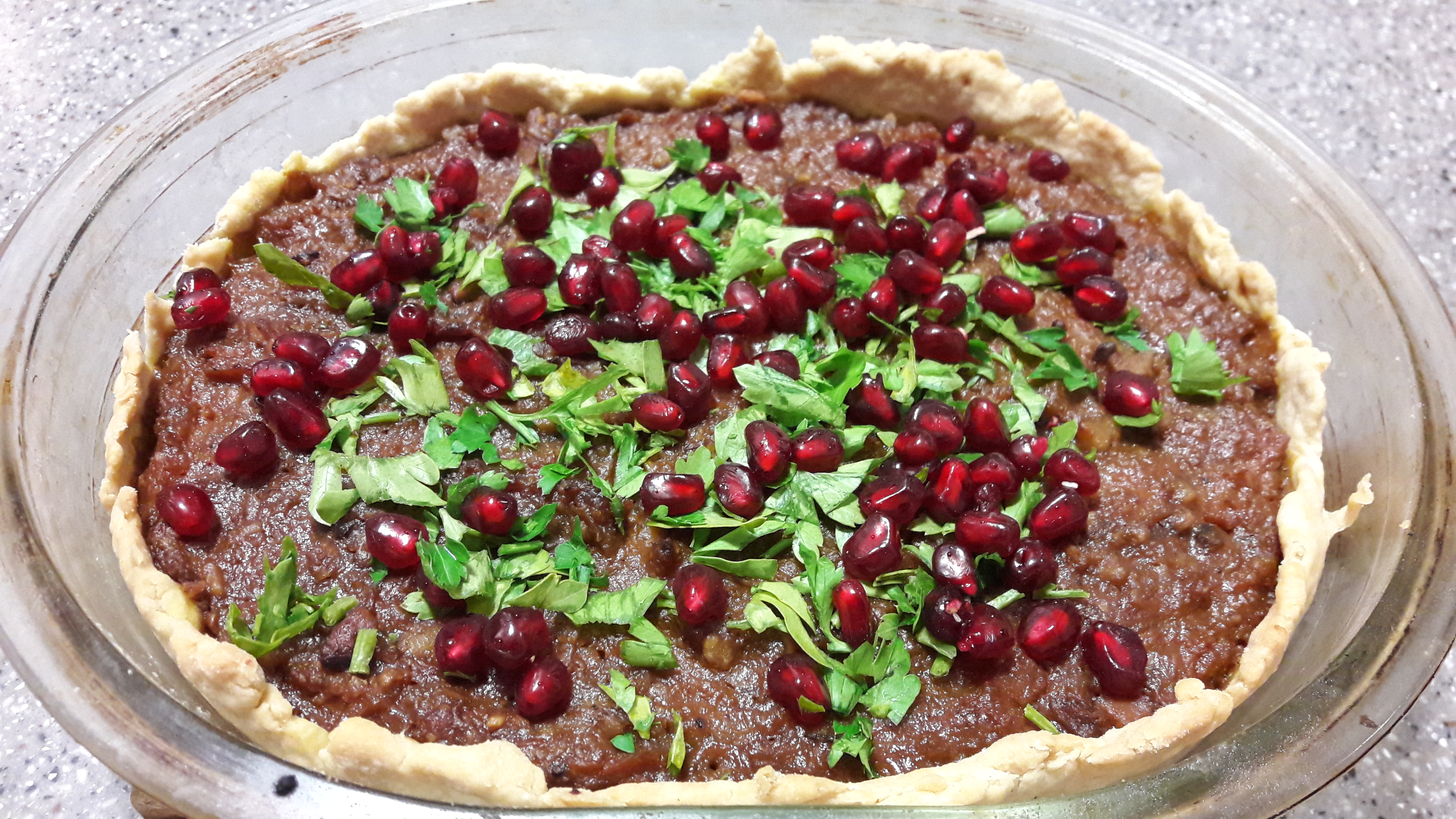
KCC’s Fesenjan Tart
Usually served as a thick stew with rice, we’ve decided to put it in a pie case to make a tasty walnut and pomegranate infused tart. Making this stew can be quite labour-intensive – shelling the walnuts, toasting them, crushing them, extracting the pomegranate seeds and so on, but the end result makes it well worth all the effort.
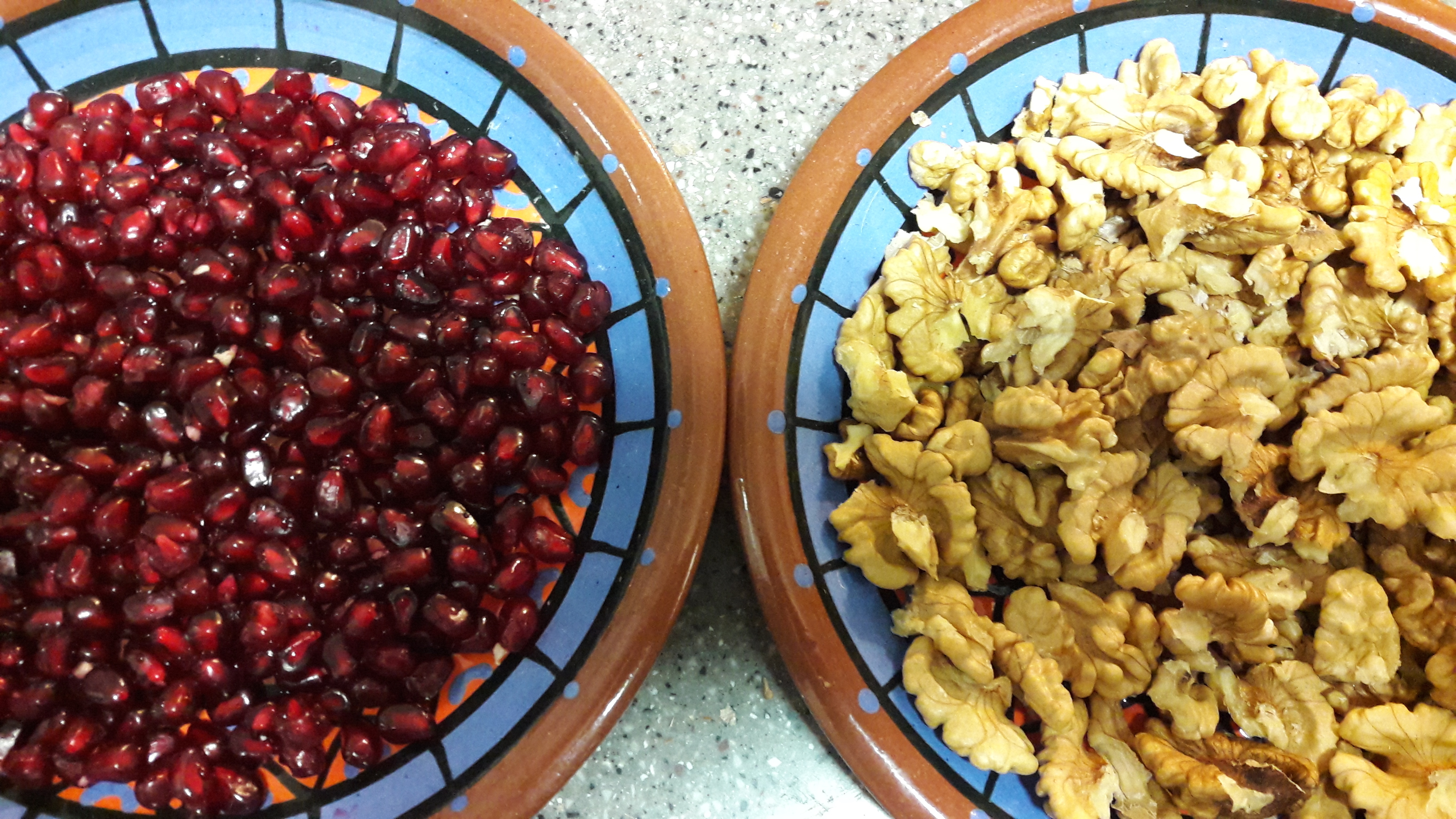
Can’t get much fresher than this!
Look out for Nar Ekşisi (pomegranate syrup)or the sweeter Nar Ekşili Sos (pomegranate sauce) in your local Middle-Eastern shop or make your own. If using Nar Ekşisi, add a teaspoon or two of honey to the stew to make it a bit sweeter.
To save time you can use shop-bought pastry, but we think it tastes better with a homemade pie crust. To keep it vegan, we’ve used olive oil instead of butter to make our shortcrust pastry.
Ingredients (serves 4)
125 g shelled walnuts
one medium onion
500 g pumpkin or butternut squash
300 ml vegetable stock
30 ml olive oil
2-3 tablespoons pomegranate syrup or sauce (Nar Ekşisi or Nar Ekşili Sos in Turkish)
0.5 teaspoon cumin seeds
0.25 teaspoon cinnamon and turmeric
Black pepper
Handful of pomegranate seeds
Bunch of fresh parsley
200 g shortcrust pastry
Method
Toast the walnuts for 10 minutes over a low heat and then mince in a blender. Heat the olive oil and fry the onion in a heavy-based pan over a medium heat for ten minutes. Add the spices and then add the cubed pumpkin and stir to cover.
Pour over the vegetable stock, add the pomegranate molasses and the minced walnuts and cook over a medium heat for 30 minutes until the pumpkin is cooked. Make sure the sauce is quite thick – if it’s runny, boil it until it starts to thicken.
Roll out the pastry and place it in a greased baking tray. Bake blind for ten minutes at 180c and then put the filling into the pie case. Cook for 40 minutes or so until the pastry starts to go golden brown.
Garnish the tart with chopped parsley and pomegranate seeds and serve with saffron rice and a green salad.
Seasoned greetings to all our readers! To end the year on a high, we’ve come up with a thick and hearty pumpkin and pear soup sprinkled with pomegranate to add a colourful touch to your seasonal table.
Roasting pumpkin in the oven is a great way to prepare our favourite winter vegetable. After cubing the pumpkin, it’s just a matter of waiting about an hour or so for it all to cook leaving time to enjoy a few glasses of mulled wine or a snowball or
Knidos Cookery Club would like to say a big thank you for all our readers who voted for us in the Saveur food blog awards – unfortunately we didn’t win this time round…
Wishing you all a creative and tasty 2018 in your kitchen. Have a great time with whatever tickles your festive fancy in what’s left of 2017. See you next year!
Ingredients (serves 3-4)
500 g pumpkin cubed
100 g pear
One small onion (around 75 g)
One teaspoon cumin seeds
Half teaspoon ground cinnamon
Pinch of black pepper
50 ml olive oil
250 ml vegetable stock
50 g pomegranate seeds
Method
Chop the pumpkin into 2 cm cubes, quarter and slice the pear into 1 cm cubes and put in a baking dish. Sprinkle the sliced onion, cumin seeds and cinnamon over the pumpkin and pear and then slosh the olive oil over the top. Bake for 40 minutes at 180 c in a pre-heated oven.
While this is baking, boil up some vegetable stock. Add the pumpkin and other ingredients to the stock, blend with a hand blender and serve immediately in a bowl with a smattering of pomegranate seeds over the soup.








 Knidos Cookery Club