With autumn upon us once again, it’s time for pumpkin to make a return to the table. This versatile memeber of the squash family makes for perfect comfort food for the longer, chillier nights. KCC’s back catalogue features a number of pumpkin dishes – try this cousin of lasagne made with chickpeas and mixed greens and this roasted pumpkin with halloumi for starters.
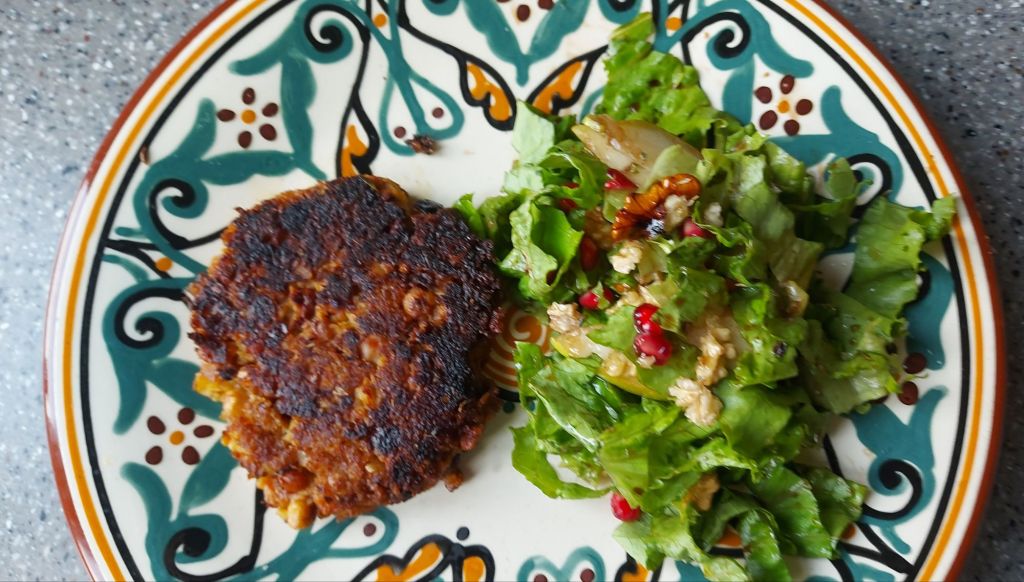
A nutty chickpea and pumpkin fritter served with a lettuce, pear, pomegranate and walnut salad
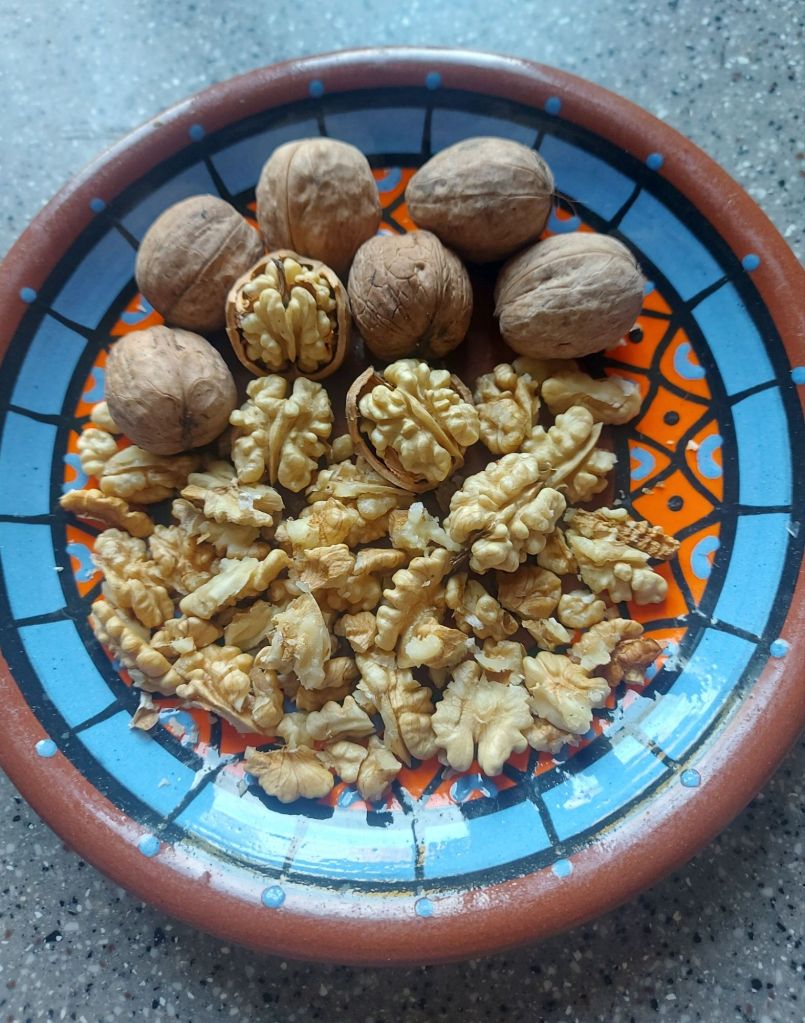
This time, we’re using the pumpkin in a fritter made with chickpeas and fine bulgur wheat. Recently, we recieved some walnuts from a friend of a friend’s dacha outside Almaty, here in Kazakhstan, which are ideal for adding a nutty edge to these chickpea and pumpkin fritters. We also added some walnuts to a fruity salad made with lettuce, pear and pomegranate seeds to accompany the fritters. Dress it with equal parts of balsamic vinegar and extra virgin olive oil.
This year’s walnuts fresh from the dacha in Almaty, Kazakhstan
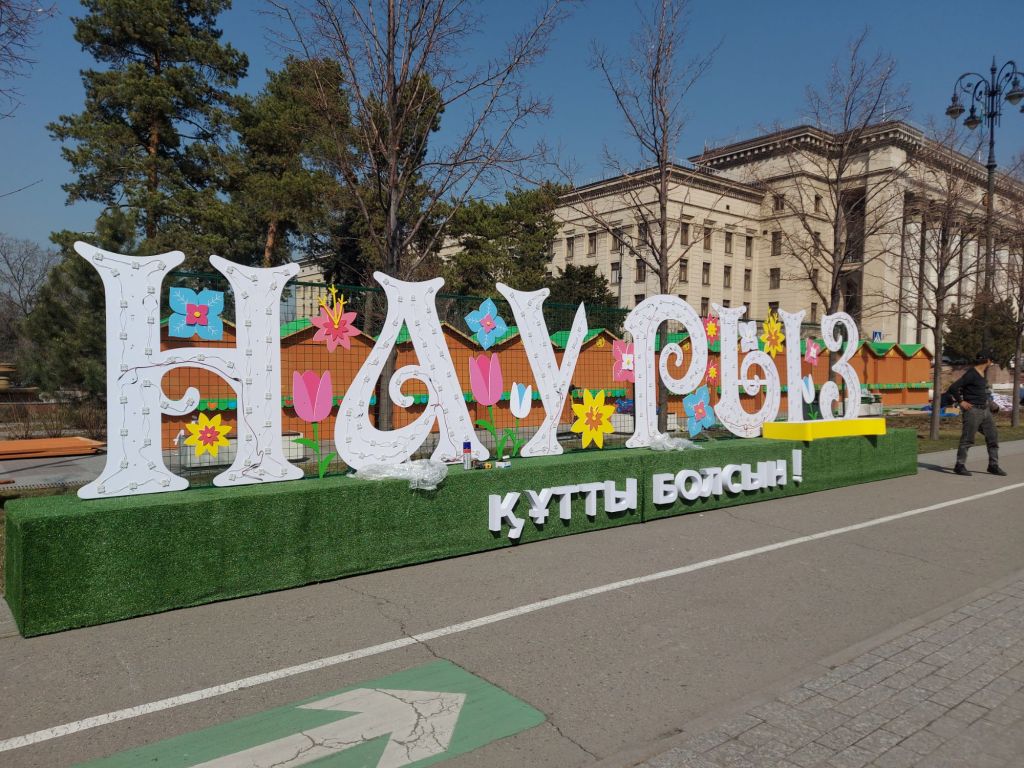
This weekend is Nowruz, a spring festival which originated in Persia some 3,000 years ago. Nowruz, or New Day, is a celebration of the end of winter and the start of a new year on the date when day and night are equal in the Northern Hemisphere – usually on or around the 20 – 21 March. The holiday is celebrated in Iran, Afghanistan, Azerbaijan and Central Asia, and in parts of Turkey, Syria, India, Iraq, Pakistan, Russia and China.
Preparing for Nowruz (Nauryz) in Almaty, Kazakhstan
There are many traditional foods associated with the holiday – Uzbekistan has sumalak, a paste made from what flour, sprouted wheat and oil. Kazakhstan has Nauryz Kozhe, a soup made from seven ingredients: barley, meat, kumis (fermented horse milk), onion, garlic, water and salt.
Iran’s Kookoo Sabzi – a herby frittata
Iran’s Nowruz table features the wonderfully named Kookoo Sabzi, sometimes written as Kuku – a herb-filled cousin of Italy’s frittata. The fresh herbs represent rebirth, while the eggs stand for fertility.
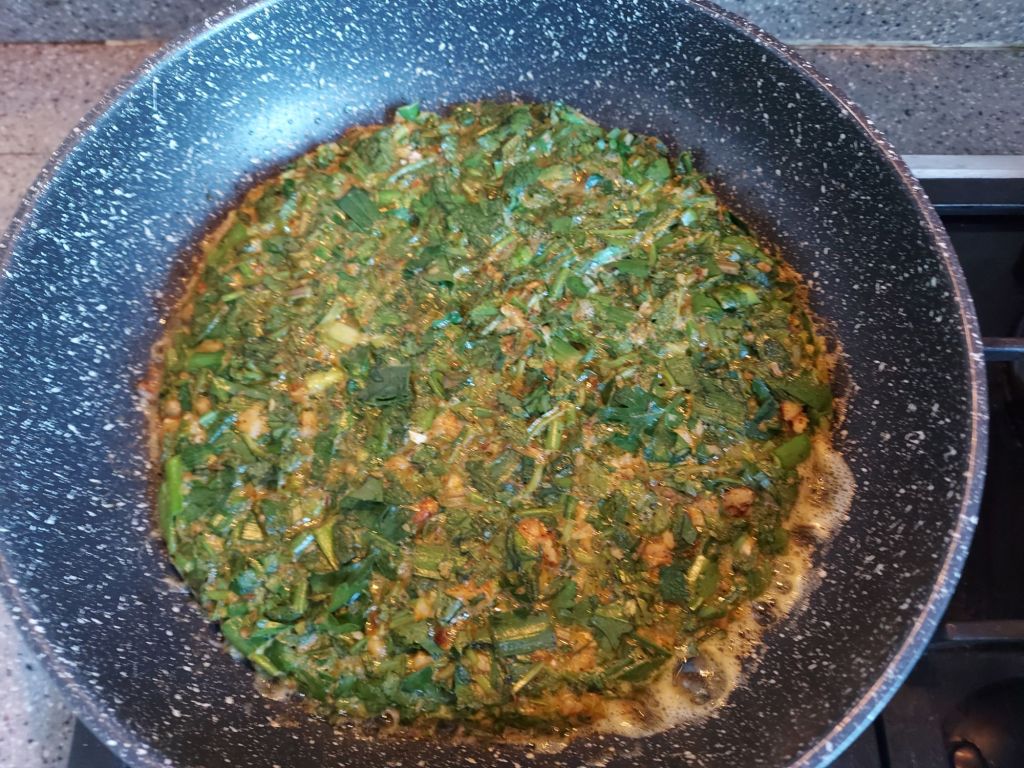
This Kookoo Sabzi’s ready to flip
Kookoo Sabzi is usually a combination of garlic chives, corainder (cilantro) and dill, but seeing as we’re not fans of dill, we’ve opted to replace it with parsley and mint. You can also omit the coriander if that’s not your thing (feel free to add some dill if you must). We’ve added parsley and mint, along with toasted walnuts, for some protien, and barberries (if you can find them – we couldn’t), to add a tart edge to the dish. Cranberries are a good replacement if barberries are proving hard to track down.
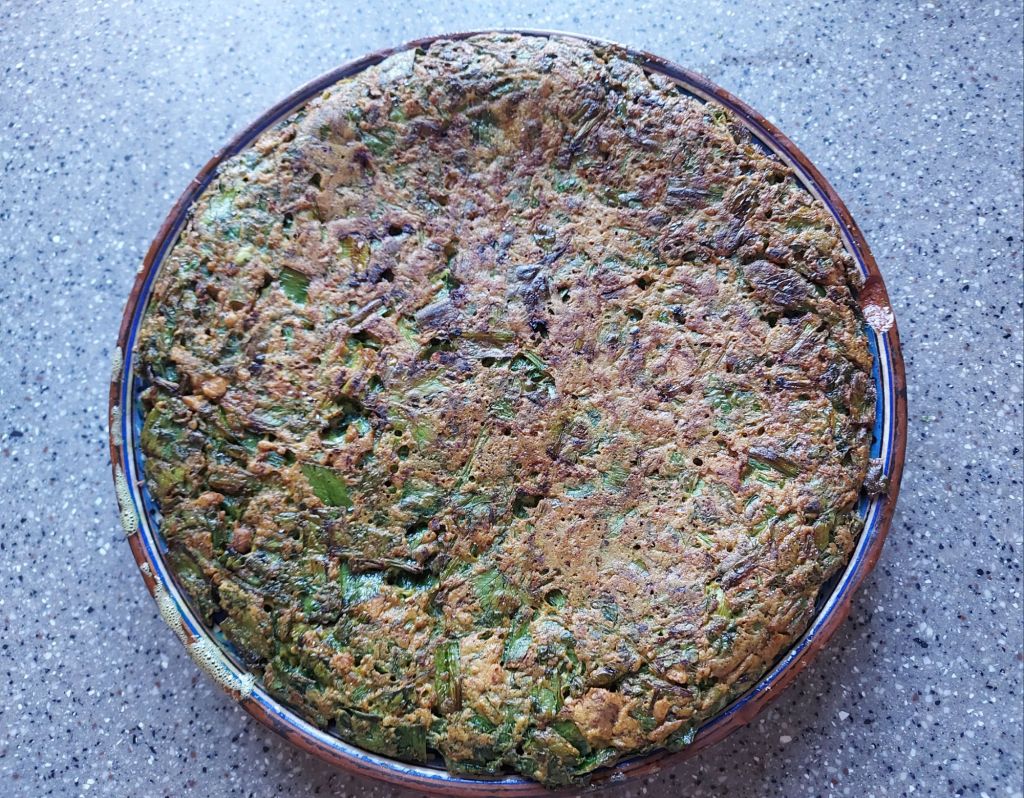
Turn it onto a plate and slide it back into the pan
Ingredients (makes four servings)
50 g fresh parsley
50 g fresh coriander
50 g garlic chives (jusai)
25 g fresh mint leaves
50 g walnuts
10 g dried barberries (or cranberries)
4 eggs
20 g chickpea flour
One teaspoon each of: cumin seeds, sumac and turmeric
25 ml olive oil
Method
Wash the garlic chives and cut into 0.5 cm pieces. Leave to dry on a tea towel or kitchen paper. Wash and finely chop the parsley, coriander (including stems) and mint leaves. Combine all these ingredients with the chickpea flour, spices, berries and the eggs.
Crush and then toast the walnuts (without oil) for 10 minutes in a 12 cm frying pan. Remove the walnuts and mix them in with the herbs and eggs. Put half the olive oil in the frying pan and heat it up and then add the herb mixture, flattening it with a spatula.
Cook over a medium heat for 10 minutes. Put a plate on top of the kookoo and turn the frying pan over. Add the rest of the oil to the empty pan and heat it up. Slide the kookoo back into the frying pan and cook for another 10 minutes.
Cut the kookoo into four slices and serve with a dollop of natural yogurt and some olives.
It’s that asparagus time of year once again. These tasty green spears are a harbinger of the warmer months of Spring and Summer – the first tips are ready for harvest shortly after the ground temperature hits 10°C.
Asparagus and chickpea pasta
Here in Almaty, Kazakhstan, locally-grown asparagus is currently having its moment in the sun, with many restaurants offering seasonal dishes featuring these flavour-packed spears of goodness.
Asparagus from Kazakhstan
Over the years, KCC has featured a number of asparagus dishes, such as a bulgur pilaf with asparagus (KCC’s first ever recipe), Mr Alan’s Top Tips, and in a stir-fry. This time round, after tracking down some locally-grown asparagus in Almaty, we’ve cooked it with chickpeas, capers, walnuts and tagliatelle:
Ingredients (for 2 servings)
150 g asparagus
175 g chickpeas
30 g walnuts
20 g capers
50 – 100 ml aquafaba (chickpea cooking liquid)
25 ml olive oil
150 g dried taglaitelle
One teaspoon fresh or dried rosemary
Method
To make the green sauce, blitz 50 g of chopped, raw asparagus in a blender with 75 g chickpeas, the chopped walnuts and capers and olive oil. Keep adding aquafaba slowly until the sauce had a creamy consistency,
Cook the pasta according to the packet instructions in a pan of boiling, salty water. Slice the remaining asparagus into 3 mm slices and cook with the pasta for the last five minutes. While the pasta is cooking, add the remaining chickpeas to the green sauce in a heavy-based pan, warm over a low heat and stir in the rosemary.
Drain the pasta and asparagus, reserving some of the cooking Waterloo to loosen the sauce, if needed, and add to the green sauce and chickpeas, combine well and serve.
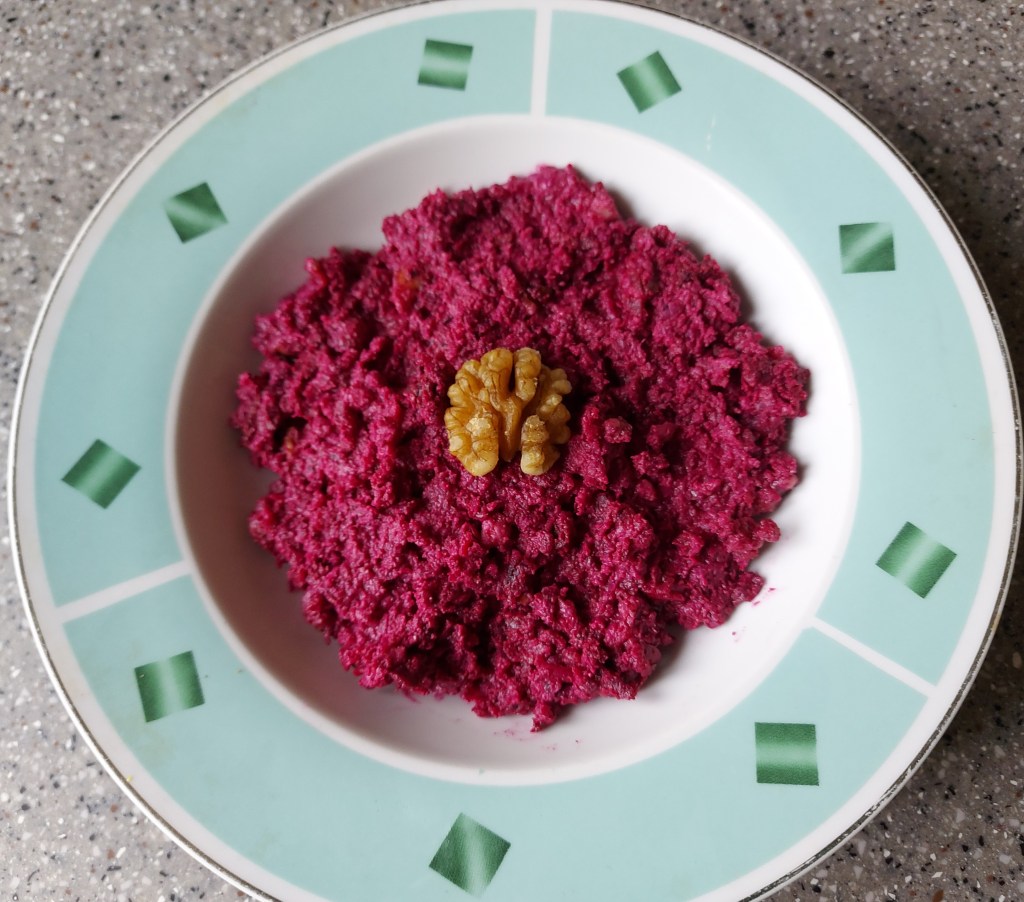
Hummus is one of those dips that we come back to time after time here on KCC. Beyond the classic basic dip of chickpeas, tahini, garlic, lemon juice and olive oil, the possibilities are endless. Our latest version is inspired by a recent trip to Myrtos, Crete where we tasted a beetroot-driven hummus at the excellent O Platanos restaurant.
In the past, we’ve made a turmeric-infused hummus and one from red beans, now here’s our latest variation. Beetroot is one of our favourite root vegetables, and it’s really good for you to boot. Taking some tips from Georgia, where a similar dip called pkhali is a regular feature on the dinner table, we’ve added some walnuts to give this hummus an extra protein boost.
Ingredients
125 g baked beetroot – grated
125 g crushed chickpeas
50 g tahini – mixed with up to 50 ml of hot water
25 g toasted walnuts
One garlic clove
100 ml aquafaba (chickpea water)
a few dashes of olive oil
Two teaspoons of sumac
pinches of ground cumin and coriander
Method
Grate the beetroot and then put in a large bowl and crush with a fork (you can also put it in the blender, if you have one). Add the mashed up chickpeas and stir well. Combine the tahini with hot water until you have a creamy paste and then add to the mix.
Add the crushed, toasted walnuts, finely chopped garlic and sumac (this replaces lemon juice to give the hummus a citrusy kick without the acid) and stir together. Add some aquafaba and some splashes of olive oil and blend until the dip achieves your favoured consistency. Season with cumin and coriander and serve with warm pita bread.
If you’re a purist who believes that fruits have no business being in salads, then this is not the place for you. At KCC we have no such qualms about mixing vegetables and fruits. In the past we’ve featured a salad with raspberries, one with grilled peaches and another with watermelon, to name a few. As long as something salty, like feta or halloumi cheese, is included to counterbalance the sweetness, then adding fruit to to your salad is fine in our book.
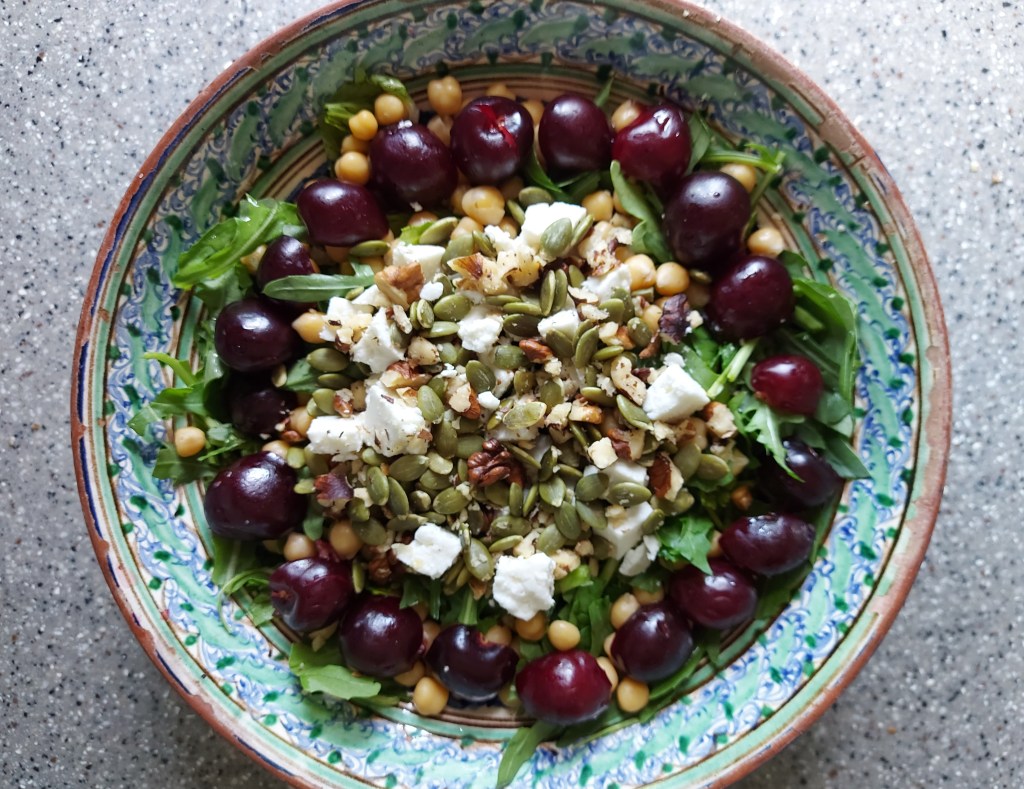
A rocket-fuelled cherry, chickpea, feta and walnut salad
Cherries are at their peak at this time of the year. Whatever variety you can get your hands on – sweet or sour, both work fine in this salad. Prepare a bed of rocket and celery, top with chickpeas, pumpkin seeds, walnuts and feta, arrange the cherries around the edge and dress with pomegranate sauce and olive oil to make a balanced meeting of sweet and sour in this early summer special.
With Wimbledon in full swing and the British hopes fading fast, it’s time to seek some consolation in some seasonal soft fruits. Strawberries and cream, of course, is a dish associated with the tennis extravaganza in SW19.
This summer, KCC has noticed a glut of strawberry recipes in the mainstream UK press and on Instagram, using these berries in salads or in gazpacho, a cold, blended vegetable soup.
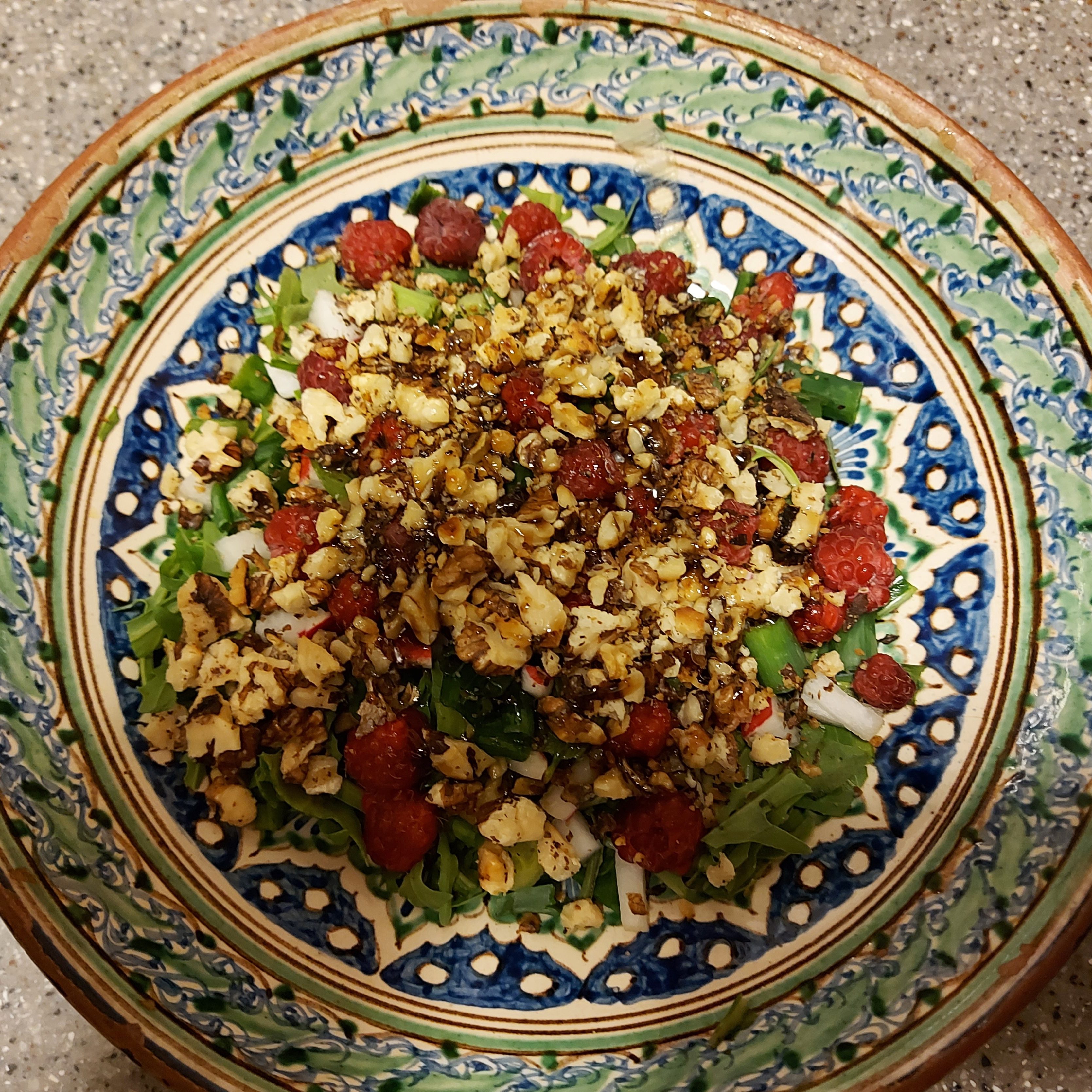
KCC’S Raspberry, rocket and walnut delight
We popped along to see Gulzhaina, our local greengrocer in Almaty, but alas she only had raspberries in stock. Not to worry, though, as these tart berries are also great when used in a salad.
We served our raspberries on a bed of rocket, radish and spring onion and topped with toasted walnuts, pomegranate sauce and olive oil – a great combination on a hot summer’s day.
Serves 2: 50g chopped rocket leaves Add one sliced radish and one spring onionAdd 50g raspberriesAdd 25g toasted walnuts and dress with 10ml pomegranate sauce and 10ml olive oil
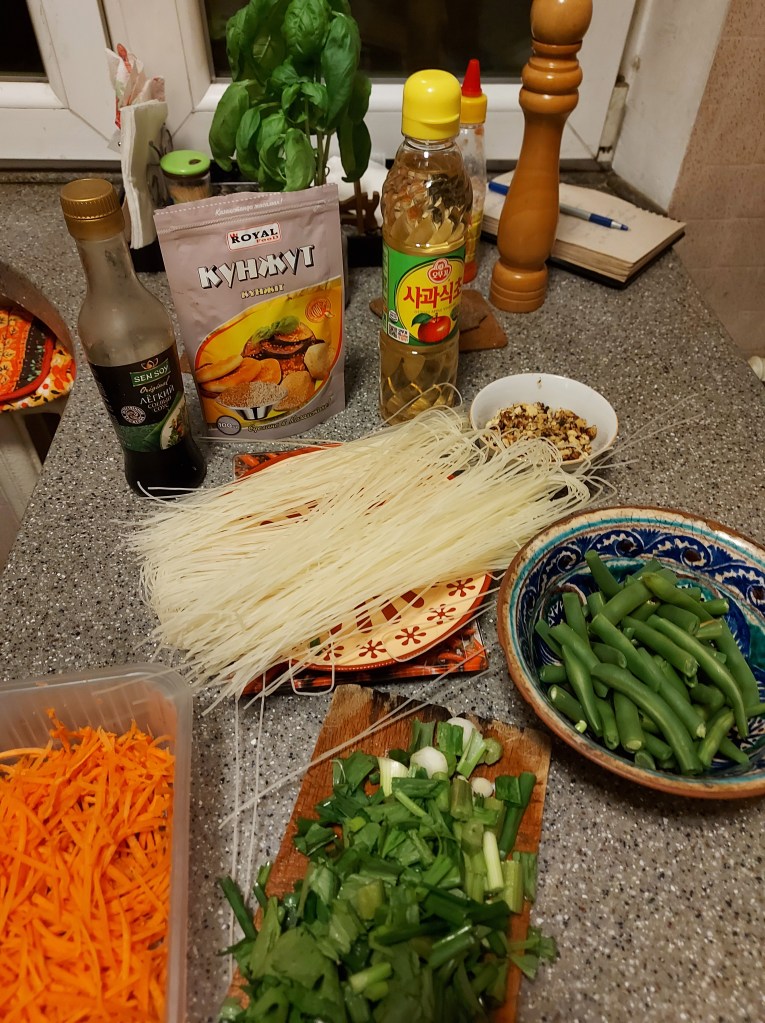
Continuing with our summery vibe, the year’s first green bean crops are appearing. Green beans are great for adding a bit of crunch to a stir fry or a salad, we’ve gone for the best of both worlds by mixing our green beans in with celery, carrots, spring onions and walnuts on a bed of funchoza (vermicelli) noodles, liberally dressed with soy sauce, apple vinegar and sesame seeds.
KCC’s green bean funchoza supreme
This recipe lends itself to the pictorial treatment – see below for the steps needed to assemble this summery salad. Also check out our reel on Instagram as well with an orangey red, green and gold inspired Black Uhuru backing track.
Get the ingredients ready – serves twoPut a bed of 150g noodles in the bowl – cook them according to the pack instructions and cool in cold waterAdd 50g sliced celery and 50g chopped spring onionAdd 75g grated carrotsAdd 150g cooked green beans – cook in boiling water for five minutes and then put in cold water to keep them crunchyAdd 50g chopped walnuts – toast them for a tastier flavourSprinkle with one teaspoon sesame seeds, 10ml soy sauce and 10ml apple vinegar, mix well and serve in two smaller bowls
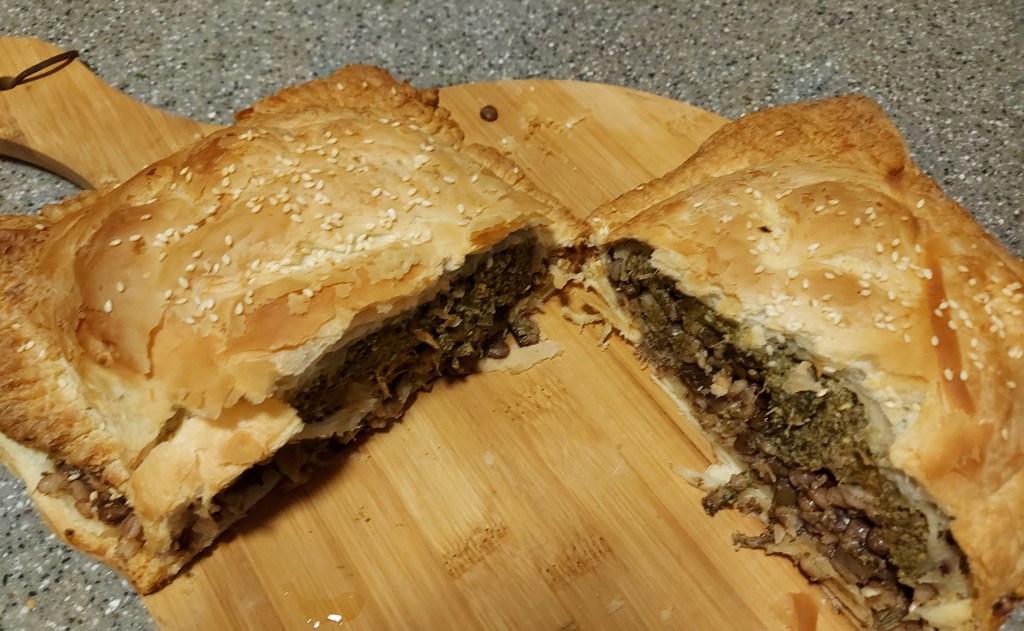
Seasoned greetings to all our readers from KCC — with Christmas fast approaching, here’s our recipe for a festive pie filled with a nutty, lentily barley roast, spinach pkhali and a mystery guest – banana peel!
A nutty, lentily barley filled piece with spinach pkhali and banana peel
We’ve come under the spell of The Great British Bake Off winner Nadiya Hussain who caused a splash in lockdown in 2020 when she advocated the use of banana peel as an ingredient. KCC is always on the lookout for ingenious solutions that cut down on waste and this use of banana peel certainly fits the bill perfectly.
KCC’s Festive Feast 2021
The banana peel has a texture that is a bit like mushroom and makes for an unusual addition to the standard nut roast. The peel can also be put in curries and stir fries — a great move for fans of zero waste.
Ingredients (serves 3-4)
For the pie
75 g pearl barley
50 g green lentils
2 cm cinnamon stick
2 cm ginger
3 cloves
Zest of one lemon
1 litre hot water
1 banana skin
150 g onion
50 g celery
75 g walnuts
75 ml olive oil
100 ml white wine
250 ml vegetable stock
1 teaspoon cumin seeds
1 teaspoon oregano
1 teaspoon thyme
1 teaspoon rosemary
3 teaspoons chia seeds
250 g puff pastry
For the spinach pkhali
200 g fresh spinach
75 g walnuts
One small onion (around 75 g)
One garlic clove
5 g fresh parsley
5 g fresh coriander
1 teaspoon blue fenugreek powder
1 teaspoon black pepper
20 ml wine vinegar
Method
Wash the pearl barley and green lentils until the water runs clear and then soak in the hot water for one hour with the cinnamon stick, chopped ginger, cloves and lemon zest. While this is soaking, cook 75 g of sliced onion in 25 ml of olive oil over a low heat until turning translucent.
To prepare the banana skin, wash the peel thoroughly in cold water and then use a spoon or knife to remove the pulp from the inside of the peel (you can use this in a smoothie or a cake). Slice the peel into thin strips about 2 cm long and 2-3 mm thick. Now add to the fried onions and cook util the peel starts to go crispy. Set aside to cool.
Fry the sliced celery and the rest of the chopped onion in the remaining olive oil in a different pan, add the cumin seeds, oregano, thyme and rosemary and cook over a low heat for 10 minutes and then add the soaked barley and lentils along with the cinnamon stick, ginger, cloves and lemon zest (you can use the soaking water to make our LGBTQ drink).
Then add the white wine and vegetable stock and stir well. Leave to cook over a low heat, stirring occasionally, until all the liquid is absorbed, this should take up to 30 minutes.
While this is cooking, make the spinach pkhali. Cook the spinach in boiling water for 5 minutes until it begins to wilt. Remove and place in cold water and then drain. Finely chop the onion and put it in a mixing bowl with the garlic, herbs and spices. Toast the walnuts over a low heat for 5-10 minutes and then add to the bowl. Add the vinegar and use a blender to make a smooth paste. Add the spinach and keep blending until you have a gloopy mixture.
Toast the remaining chopped walnuts and then add to the cooled barley and lentil mix along with the cooked banana peel and chia seeds. Mix well.
To assemble the pie, cut the pastry into two rectangles, one slightly smaller than the other. roll out the smaller piece and top with the nut roast mix, leaving 1 cm around the edges. Put a layer of spinach pkhali on top of the nut mix.
Roll out the other piece of pastry, brush the 1 cm edge of the pie with olive oil and then place the larger piece of pastry over the top of the nut and pkhali mix and then crimp down the edges with a fork. Brush the pie with olive oil and bake in an oven heated to 180 c for 30 minutes or until the pie is a golden brown colour.
Serve with seasonal roasted vegetables — we used potatoes, beetroot, onion and carrots, and a gravy of your choice (we made one with a pomegranate sauce base).
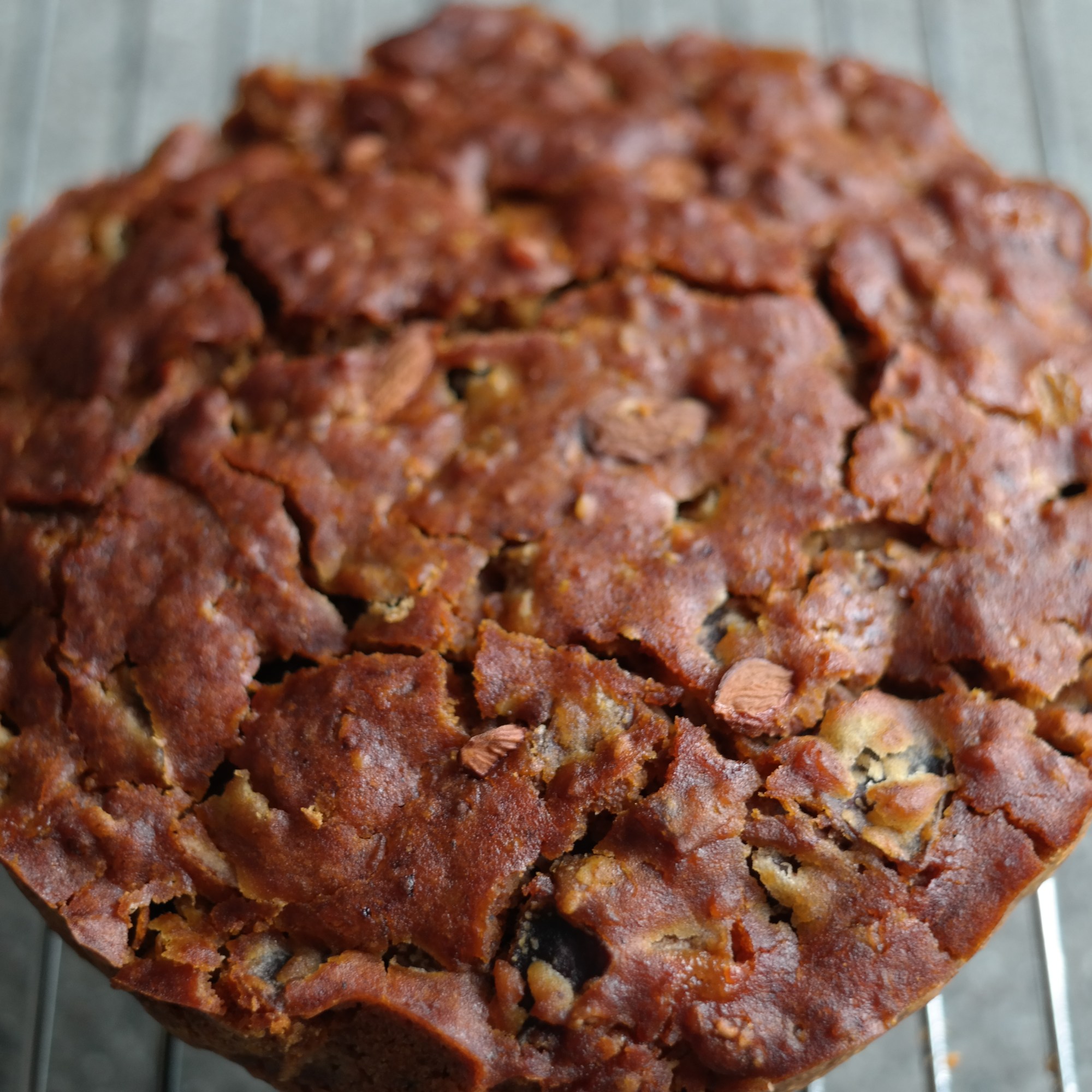
If you’re feeling down after all the partying in December, then never fear as Russian Christmas is here! To help celebrate it in style we’ve opened up our Vodkatopf (a slavic cousin of the Rumtopf) and used the fruit that’s been stewing in the vodka since summer to make a booze-infused fruitcake.
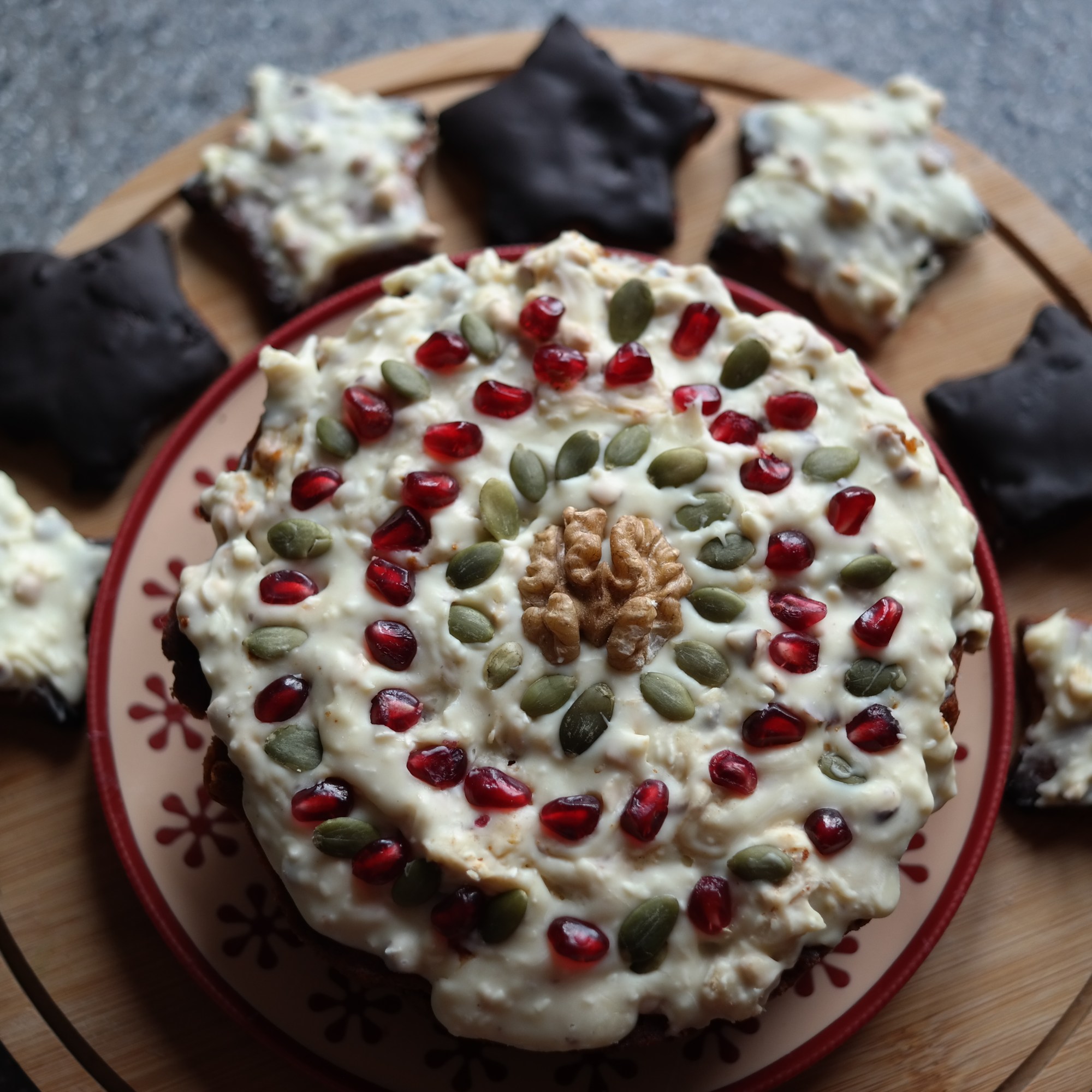
KCC’s booze-fuelled festive fruitcake
In Russia, Christmas is celebrated on 7 January – the Orthodox Church still follows the Julian calendar rather than the Gregorian calendar whereas Russia switched to the latter in 1917. The switch created a 13-day lag between the calendars so, for followers of the Orthodox faith, Christmas Eve falls on 6 January and 13 January marks the end of the old year
To make the vodkatopf we poured vodka over layers of different fruits as they appeared over the summer. The apricots, cherries and raspberries of early summer were followed by peaches and plums to make a great , fruity vodka for shooting or mixing. As an added bonus, the preserved fruit went into a the fruitcake mix. We decorated the cake with melted white chocolate and crushed almonds and used pumpkin and pomegranate seeds as the finishing touch.
Ingredients (for 6 – 8 servings)
325 g vodka-soaked mixed fruit (soak overnight in 250 ml vodka or other spirit if using dried fruit)
90 g olive oil
100 g honey (or golden syrup for a vegan cake)
175 g plain flour (we used rice flour for a gluten free cake)
50 g mixed nuts
100 ml coconut milk
25 g desiccated coconut
One teaspoon baking powder
One teaspoon each of cloves, ginger, nutmeg and cinnamon
25 ml vodka
100 g melted white chocolate
pumpkin and pomegranate seeds to decorate the cake
Method
Line a 15cm cake tin with a double layer of parchment paper, this will help stop the cake from burning
Sieve the flour and combine with the coconut milk, vodka, 30 g of chopped nuts, desiccated coconut, baking powder, cloves, ginger, nutmeg and cinnamon and stir together to make a thick batter
Melt the honey into the olive oil in a heavy-bottomed pan over a low heat and stir.
Combine the honey and oil mix with the batter.
Stir in the soaked fruits into the batter, along with any leftover liquid.
Layer the batter into the prepared tin and use a spatula to spread it level.
Melt the white chocolate in a glass or ceramic bowl over a pan of boiling water.
Spread the chocolate evenly over the top of the cake, sprinkle some mixed nuts over the icing and then decorate with pomegranate and pumpkin seeds.
We’re turning our attention back to Georgia to take a look at how walnuts form the backbone of the nation’s cuisine. This versatile nut can be made into a sauce, bazhe, and slathered on slices of fried aubergine or poured over a cucumber and tomato salad. It’s also used liberally in the vegetable dip, pkhali, in the thicker satsivi paste and in the red bean dish, lobio.
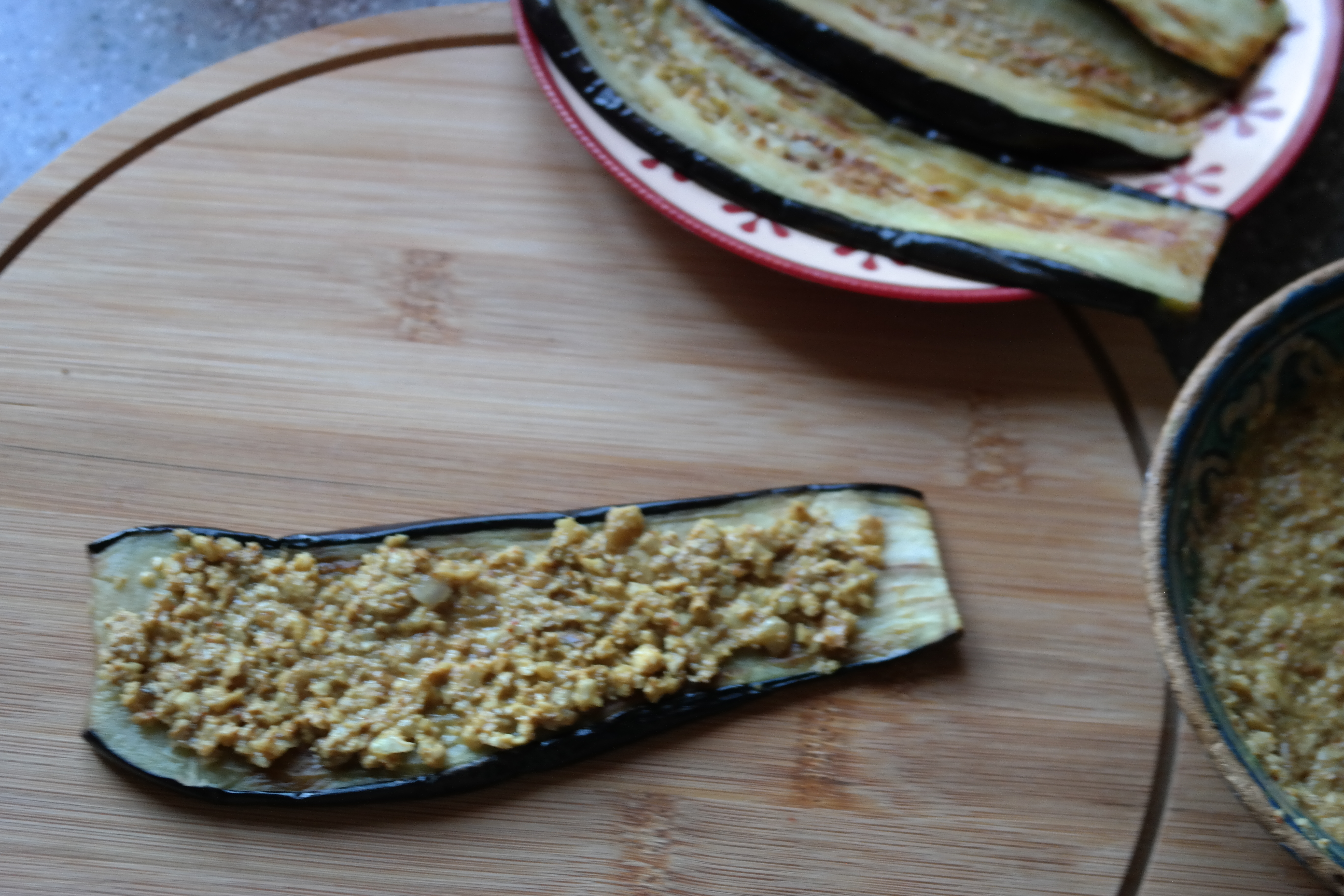
Aubergine slices stuffed with bazhe, Georgia’s versatile walnut sauce
We made some bazhe to roll up in slices of fried aubergine, a favourite from the days of visiting Georgian restaurants. These aubergine rolls, nigvziani badrijani in Georgian, are usually served at the start of the meal, especially at lengthy wine and chacha (a grape-based spirit akin to Italy’s grappa or Greece’s tsipouro) fuelled banquets, but we think they’re great to eat at anytime and they’re particularly handy for picnics or barbecues.
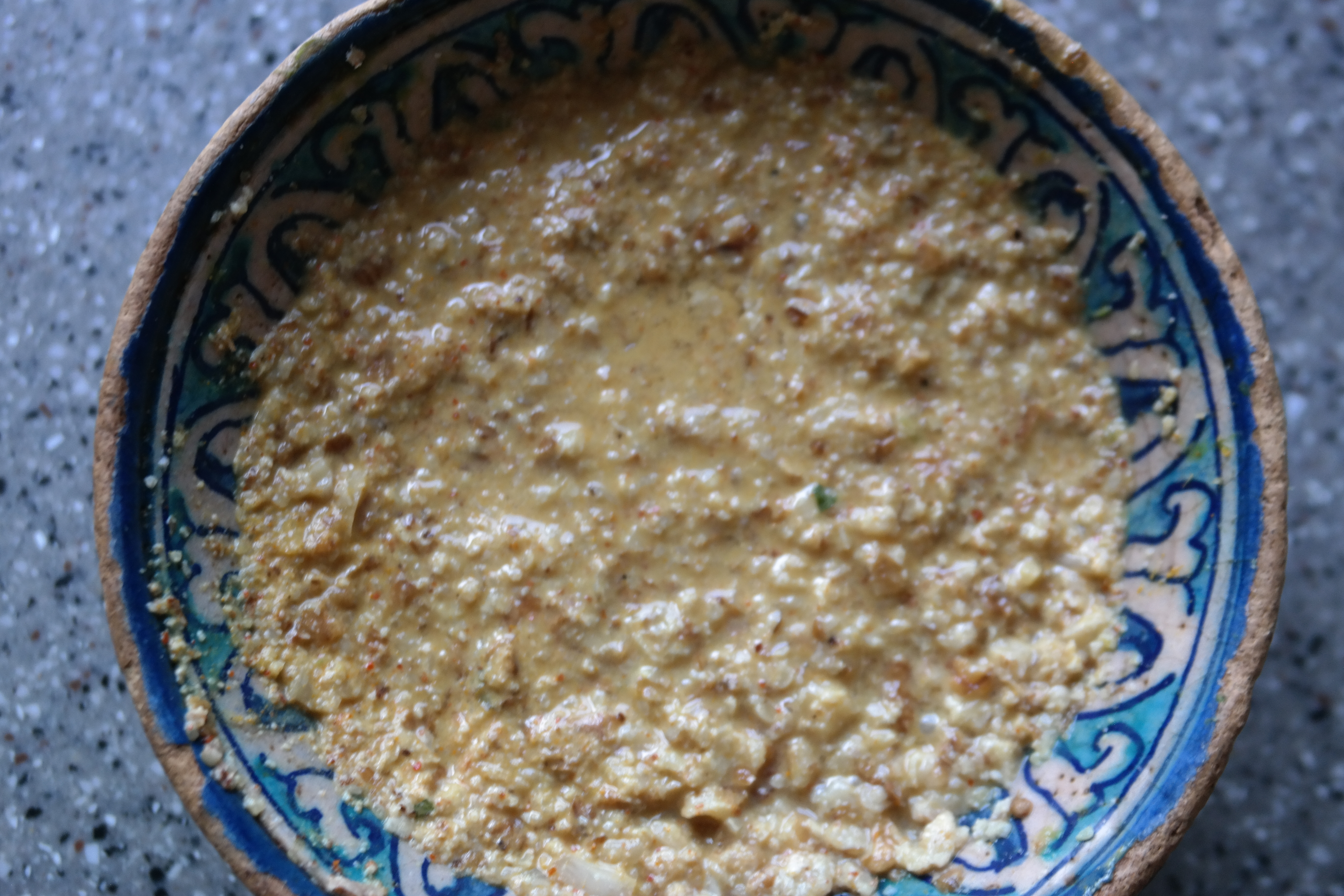
Bazhe – Georgia’s versatile walnut sauce
To remove the bitter taste of the aubergine, sprinkle with salt and leave for 30 minutes. Rinse in cold water and pat dry with kitchen roll. Make sure the oil is very hot when frying the slices – this will help them not to soak up too much fat while cooking.,
Spread the sauce on the fried aubergine slice and then roll it up
Ingredients (for 16-20 aubergine rolls)
3 or 4 large aubergines
100 ml cooking oil
100 g walnuts
2 garlic cloves
1 tablespoon vinegar (red or white wine or apple)
1 tablespoon pomegranate sauce
1 teaspoon blue fenugreek (use cumin seeds if you can’t find this)
1 teaspoon marigold flower (use turmeric if you can’t find this)
1 teaspoon coriander seeds
1 teaspoon paprika
50 ml cold water
Salt to sprinkle over the aubergine slices
Fresh basil and coriander leaves to garnish
Method
Make the walnut sauce first. Crush the nuts using the back of a wooden spoon on a wooden chopping board. This method gives the sauce a more crunchy texture. Mince the garlic and mix with the nuts in a bowl. Add the spices, vinegar and pomegranate sauce and combine all the ingredients into a smooth paste. Add water until the sauce has a more runny consistency but is still quite thick.
While the sauce is chilling in the fridge, fry the aubergine. Heat 50 ml of oil in a heavy based pan. Top and tail the aubergine and slice off a thin layer of skin on both sides. Cut the aubergine into 0.5 cm slices lengthways and then fry on both sides until golden brown. Drain on kitchen paper.
When the slices have cooled down, spread the walnut sauce onto the slice and then roll it up. Garnish with fresh herbs such as coriander and basil, and pomegranate seeds (if you have any – we’re not expecting any until autumn) and serve cold with other Georgian starters such as pkhali and crusty bread.












 Knidos Cookery Club