Kookoo Sabzi – Welcoming Nowruz with a Herby Frittata

19 March 2025

This weekend is Nowruz, a spring festival which originated in Persia some 3,000 years ago. Nowruz, or New Day, is a celebration of the end of winter and the start of a new year on the date when day and night are equal in the Northern Hemisphere – usually on or around the 20 – 21 March. The holiday is celebrated in Iran, Afghanistan, Azerbaijan and Central Asia, and in parts of Turkey, Syria, India, Iraq, Pakistan, Russia and China.

Preparing for Nowruz (Nauryz) in Almaty, Kazakhstan

There are many traditional foods associated with the holiday – Uzbekistan has sumalak, a paste made from what flour, sprouted wheat and oil. Kazakhstan has Nauryz Kozhe, a soup made from seven ingredients: barley, meat, kumis (fermented horse milk), onion, garlic, water and salt.

Iran’s Kookoo Sabzi – a herby frittata

Iran’s Nowruz table features the wonderfully named Kookoo Sabzi, sometimes written as Kuku – a herb-filled cousin of Italy’s frittata. The fresh herbs represent rebirth, while the eggs stand for fertility.
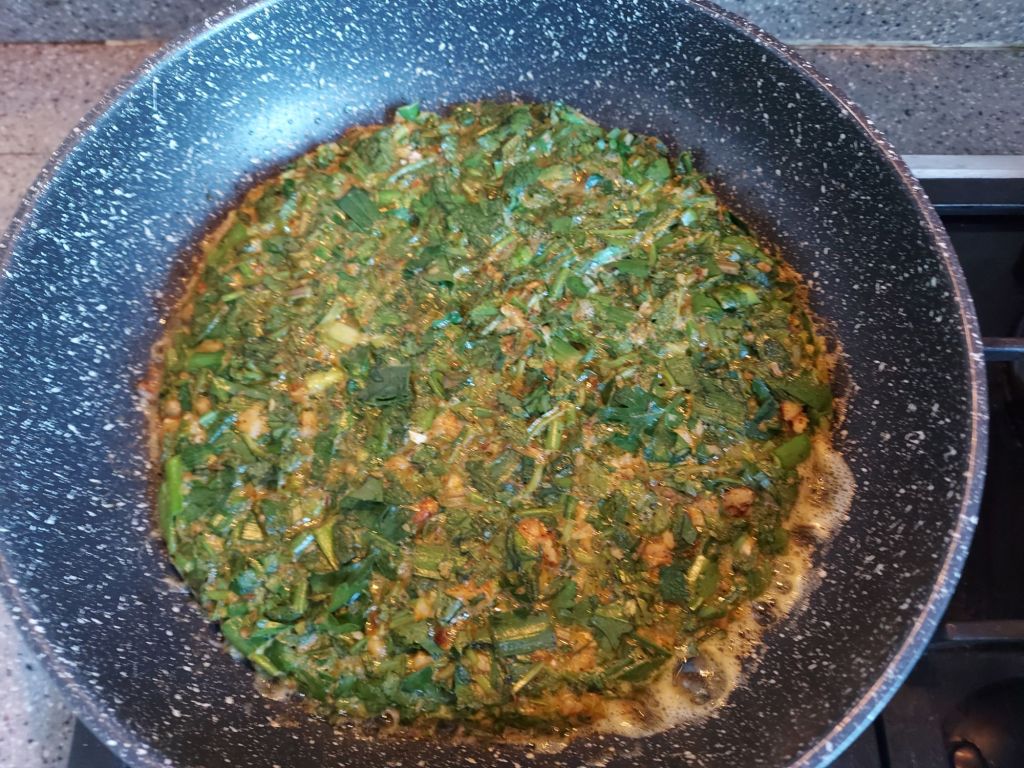
This Kookoo Sabzi’s ready to flip

Kookoo Sabzi is usually a combination of garlic chives, corainder (cilantro) and dill, but seeing as we’re not fans of dill, we’ve opted to replace it with parsley and mint. You can also omit the coriander if that’s not your thing (feel free to add some dill if you must). We’ve added parsley and mint, along with toasted walnuts, for some protien, and barberries (if you can find them – we couldn’t), to add a tart edge to the dish. Cranberries are a good replacement if barberries are proving hard to track down.
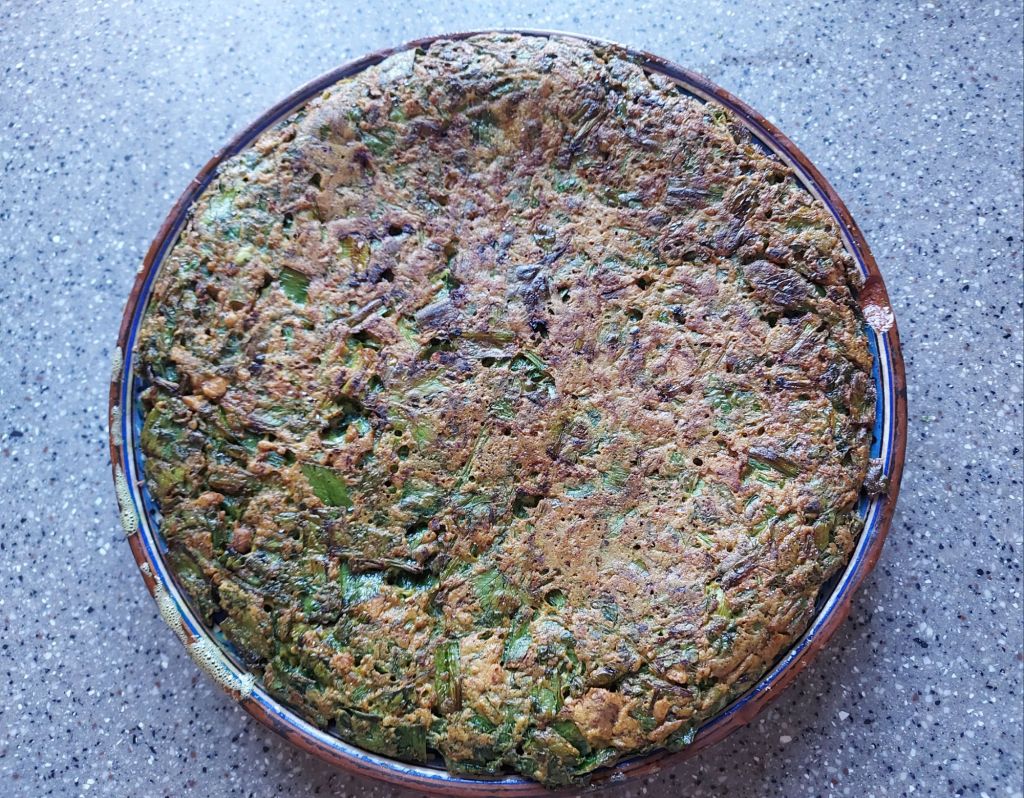
Turn it onto a plate and slide it back into the pan

Ingredients (makes four servings)

  • 50 g fresh parsley
  • 50 g fresh coriander
  • 50 g garlic chives (jusai)
  • 25 g fresh mint leaves
  • 50 g walnuts
  • 10 g dried barberries (or cranberries)
  • 4 eggs
  • 20 g chickpea flour
  • One teaspoon each of: cumin seeds, sumac and turmeric
  • 25 ml olive oil

Method

  • Wash the garlic chives and cut into 0.5 cm pieces. Leave to dry on a tea towel or kitchen paper. Wash and finely chop the parsley, coriander (including stems) and mint leaves. Combine all these ingredients with the chickpea flour, spices, berries and the eggs.
  • Crush and then toast the walnuts (without oil) for 10 minutes in a 12 cm frying pan. Remove the walnuts and mix them in with the herbs and eggs. Put half the olive oil in the frying pan and heat it up and then add the herb mixture, flattening it with a spatula.
  • Cook over a medium heat for 10 minutes. Put a plate on top of the kookoo and turn the frying pan over. Add the rest of the oil to the empty pan and heat it up. Slide the kookoo back into the frying pan and cook for another 10 minutes.
  • Cut the kookoo into four slices and serve with a dollop of natural yogurt and some olives.

More Adventures with Asparagus

24 May 2024

It’s that asparagus time of year once again. These tasty green spears are a harbinger of the warmer months of Spring and Summer – the first tips are ready for harvest shortly after the ground temperature hits 10°C.

Asparagus and chickpea pasta

Here in Almaty, Kazakhstan, locally-grown asparagus is currently having its moment in the sun, with many restaurants offering seasonal dishes featuring these flavour-packed spears of goodness.

Asparagus from Kazakhstan

Over the years, KCC has featured a number of asparagus dishes, such as a bulgur pilaf with asparagus (KCC’s first ever recipe), Mr Alan’s Top Tips, and in a stir-fry. This time round, after tracking down some locally-grown asparagus in Almaty, we’ve cooked it with chickpeas, capers, walnuts and tagliatelle:

Ingredients (for 2 servings)

  • 150 g asparagus
  • 175 g chickpeas 
  • 30 g walnuts
  • 20 g capers 
  • 50 – 100 ml aquafaba (chickpea cooking liquid)
  • 25 ml olive oil
  • 150 g dried taglaitelle
  • One teaspoon fresh or dried rosemary

Method

  • To make the green sauce, blitz 50 g of chopped, raw asparagus in a blender with 75 g chickpeas, the chopped walnuts and capers and olive oil. Keep adding aquafaba slowly until the sauce had a creamy consistency, 
  • Cook the pasta according to the packet instructions in a pan of boiling, salty water. Slice the remaining asparagus into 3 mm slices and cook with the pasta for the last five minutes. While the pasta is cooking, add the remaining chickpeas to the green sauce in a heavy-based pan, warm over a low heat and stir in the rosemary. 
  • Drain the pasta and asparagus, reserving some of the cooking Waterloo to loosen the sauce, if needed, and add to the green sauce and chickpeas, combine well and serve.

Rocket-Fuelled Cherry, Chickpea, Feta and Walnut Salad

9 June 2023

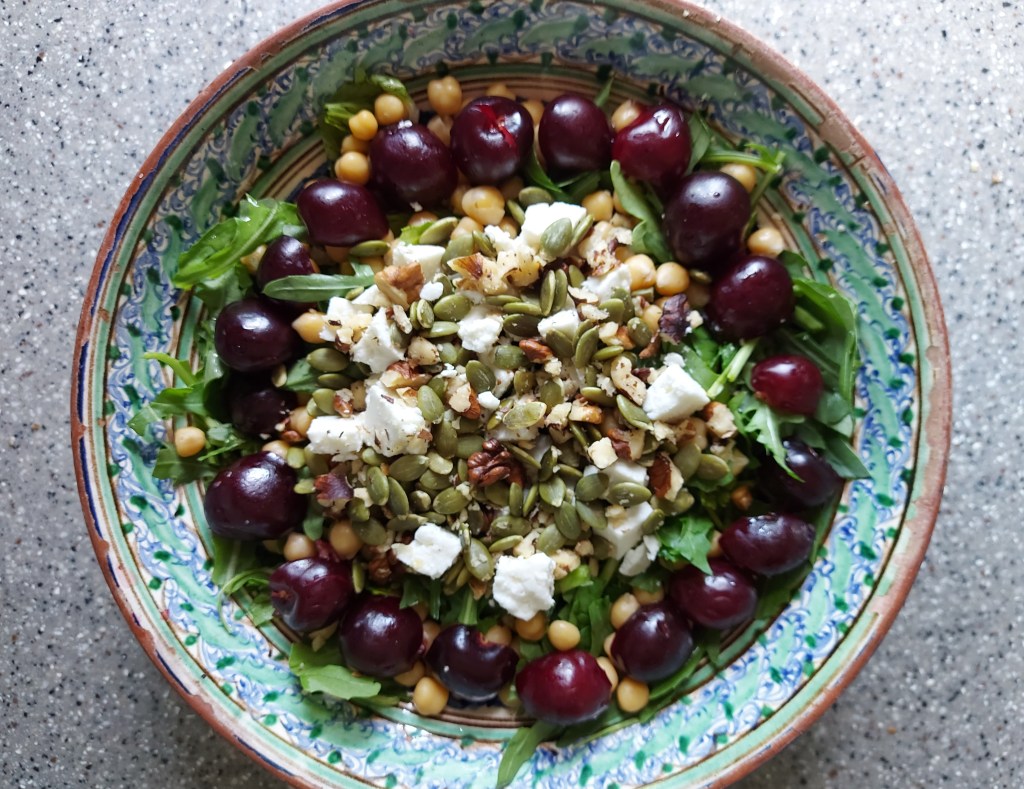
If you’re a purist who believes that fruits have no business being in salads, then this is not the place for you. At KCC we have no such qualms about mixing vegetables and fruits. In the past we’ve featured a salad with raspberries, one with grilled peaches and another with watermelon, to name a few. As long as something salty, like feta or halloumi cheese, is included to counterbalance the sweetness, then adding fruit to to your salad is fine in our book.

A rocket-fuelled cherry, chickpea, feta and walnut salad

Cherries are at their peak at this time of the year. Whatever variety you can get your hands on – sweet or sour, both work fine in this salad. Prepare a bed of rocket and celery, top with chickpeas, pumpkin seeds, walnuts and feta, arrange the cherries around the edge and dress with pomegranate sauce and olive oil to make a balanced meeting of sweet and sour in this early summer special.

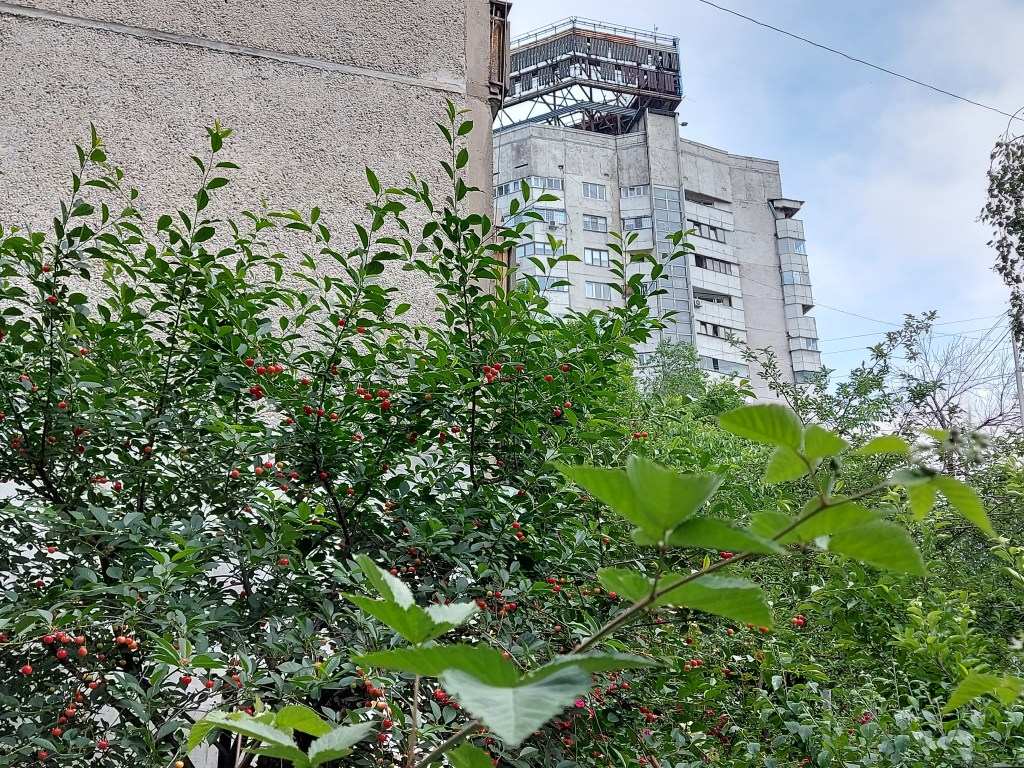
Cherries growing in Almaty’s urban jungle

Ingredients (serves 4)

  • 200 g cooked chickpeas
  • 150 g rocket leaves
  • 100 g crumbled feta cheese
  • 50 g celery
  • 20 cherries, halved and de-stoned
  • 40 g walnuts, lightly toasted
  • 40 g pumpkin seeds
  • 25 ml olive oil
  • 25 ml pomegranate sauce

Ride the Raspberry Rocket

30 June 2022

With Wimbledon in full swing and the British hopes fading fast, it’s time to seek some consolation in some seasonal soft fruits. Strawberries and cream, of course, is a dish associated with the tennis extravaganza in SW19.

This summer, KCC has noticed a glut of strawberry recipes in the mainstream UK press and on Instagram, using these berries in salads or in gazpacho, a cold, blended vegetable soup.

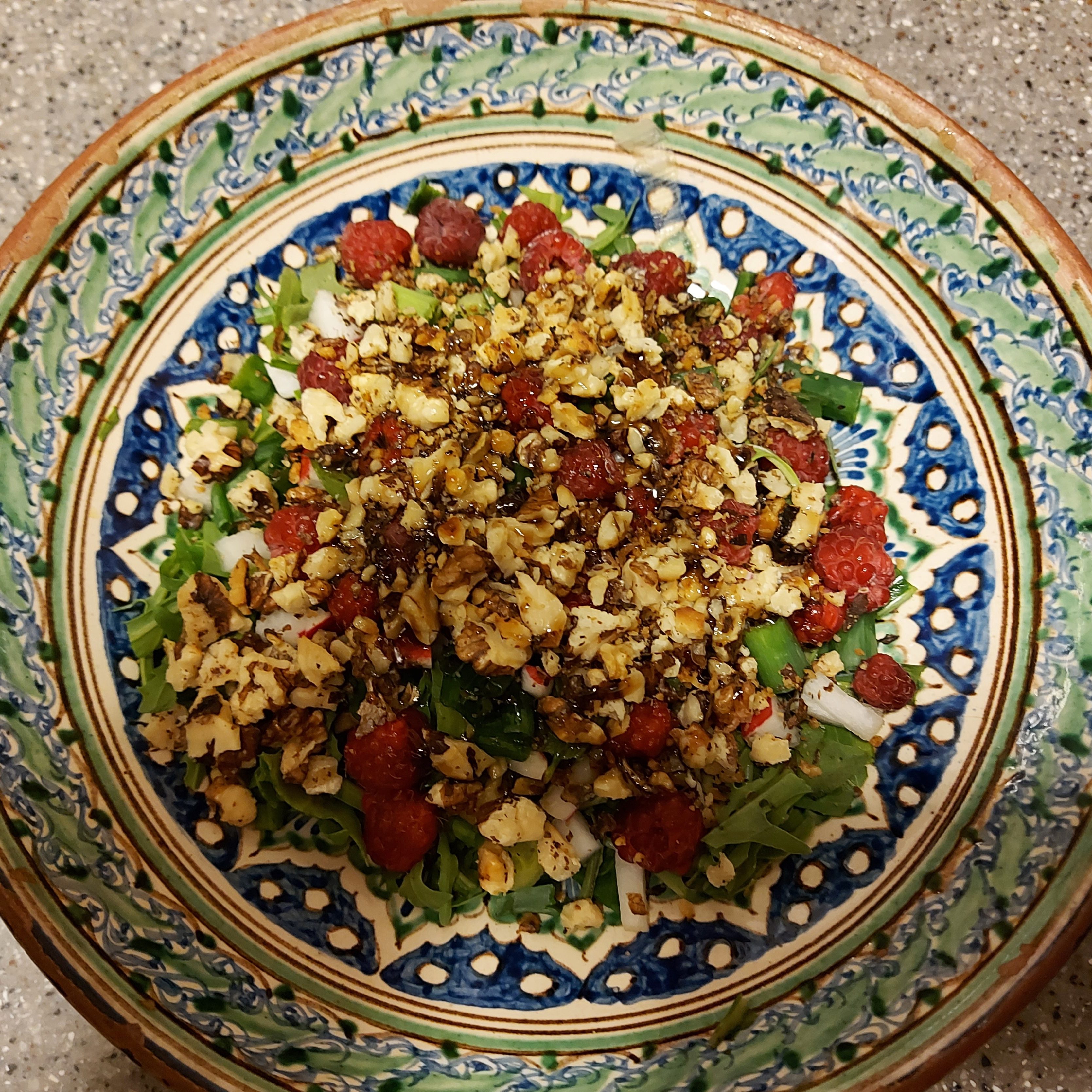
KCC’S Raspberry, rocket and walnut delight

We popped along to see Gulzhaina, our local greengrocer in Almaty, but alas she only had raspberries in stock. Not to worry, though, as these tart berries are also great when used in a salad.

We served our raspberries on a bed of rocket, radish and spring onion and topped with toasted walnuts, pomegranate sauce and olive oil – a great combination on a hot summer’s day.

Green Bean Funchoza Supreme

17 June 2022

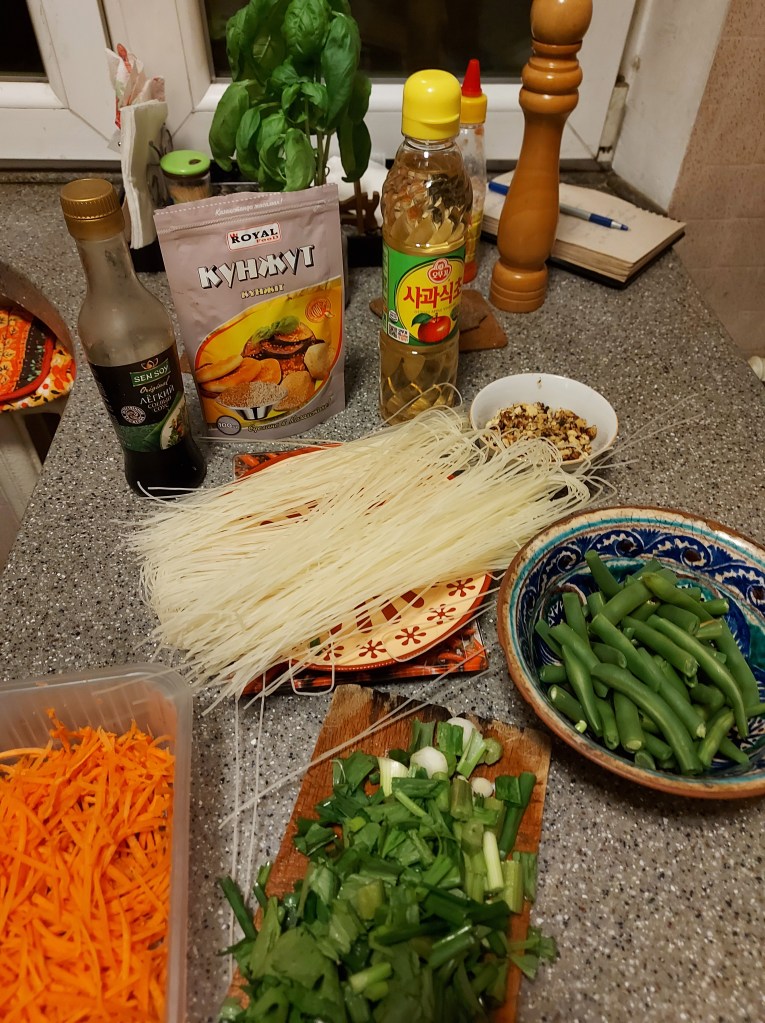
Continuing with our summery vibe, the year’s first green bean crops are appearing. Green beans are great for adding a bit of crunch to a stir fry or a salad, we’ve gone for the best of both worlds by mixing our green beans in with celery, carrots, spring onions and walnuts on a bed of funchoza (vermicelli) noodles, liberally dressed with soy sauce, apple vinegar and sesame seeds.

This recipe lends itself to the pictorial treatment – see below for the steps needed to assemble this summery salad. Also check out our reel on Instagram as well with an orangey red, green and gold inspired Black Uhuru backing track.

Going Bananas for Christmas

23 December 2021

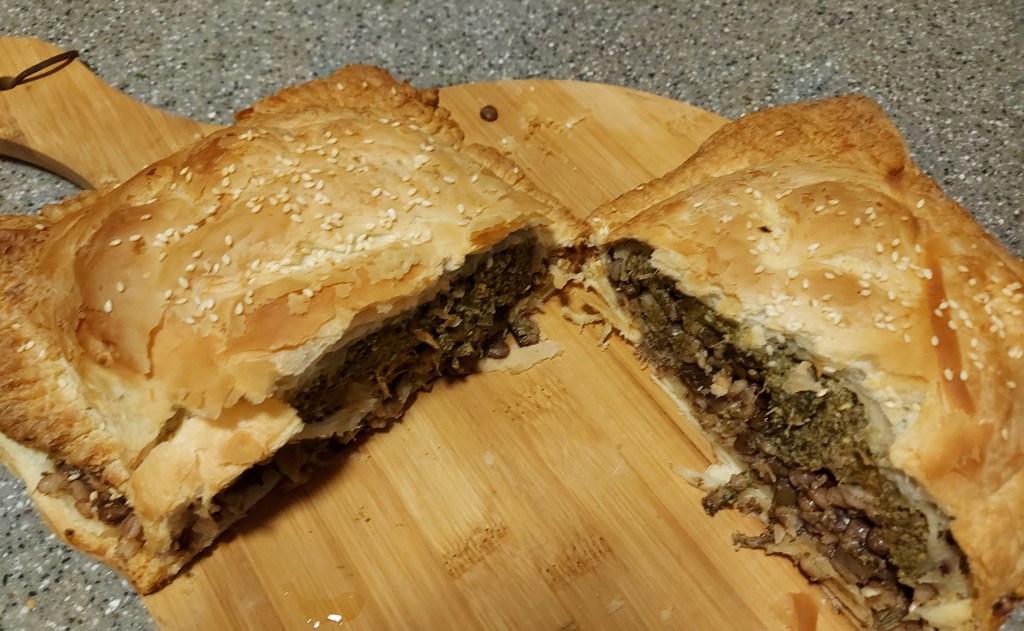
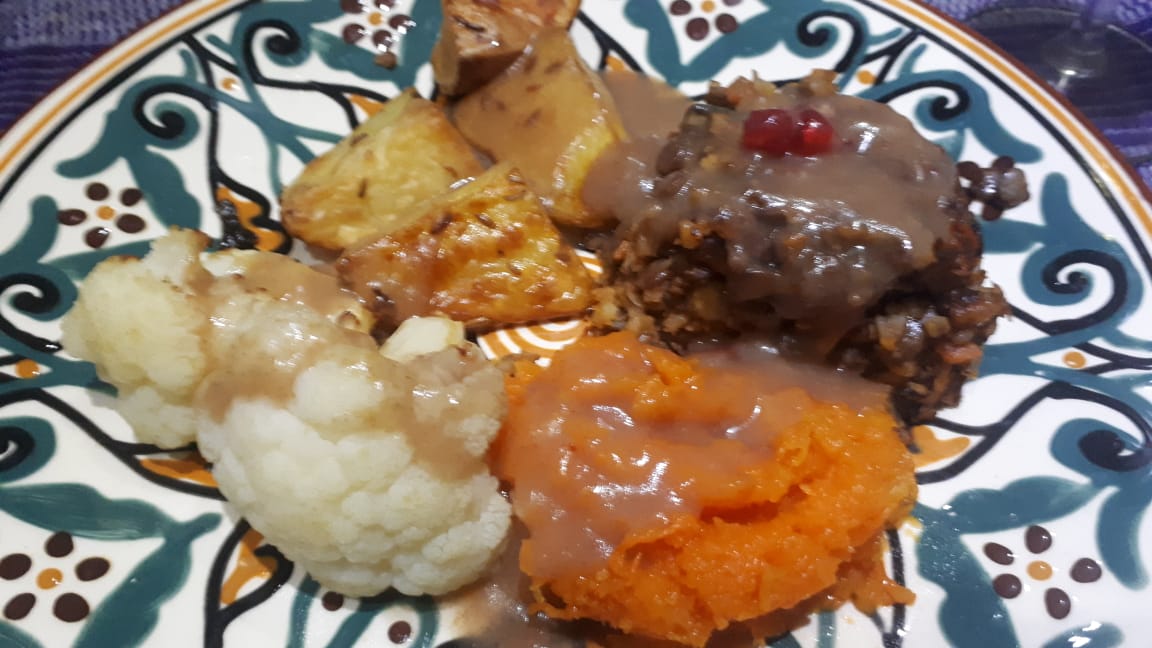
Seasoned greetings to all our readers from KCC — with Christmas fast approaching, here’s our recipe for a festive pie filled with a nutty, lentily barley roast, spinach pkhali and a mystery guest – banana peel!

A nutty, lentily barley filled piece with spinach pkhali and banana peel

We’ve come under the spell of The Great British Bake Off  winner Nadiya Hussain who caused a splash in lockdown in 2020 when she advocated the use of banana peel as an ingredient. KCC is always on the lookout for ingenious solutions that cut down on waste and this use of banana peel certainly fits the bill perfectly.

KCC’s Festive Feast 2021

The banana peel has a texture that is a bit like mushroom and makes for an unusual addition to the standard nut roast. The peel can also be put in curries and stir fries — a great move for fans of zero waste.

Ingredients (serves 3-4)

For the pie

  • 75 g pearl barley
  • 50 g green lentils
  • 2 cm cinnamon stick
  • 2 cm ginger
  • 3 cloves
  • Zest of one lemon
  • 1 litre hot water
  • 1 banana skin
  • 150 g onion 
  • 50 g celery
  • 75 g walnuts
  • 75 ml olive oil
  • 100 ml white wine
  • 250 ml vegetable stock
  • 1 teaspoon cumin seeds
  • 1 teaspoon oregano
  • 1 teaspoon thyme
  • 1 teaspoon rosemary
  • 3 teaspoons chia seeds
  • 250 g puff pastry

For the spinach pkhali

  • 200 g fresh spinach
  • 75 g walnuts
  • One small onion (around 75 g)
  • One garlic clove
  • 5 g fresh parsley
  • 5 g fresh coriander
  • 1 teaspoon blue fenugreek powder
  • 1 teaspoon black pepper
  • 20 ml wine vinegar

Method 

  • Wash the pearl barley and green lentils until the water runs clear and then soak in the hot water for one hour with the cinnamon stick, chopped ginger, cloves and lemon zest. While this is soaking, cook 75 g of sliced onion in 25 ml of olive oil over a low heat until turning translucent. 
  • To prepare the banana skin, wash the peel thoroughly in cold water and then use a spoon or knife to remove the pulp from the inside of the peel (you can use this in a smoothie or a cake). Slice the peel into thin strips about 2 cm long and 2-3 mm thick. Now add to the fried onions and cook util the peel starts to go crispy. Set aside to cool.
  • Fry the sliced celery and the rest of the chopped onion in the remaining olive oil in a different pan, add the cumin seeds, oregano, thyme and rosemary and cook over a low heat for 10 minutes and then add the soaked barley and lentils along with the cinnamon stick, ginger, cloves and lemon zest (you can use the soaking water to make our LGBTQ drink).
  • Then add the white wine and vegetable stock and stir well. Leave to cook over a low heat, stirring occasionally, until all the liquid is absorbed, this should take up to 30 minutes.
  • While this is cooking, make the spinach pkhali. Cook the spinach in boiling water for 5 minutes until it begins to wilt. Remove and place in cold water and then drain. Finely chop the onion and put it in a mixing bowl with the garlic, herbs and spices. Toast the walnuts over a low heat for 5-10 minutes and then add to the bowl. Add the vinegar and use a blender to make a smooth paste. Add the spinach and keep blending until you have a gloopy mixture.
  • Toast the remaining chopped walnuts and then add to the cooled barley and lentil mix along with the cooked banana peel and chia seeds. Mix well. 
  • To assemble the pie, cut the pastry into two rectangles, one slightly smaller than the other. roll out the smaller piece and top with the nut roast mix, leaving 1 cm around the edges. Put a layer of spinach pkhali on top of the nut mix.
  • Roll out the other piece of pastry, brush the 1 cm edge of the pie with olive oil and then place the larger piece of pastry over the top of the nut and pkhali mix and then crimp down the edges with a fork. Brush the pie with olive oil and bake in an oven heated to 180 c for 30 minutes or until the pie is a golden brown colour.
  • Serve with seasonal roasted vegetables — we used potatoes, beetroot, onion and carrots, and a gravy of your choice (we made one with a pomegranate sauce base).

Let Them Eat KCC’s Vodka-fuelled Festive Fruitcake

6 January 2021

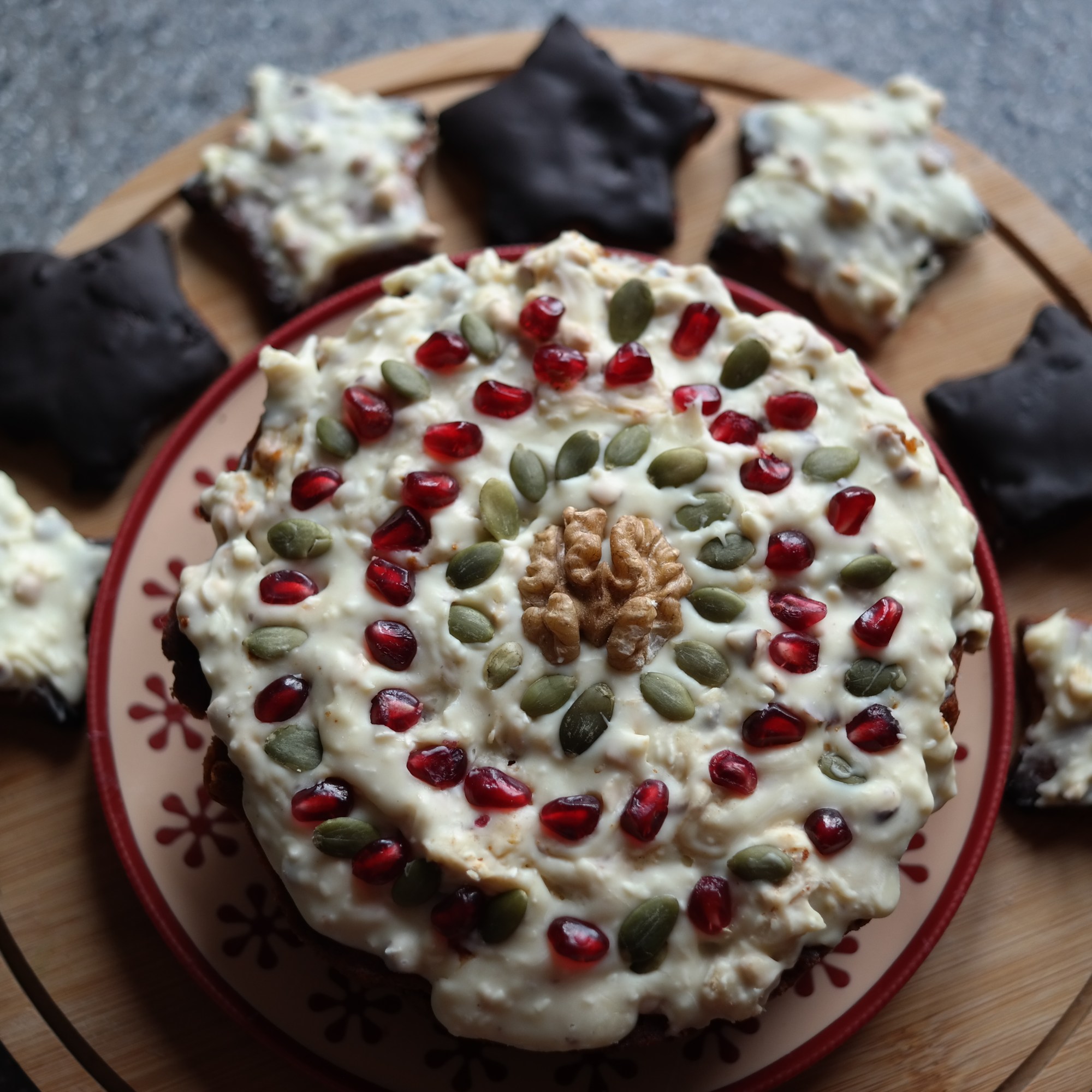
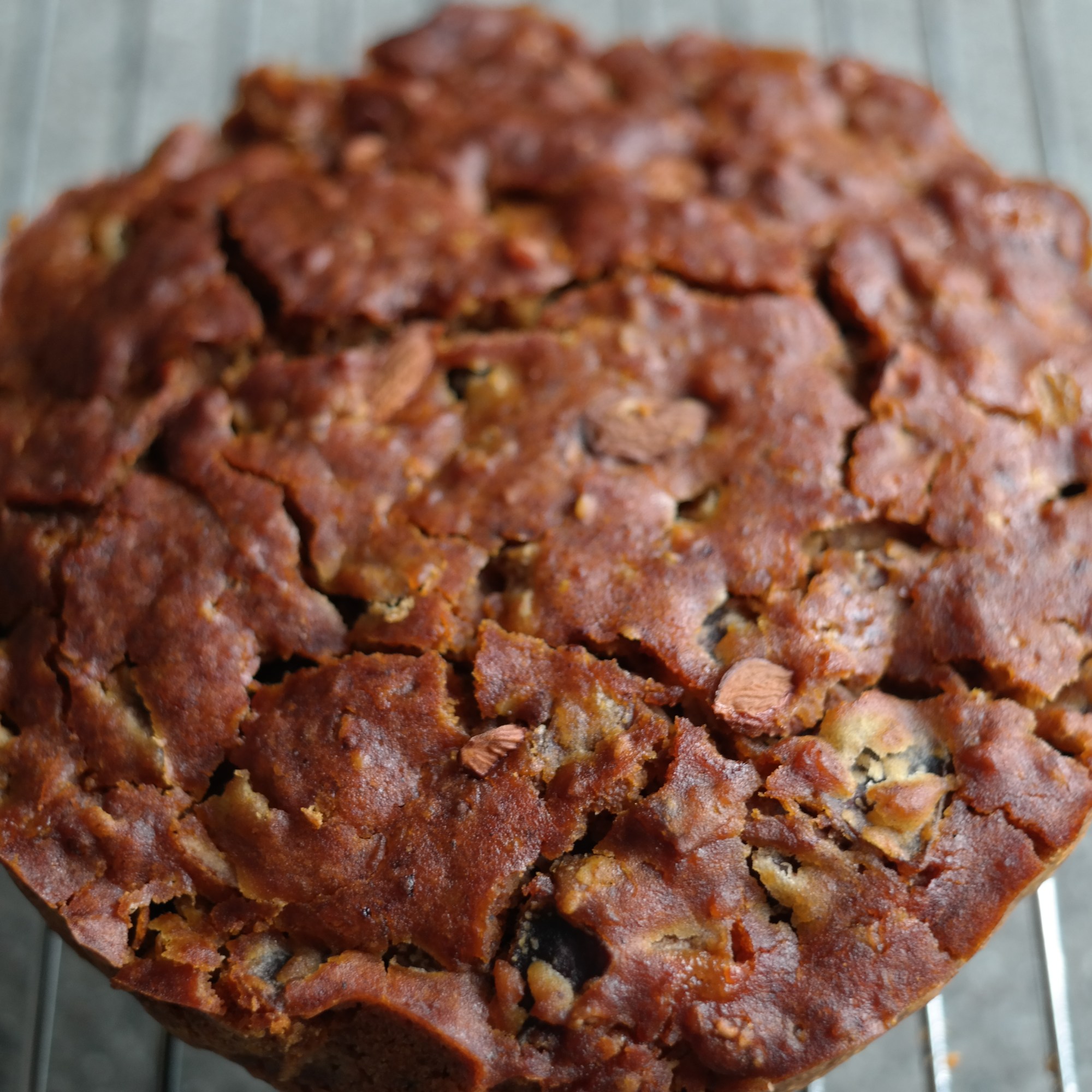
If you’re feeling down after all the partying in December, then never fear as Russian Christmas is here! To help celebrate it in style we’ve opened up our Vodkatopf (a slavic cousin of the Rumtopf) and used the fruit that’s been stewing in the vodka since summer to make a booze-infused fruitcake.

In Russia, Christmas is celebrated on 7 January – the Orthodox Church still follows the Julian calendar rather than the Gregorian calendar whereas Russia switched to the latter in 1917. The switch created a 13-day lag between the calendars so, for followers of the Orthodox faith, Christmas Eve falls on 6 January and 13 January marks the end of the old year

To make the vodkatopf we poured vodka over layers of different fruits as they appeared over the summer. The apricots, cherries and raspberries of early summer were followed by peaches and plums to make a great , fruity vodka for shooting or mixing. As an added bonus, the preserved fruit went into a the fruitcake mix. We decorated the cake with melted white chocolate and crushed almonds and used pumpkin and pomegranate seeds as the finishing touch.

Ingredients (for 6 – 8 servings)

  • 325 g vodka-soaked mixed fruit (soak overnight in 250 ml vodka or other spirit if using dried fruit)
  • 90 g olive oil
  • 100 g honey (or golden syrup for a vegan cake)
  • 175 g plain flour (we used rice flour for a gluten free cake) 
  • 50 g mixed nuts 
  • 100 ml coconut milk
  • 25 g desiccated coconut
  • One teaspoon baking powder
  • One teaspoon each of cloves, ginger, nutmeg and cinnamon
  • 25 ml vodka
  • 100 g melted white chocolate
  • pumpkin and pomegranate seeds to decorate the cake

Method

  • Line a 15cm cake tin with a double layer of parchment paper, this will help stop the cake from burning
  • Sieve the flour and combine with the coconut milk, vodka, 30 g of chopped nuts, desiccated coconut, baking powder, cloves, ginger, nutmeg and cinnamon and stir together to make a thick batter
  • Melt the honey into the olive oil in a heavy-bottomed pan over a low heat and stir.
  • Combine the honey and oil mix with the batter.
  • Stir in the soaked fruits into the batter, along with any leftover liquid.
  • Layer the batter into the prepared tin and use a spatula to spread it level. 
  • Melt the white chocolate in a glass or ceramic bowl over a pan of boiling water.
  • Spread the chocolate evenly over the top of the cake, sprinkle some mixed nuts over the icing and then decorate with pomegranate and pumpkin seeds.

Lockdown Lunch: Tbilisi Calling

26 March 2020

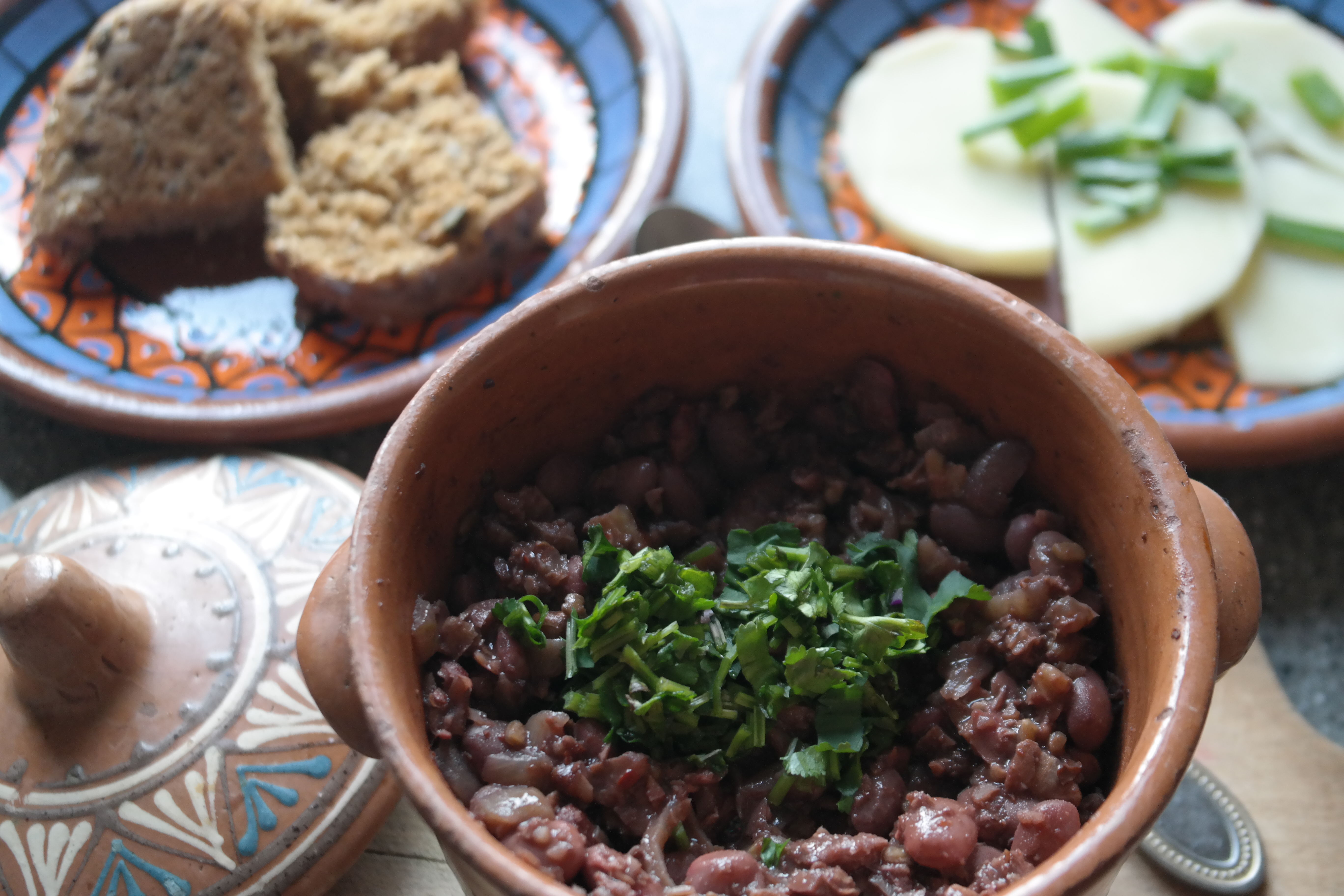
For this week’s lockdown lunch we had a root around the cupboards and came up with some dried red beans, last autumn’s walnuts and a bottle of Turkish pomegranate sauce (Nar Ekşili Sos) – perfect ingredients for taking us on a culinary away day to Tbilisi for a bowl of lobio, Georgia’s signature bean dish.

SAMSUNG CSC
Take a trip to Georgia with KCC’s Lobio lockdown lunch

Lobio can be more like a soup, a stew, a salad or even re-fried beans depending on which region of Georgia it’s prepared in – we’ve gone for lobio nigvzit which is somewhere between a soup and a stew. Serve the lobio in a clay pot with white cheese and a hunk of fresh mchadi (corn bread – recipe link here) or any other bread for an authentic taste of Georgia.

To help pass the time during lockdown, here’s something on the etymology of lobio from @thomas_wier on twitter:

Ingredients (makes four servings)

  • 500 g cooked red beans
  • 50 g walnuts
  • One medium onion
  • Two garlic cloves
  • One teaspoon coriander seeds
  • One teaspoon blue fenugreek (use fenugreek or cumin seeds if you can’t find this)
  • One teaspoon red chilli flakes
  • One small bunch fresh coriander
  • Three bay leaves
  • 50 ml cooking oil
  • 50 ml pomegranate sauce
  • 250 ml water the beans were cooked in or vegetable stock

Method 

  • If cooking dried beans, then soak 250 g of beans overnight. Change water and cook for one hour or so until the beans are just cooked but not yet falling apart. Remove from the heat and allow to cool.
  • Heat the oil in a heavy-based pan and add the coriander seeds and blue fenugreek. Cook for a few minutes and then add the diced onions, mashed garlic and chilli flakes. Cook for ten minutes over a low heat and then add the crushed walnuts and the pomegranate sauce. Cook for another five minutes.
  • Now add the drained beans, bay leaves and reserved cooking water. Leave to simmer until most of the liquid is absorbed. Stir frequently with a wooden spoon – don’t worry if the beans start to fall apart – they taste better like this and absorb more sauce.
  • Add the chopped fresh coriander and serve hot with bread and white cheese. It tastes even better if left overnight and reheated, but only add the fresh coriander after re-heating the mix.


KCC’s Nutty Festive Fare

22 December 2019

Seasoned greetings from Knidos Cookery Club – we’d just like to take this opportunity to thank all our readers, old and new, in 2019 and wish you a great holiday season and all the best for the New Year.

With the winter solstice, Hanukkah, Christmas and New Year all upon us, we’d like to share this nutty lentil bake recipe with you. It makes a great centrepiece for a festive feast.

We served it with roast potatoes, charred cauliflower and smashed pumpkin and then poured a rich pomegranate sauce over everything.

Ingredients (for 6 servings)

  • 150 g green lentils
  • One carrot
  • One medium-sized onion
  • One stick of celery
  • 75 g walnuts
  • 75 g coarse bulgur
  • Two tablespoons tomato paste
  • Two teaspoons cumin seeds
  • One teaspoon coriander seeds
  • One teaspoon chilli powder
  • Half a teaspoon cloves
  • 50 ml olive oil
  • 250 ml vegetable stock
  • 25 g chickpea flour
  • Pomegranate seeds

Method

  • Cook the lentils in the vegetable stock until most of the liquid has been soaked up. The lentils should still be firm, not mushy. Stir in the bulgur and leave to stand for 30 minutes.
  • Heat the olive oil in a heavy based pan and add the spices. Cook for a few minutes and then add the chopped onions, grated carrot and thin slices of celery and cook for 10 minutes, stirring regularly.
  • Combine the vegetable mix with the lentils. Stir in the tomaro paste. Toast the chopped walnuts for 5 minutes then add to the lentil mix. Finally add the chickpea flour to thicken the mix.
  • Pack the mix into a greased baking dish and cook for 30 minutes in an oven pre-heated to 180 c. Garnish with pomegranate seeds and then cut the loaf into 6 slices and serve.

Chiving around with Jusai

17 May 2018

This time round on Knidos Cookery Club, we’ll be cooking with jusai, one of the few leafy greens to make it past the strict controls of Kazakhstan’s carnivore police.

screen-shot-2018-05-16-at-16-45-35.png
Jusai in bloom

The fare in Kazakhstan is a salad-dodger’s delight – it’s very meat heavy with potatoes or carrots only occasionally making an appearance – Kazakhs like to joke that they are second only to wolves in their meat consumption, so jusai is a welcome addition to this diet.

Jusai’s official name is allium tuberosum, and it’s a member of the onion family – you might know it as Chinese chives or garlic chives in English. Jusai originated in China but it’s now grown all over Kazakhstan. It imparts a mild garlic flavour to dishes and is used as a filling for pasties and dumplings in Kazakh kitchens.

20180513_230804
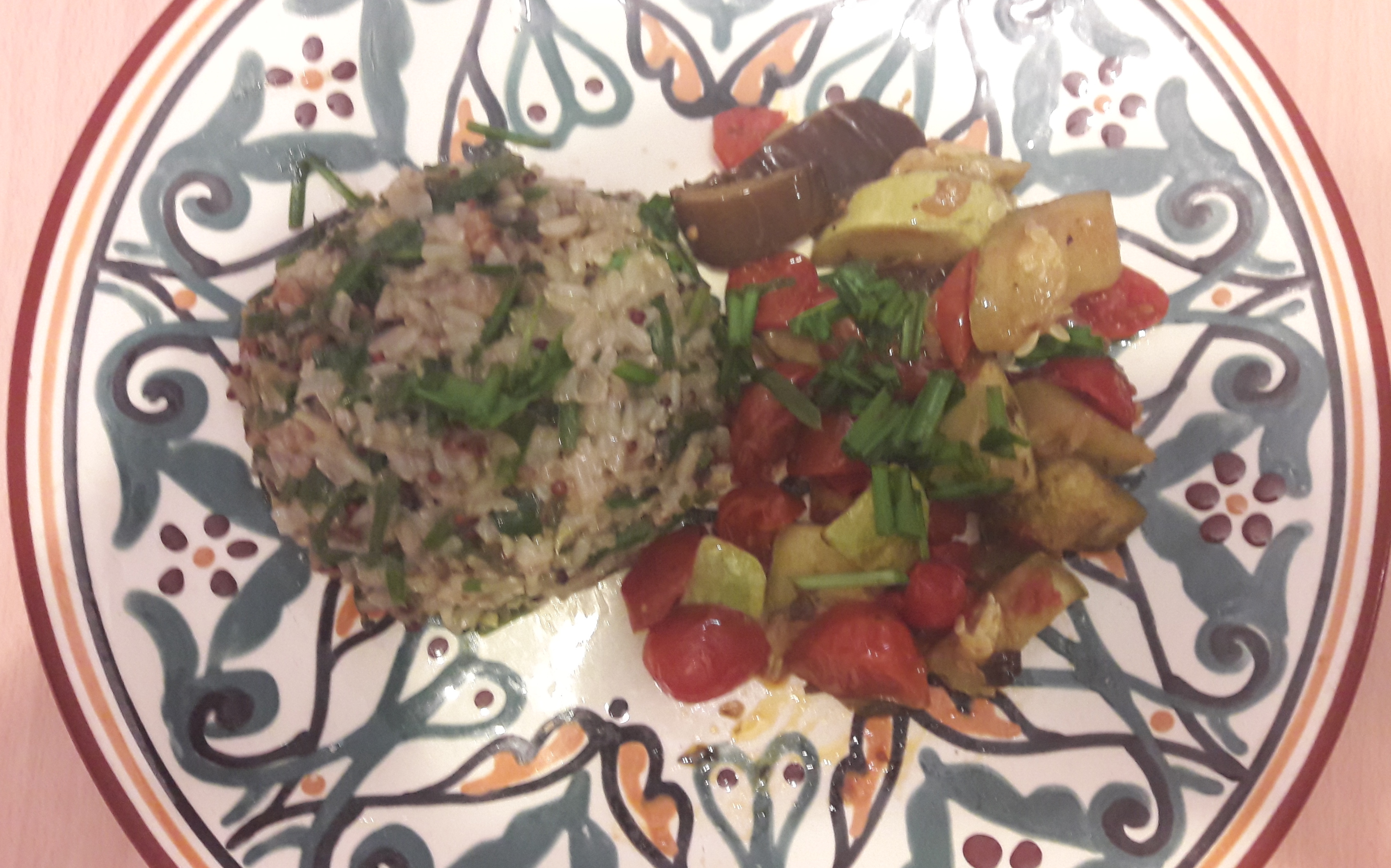
Brown rice pilau with jusai, lemon and walnuts

We decided to cook it up in some cider with some brown rice, onion, lemon and walnuts to make a pilau, or a loose take on risotto. It pairs well with some oven-baked seasonal vegetables or a seasonal salad.

Ingredients (serves 3-4)

  • 300 g brown rice
  • 50 ml olive oil
  • one medium-sized onion
  • one lemon
  • 100 g toasted walnuts
  • 200 g garlic chives
  • 250 ml dry cider
  • 750 ml vegetable stock
  • one teaspoon mustard seeds
  • one teaspoon cumin seeds

Method

  • Heat the oil in a heavy-based pan and add the mustard seeds – when the seeds start to pop, put the finely diced onion in and fry for five minutes over a medium heat. Add the cumin seeds and stir well and then add the rice, stirring for a minute to coat the grains with oil.
  • Reduce the heat and pour in the cider, stirring occasionally as the mix simmers so the rice doesn’t stick to the pan. When the liquid is absorbed, add 250 ml stock and continue to simmer and stir every now and then. Add more stock when this is absorbed and keep going until the rice is almost cooked.  Add more stock if needed – the rice should be al-dente.
  • Remove for the heat and mix in the finely chopped garlic chives (leave some to garnish the pilau), the lemon zest, toasted, chopped walnuts and the lemon juice and mix well. Cover the pan and leave to stand for five minutes.
  • Serve with oven-roasted vegetables or a leafy green salad and garnish with the remaining garlic chives.