Bulgur Biryani

15 November 2024

Turkey meets India this time round on KCC as we cook Turkey’s beloved bulgur wheat in in Indian biryani style. Bulgur, parboiled, dried and cracked wheat, is a quick-cooking alternative to rice that works really when combined with spicy vegetables.

Bulgur biryani

Biryani belongs to the family of layered rice dishes that includes Uzbekistan’s plov and other pilafs. The name is from the Persian barian, which translates as ‘roasted’.

The dish was originally brought to the Indian sub-continent by travellers from Iran and has developed into a number of regional variations, with the Hyderabadi one, served with a yoghurty raitha, being the most famous.

As bulgur is parboiled, it cooks really quickly. It takes around 15 – 20 minutes to cook – the total prep time for this dish is less than an hour from start to finish and it is cooked in one-pan, so less washing up to worry about.

Ingredients (for two servings)

  • 100g coarse bulgur
  • 100g diced carrot
  • 100 g courgette
  • 150 g cooked chickpeas
  • 25 g tomato paste
  • 25 g pepper paste (we used tatli (sweet), if you want it hot, use acili)
  • 20 ml olive oil
  • 1 stick of celery (approx 25 g)
  • 2 spring onions (approx 10 g)
  • 1 green pepper (approx 30 g)
  • 250 ml vegetable stock
  • 1 cinnamon stick
  • 1 teaspoon each of mustard seeds, cumin seeds, turmeric, fenugreek, chilli powder
  • 25 g fresh coriander

Method

  • Heat the oil in a large frying pan and add the mustard seeds. When they start to pop, add the chopped spring onion and celery and cook for two minutes. Then add the chopped green pepper and diced carrot and cook for two more minutes. Add the courgettes and cook for another two minutes.
  • Add the spices and stir well and then add the cooked chick peas and the vegetable stock. Stir in the tomato and pepper paste, bring to a boil and then reduce the heat to a gentle simmer. Add the bulgur in a layer over the veggies. Put a lid on the pan and cook over a low heat for 15 – 20 minutes until all the liquid is absorbed.
  • Turn off the heat and allow the mix to rest for ten minutes or so. Stir well and then serve. Garnish with chopped coriander.

Winter Warmer: Cauliflower, Spinach and Tahini Soup

15 February 2024

It’s been a crazy winter here in Almaty, Kazakhstan. It didn’t really get going until after New Year and has seen short cold snaps interspersed with rapid thaws as the temperature creeps into positive territory. This has made it particularly dicey when walking by buildings, as chunks of ice have a tendency to fall from roofs as the temperature rises. Usually, this is a once in a winter event, but this year it seems to be every few days.

A tahini-infused cauliflower and spinach soup

We’ve been getting through a lot of tahini recently, using it as a salad dressing, a pasta/noodle sauce, in variations on hummus, and, in this case, as an earthy, nutty base for a thick soup – he intermittent cold snaps call for a comforting bowl of hearty, seasonal goodness.

Crazy Almaty weather for 15 Feb 2024 onwards

Tahini is easy to make if you can’t find it in your local Middle eastern store – you just need some white sesame seeds, some olive oil and a good blender. Here’s a link to our tahini recipe from a few years ago.

Ingredients (serves 3-4)

  • 500 g cauliflower
  • 150 g spinach
  • 100 g celery
  • 5 g fresh coriander
  • 500 ml vegetable stock
  • 50 ml tahini
  • 25 ml olive oil
  • one teaspoon soy sauce
  • one teaspoon caraway seeds
  • one teaspoon dried oregano

Method

  • Heat the olive oil and then fry the chopped celery and caraway seeds in a large pan. Cook over a medium heat for five minutes and then add the cauliflower, broken into small florets, and the oregano. Stir fry over a medium heat for five minutes and then add the vegetable stock. Bring to a boil and simmer for ten minutes.
  • Put half the soup in a blender, add the soy sauce and tahini and blend until smooth. Add to the other soup in the pan, stir well and add the spinach leaves and cook until the spinach wilts. Garnish with chopped coriander and serve piping hot.

Bean and Beetroot Shakshuka

14 September 2023

This time round on KCC. we’re experimenting with a tomato-free twist on shakshuka, that North African breakfast staple.

Rip Red Shakshuka with beans and beetroot

Our latest shakshuka (click here for our grip green one from last year), replaces tomatoes and onions, which have a high acid content, with beetroot and red beans as the base to poach the eggs in.

This makes for a dish that is easier on the stomach and is ideal for people suffering from GERD, Gastroesophageal reflux disease, which occurs when excess stomach acid flows back into the tube connecting your mouth and stomach.

Ingredients

  • 150 g cooked red beans
  • 100 g diced cooked beetroot
  • 25 g celery
  • 150 ml vegetable stock
  • A pinch of fresh thyme 
  • 2 teaspoons sumac
  • 2 eggs

Mix the beetroot, red beans, celery, carrot and thyme together in a frying pan and add the vegetable stock. Bring to a boil and then reduce the heat so the mixture is simmering.

Cook for five minutes and then make two wells in the mix and break the eggs into these wells. Cover the pan and cook over a low heat for 4-5 minutes until the eggs are set. Sprinkle with sumac and serve with crusty bread or fresh pitas.

Rocket-Fuelled Cherry, Chickpea, Feta and Walnut Salad

9 June 2023

If you’re a purist who believes that fruits have no business being in salads, then this is not the place for you. At KCC we have no such qualms about mixing vegetables and fruits. In the past we’ve featured a salad with raspberries, one with grilled peaches and another with watermelon, to name a few. As long as something salty, like feta or halloumi cheese, is included to counterbalance the sweetness, then adding fruit to to your salad is fine in our book.

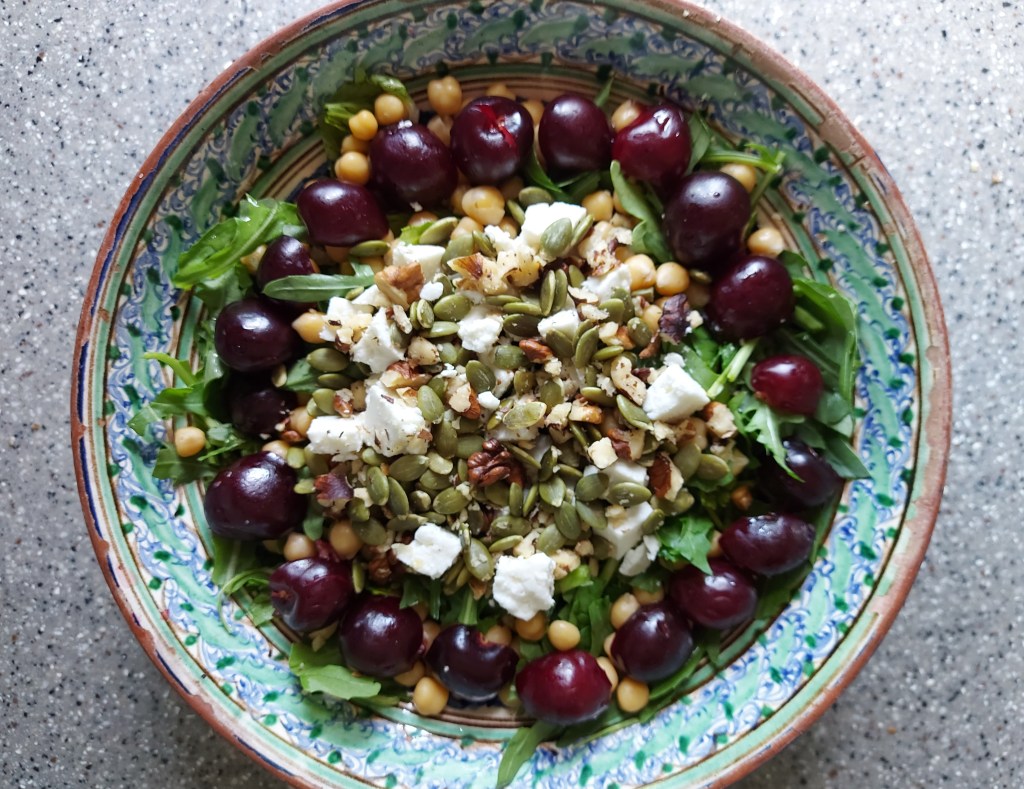
A rocket-fuelled cherry, chickpea, feta and walnut salad

Cherries are at their peak at this time of the year. Whatever variety you can get your hands on – sweet or sour, both work fine in this salad. Prepare a bed of rocket and celery, top with chickpeas, pumpkin seeds, walnuts and feta, arrange the cherries around the edge and dress with pomegranate sauce and olive oil to make a balanced meeting of sweet and sour in this early summer special.

Cherries growing in Almaty’s urban jungle

Ingredients (serves 4)

  • 200 g cooked chickpeas
  • 150 g rocket leaves
  • 100 g crumbled feta cheese
  • 50 g celery
  • 20 cherries, halved and de-stoned
  • 40 g walnuts, lightly toasted
  • 40 g pumpkin seeds
  • 25 ml olive oil
  • 25 ml pomegranate sauce

Mooli Mattar Mücver

10 February 2023

This time round on KCC we’re taking a look at mooli, or daikon as some of you might know it. This large, white member of the radish family is common in Japanese, Korean and Chinese cuisine and is also widely used in the Indian sub-continent. It’s a versatile, vitamin-packed vegetable that can be eaten raw or cooked in a variety of dishes. It has a milder flavour than its smaller red cousins but adds an interesting, mildly spicy crunch to salads and stir fries.

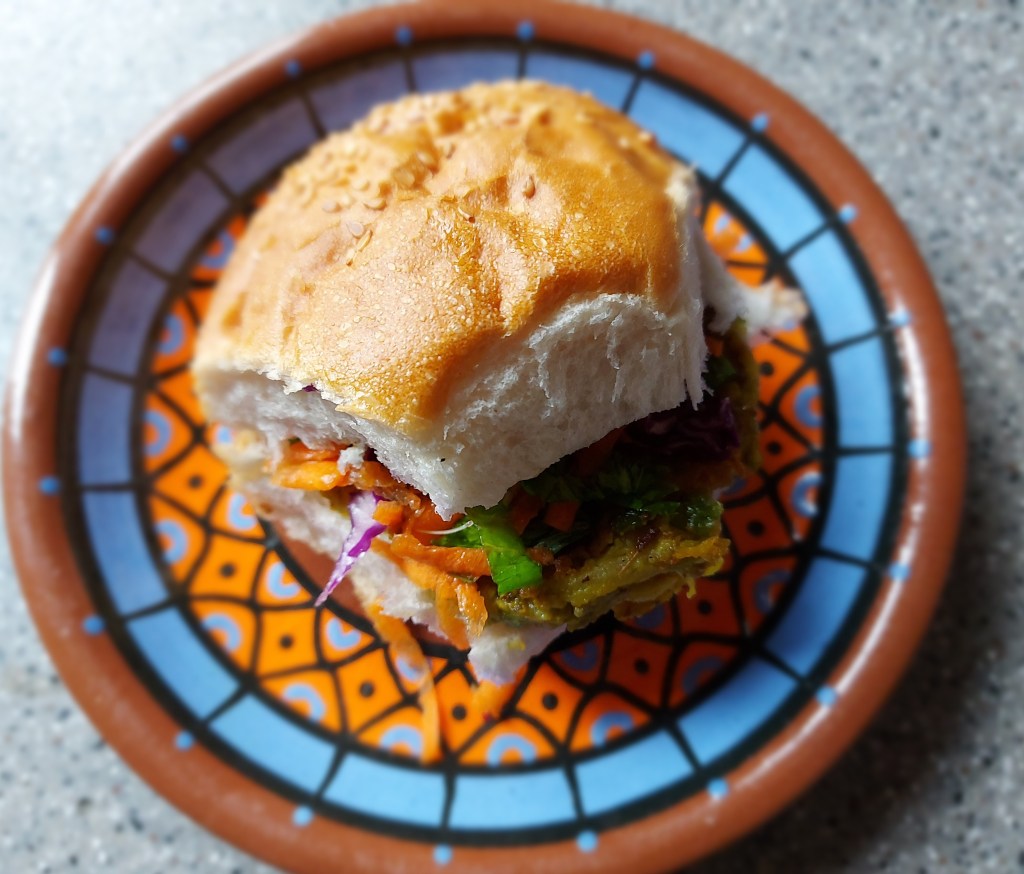
Mooli mattar mücver served in a bap with salad

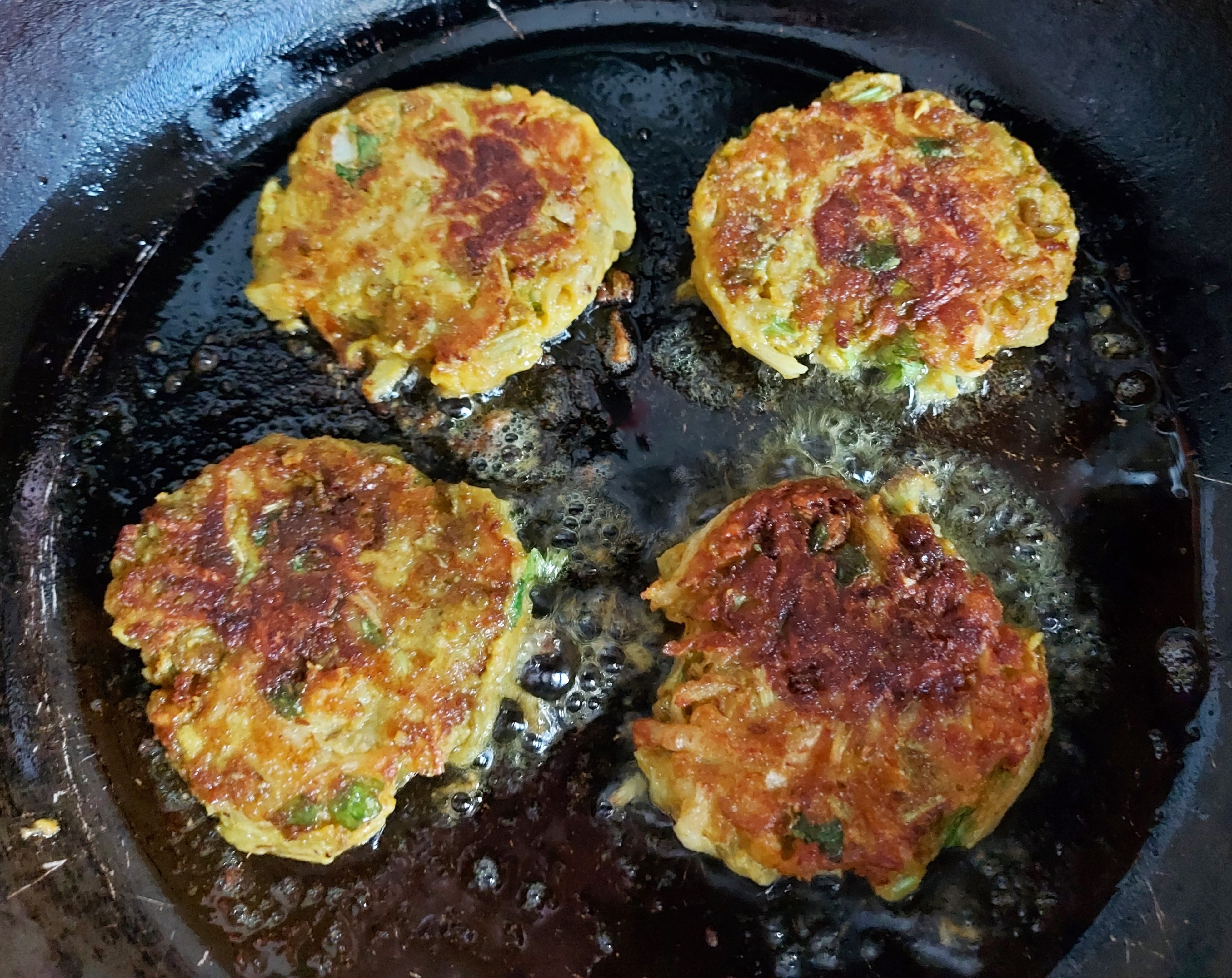
Mücver fritters are a perennial KCC favourite so we decided to make some with grated mooli, mattar (green peas), celery and some chickpea flour to glue it all together for our latest mücver variation. This version is great served in a burger bun or baguette with some fresh coleslaw, shredded salad greens and a dash of soy sauce.


Meet the mooli aka daikon or winter radish

The mooli can be quite wet when grated so give it a good squeeze to remove the excess liquid. The chickpea flour will help bind the fritters together and soak up any remaining moisture so that they hold their shape better when frying.

Ingredients (makes four 125 g fritters)

  • 200 g grated mooli
  • 200 g green peas (fresh, tinned or frozen)
  • 1 celery stick 
  • 50 g chickpea or pea flour
  • One teaspoon cumin seeds
  • One teaspoon turmeric
  • Two teaspoons paprika
  • Oil for frying

Method

  • Peel and grate the mooli into thin strips. Squeeze the moisture from the grated mooli. Chop the celery stalk and leaves finely and  put into a bowl with the grated mooli. Add the peas and the spices and mix well. Now add the chickpea flour and blend everything together. The mix should be sticky but not wet – if it’s too moist, then add a bit more flour until you get a sticky consistency. 
  • Heat the oil in a frying pan. Form the mix into four golf ball-sized pieces. Place in the pan and flatten with a fish slice. Turn the fritters over after frying for two to three minutes. Cook for another two to three minutes until both sides are a golden brown colour. Serve in a burger bun or in a baguette. Top with grated carrot and red cabbage and shredded lettuce or rocket, add a splash of soy sauce and enjoy!

Pumpkin-topped Beany Bake a.k.a. Halloweenish Shepherd’s Pie

28 October 2022

Here in the northern hemisphere we’re moving into the “darker half” of the year with the nights growing longer and the mercury dropping rapidly. Halloween is just around the corner so it’s that pumpkin time once again. Here at KCC we’re always looking cut down food waste so this year we’ve got another idea of how to use up your excess squash – a vegan variant on Shepherd’s pie.

Pumpkin-topped Beany Bake a.k.a. Halloweenish Shepherd’s Pie

Halloween has its origins in the Celtic pagan festival of Samhain that marked the end of the harvest period and the onset on the dark months of winter. It was an excuse for a wild party with feasting and drinking at a time when the boundary between our world and the spiritual world was held to be at its thinnest. 

Halloween, which is the evening before All Saints’ Day, 1 November, in the Christian calendar, is still the time when many remember the souls of the dead. Many Halloween traditions in North America were influenced by Irish and Scottish immigrants, harking back to the festival’s pagan roots.

The pumpkin, the round, oversized orange vegetable, native to the New World, has become a symbol of the festival. This has led to millions of pumpkins going to waste so here’s a reminder of some more of our pumpkin recipes to try and reduce the scale of this problem.

Ingredients (serves four)

  • 500 g pumpkin
  • One medium onion
  • One stick of celery
  • One medium carrot
  • One medium green pepper
  • One medium courgette
  • Two medium tomatoes
  • One tablespoon tomato paste (or Turkish hot pepper paste if you can find it)
  • 300 g cooked beans (cannellini or kidney beans 0r a mix of the two)
  • 75 g red lentils
  • 200 ml  vegetable stock
  • 50 ml olive oil
  • One teaspoon chilli flakes
  • One teaspoon turmeric 

Method

  • Clean the pumpkin by removing the hard outer skin and the seeds (if there are any) and then chop into small cubes, put into a baking dish and drizzle with olive oil and mix well. Roast in a pre-heated oven at 180 c for 30 minutes, stirring occasionally.
  • While the pumpkin is roasting, heat the oil in a heavy-based pan and then cook the finely chopped onion over a medium heat for five minutes.  Add the diced celery, green pepper and carrots and cook for another five minutes.
  • Mix in the cooked beans, vegetable stock and tomato paste, chilli flakes and turmeric and stir well. When it boils, add the lentils, stir and then cook for 20 minutes or so until all the liquid is absorbed. While this is cooking, top and tail the courgettes and cut into 1cm thick rounds. Thinly slice the tomato.
  • Remove the pumpkin and mash with a fork or a potato masher. Put the bean mixture into the bottom of the baking dish and cover with courgette rounds. Cover the courgette with tomato slices and then pack the mashed pumpkin on top of the tomatoes. Decorate with pumpkin seeds and bake at 180 c for 30 minutes or until the top of the pie begins to char.


Apricot and Lentil Courgette Roundels

13 October 2022

It’s that in-between time of year as the nights grow longer and thoughts turn towards more substantial meals after a long summer of salads and lighter fare. The last of the seasonal vegetables such as tomatoes and courgettes are perfect for stuffing and baking in the oven, making a bridge between summery salads and the heartier soups and stews of winter that are coming up.

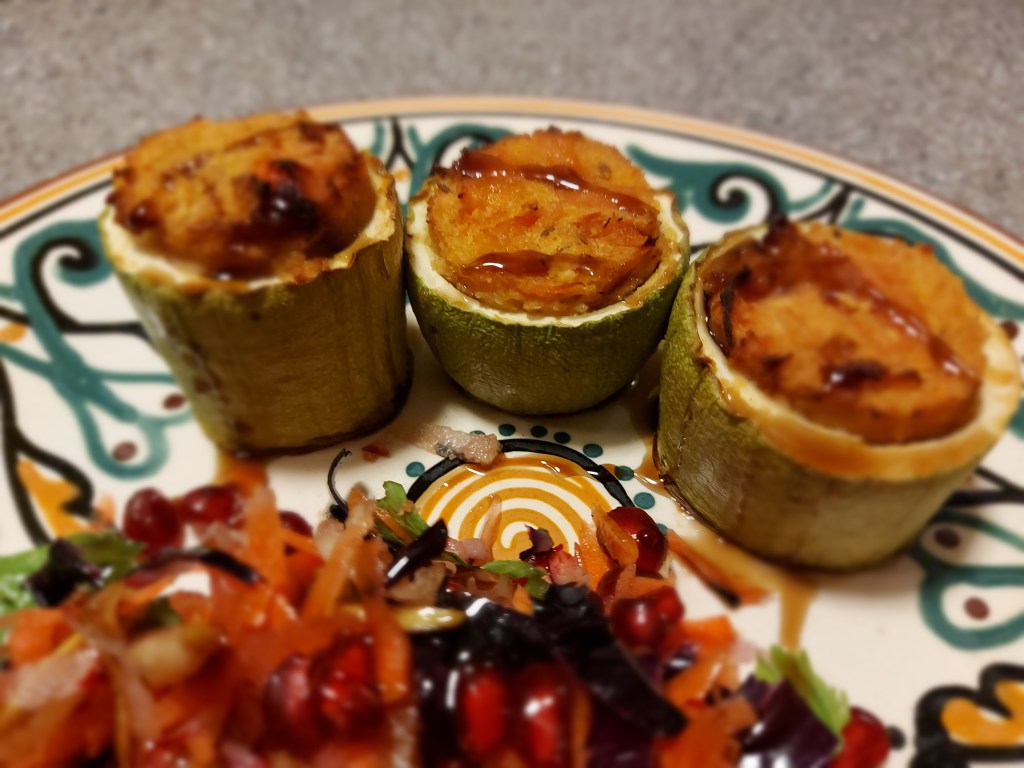
Apricot and lentil courgette roundels drizzled with pomegranate sauce and served with a seasonal salad

We stuffed some courgettes with a mixture of red lentils, apricots, tomato, onion, bulgur wheat and lemon juice to make a versatile roundel that can be served as part of a main course or eaten on its own as a meze, a fully vegan alternative to the sausage roll!

Apricot and lentil courgette roundel – a vegan alternative to the sausage roll?

The autumn fruit is at its best at the moment, and we’ve added some pear and pomegranate to an autumnal red cabbage, carrot, celery and radish salad to accompany these apricot and lentil courgette roundels to make a great lunch or supper. By adding a jacket potato, you can make it into a more filling main course.

Ingredients (makes enough mixture for 10-12 roundels)

  • Three medium sized courgettes
  • 100 g red lentils
  • 50 g dried apricots (or four fresh apricots if available)
  • One small red onion (approx 75 g)
  • One medium tomato (approx 100 g)
  • 50 g fine bulgur wheat
  • 25 ml olive oil
  • 200 ml vegetable stock
  • Juice of half a lemon
  • One teaspoon cumin seeds
  • One teaspoon red chilli flakes
  • Black pepper to taste

Method

  • Cut the dried apricots into eight pieces and soak in hot water for at least 30 minutes. While the apricots are soaking, heat the oil in a heavy based pan and add the cumin seeds. When they start to sizzle, add the finely chopped onion and fry over a medium heat until they start to soften. Grate the tomato into the fried onion and cook over a low heat for five minutes or so, stirring occasionally.
  • Now add the washed lentils, pour in the stock and stir. Cook over a low heat for 15-20 minutes until most of the water has been absorbed. Add the fine bulgur wheat, mix it in well and leave covered for 15 minutes. Drain the apricots and stir them into the mixture. Add the lemon juice, chilli flakes and black pepper to taste and mix well.
  • While the lentils are cooking, start to prepare the courgettes by slicing off the ends to make them flat. Cut into 3 cm slices. Gouge out the seeds with a small spoon, leaving a little bit of flesh at the bottom of the roundel.
  • Pre-heat the oven to 180 c. When the lentil mix is cool, pack it into the courgette roundels and stand them on a baking tray with the filling topmost. Bake at 180 c for 30 minutes or so – the courgette should still be firm and not too squidgy and the lentil mix should rise slightly and be beginning to brown on top. 
  • Serve alongside a salad of red cabbage, carrot, celery, radish, pear and pomegranate and a jacket potato, drizzling pomegranate sauce over the roundels or allow to cool and serve the roundels as a snack on their own.

Green Bean Funchoza Supreme

17 June 2022

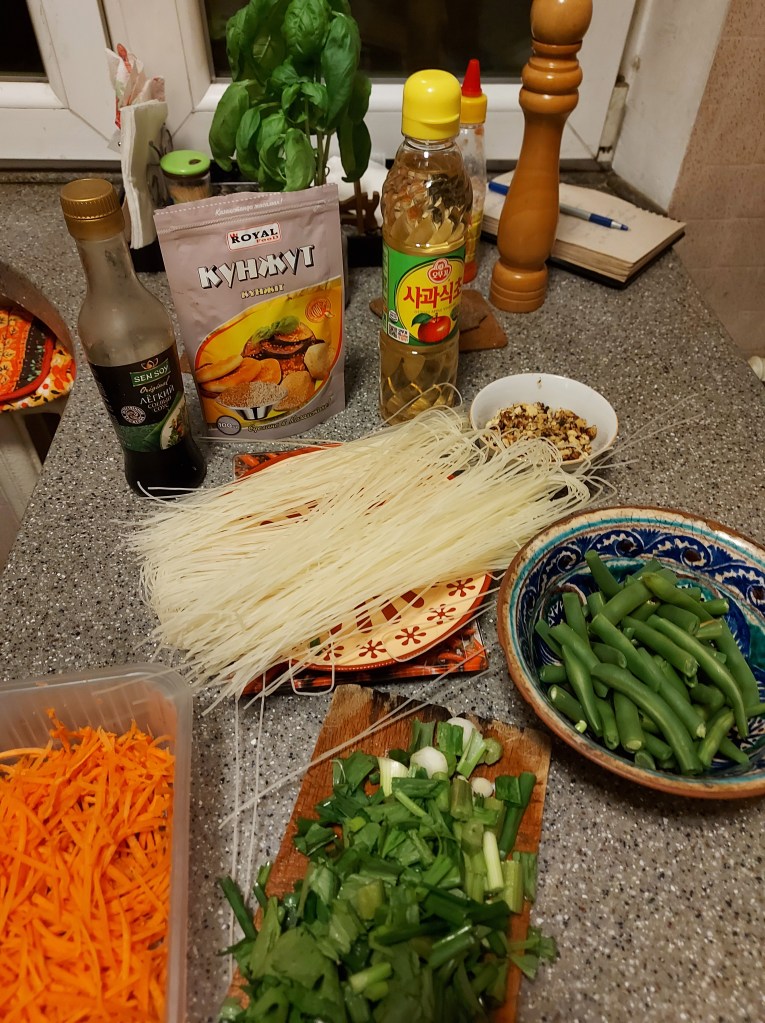
Continuing with our summery vibe, the year’s first green bean crops are appearing. Green beans are great for adding a bit of crunch to a stir fry or a salad, we’ve gone for the best of both worlds by mixing our green beans in with celery, carrots, spring onions and walnuts on a bed of funchoza (vermicelli) noodles, liberally dressed with soy sauce, apple vinegar and sesame seeds.

This recipe lends itself to the pictorial treatment – see below for the steps needed to assemble this summery salad. Also check out our reel on Instagram as well with an orangey red, green and gold inspired Black Uhuru backing track.

Move Over Risotto, Here Comes Broccoli Orzotto!

23 September 2021

This time round on KCC we’re cooking up orzotto – the barley-based cousin of risotto. The name is taken from orzo, the Italian for barley with the ‘otto’ coming from the rice-fuelled risotto. There’s also a rice-shaped pasta called orzo, but for this recipe you’ll need pearl barley, not the pasta.

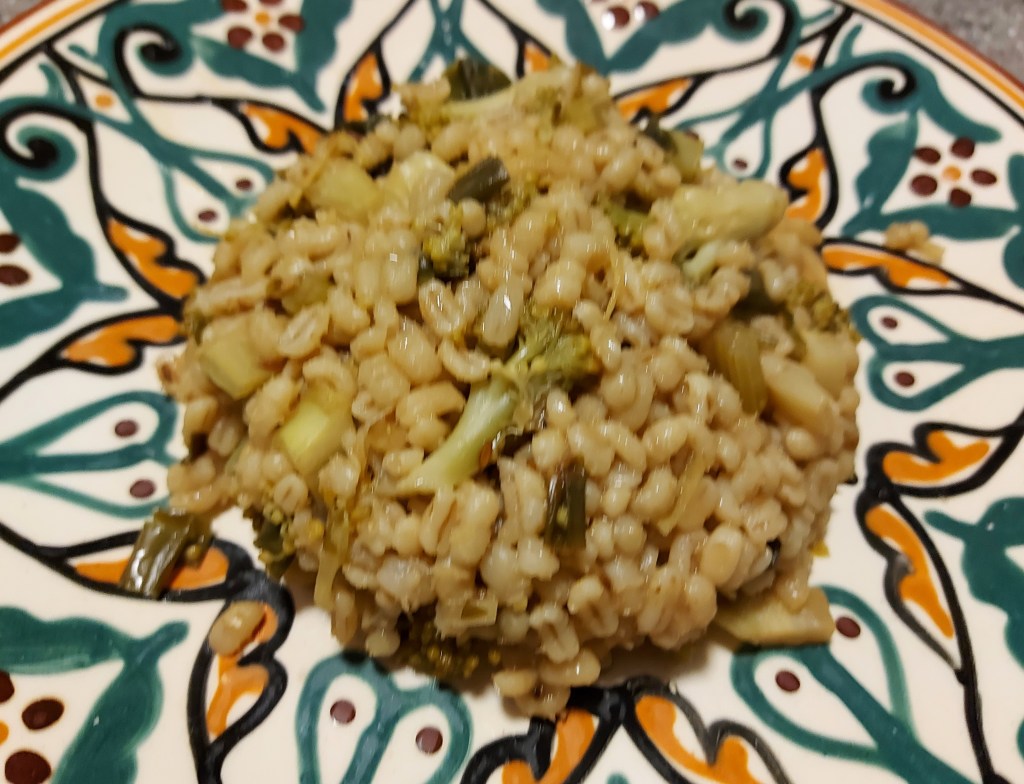
Broccoli Orzotto

Barley, a hardy crop that can be grown in challenging environments, was one of the first cereal crops to be cultivated around 10,000 years ago in the grasslands where Asia and Europe meet – modern day Central Asia, from where it spread into neighbouring areas and became a staple part of the diet.

Pearl barley is a grain that has been processed to remove the hull and some of the bran – this makes it easier to cook. It cooks in roughly the same time as rice, especially if you soak it for a few hours beforehand – you can kill two birds with one stone with our recipe for lemon barley water which can be drunk on its own or in cocktails.

We made our orzotto with broccoli and celery but you can substitute any vegetables you have to hand – mushrooms work well in this recipe, as do courgettes.

Ingredients (makes 4 servings)

  • 200 g pearl barley
  • 300 g broccoli
  • One medium-sized onion
  • One stick of celery
  • 50 ml olive oil
  • Two teaspoons cumin seeds
  • 500 ml vegetable stock
  • 125 ml dry white wine

Method

  • Soak the barley for a few hours in cold water – this will make it cook more quickly. Heat the oil in a heavy-based pan on a low heat.  Add the cumin seeds and when they begin to pop add the diced onion and celery and cook for five minutes. Break the broccoli into small florets and finely chop the stem and then add to the pan. Cook for another five minutes, stirring occasionally.
  • Add the soaked barley and stir well to coat the individual grains. Pour on the white wine and stir occasionally. When the wine has been absorbed, add 125 ml of vegetable stock and when that is absorbed keep adding liquid until the barley is tender – you might not need to use all the stock. It will take about 30 minutes to cook the orzotto. Serve immediately with a green salad.

Lashings of Laghman as KCC Turns 5

31 March 2021

Today we’re celebrating KCC’s 5th anniversary with a hearty plate of laghman, hand-pulled wheat noodles, one of Central Asia’s favourite dishes. These thick, chewy noodles are often served with a rich, spicy sauce but we decided to make a drier version with spring greens and chickpeas.

We can’t believe that it’s been five years since we started our culinary journey in Datça, Turkey. KCC’s first recipe was this asparagus risotto, inspired by the fresh produce on sale in the town’s weekly market.

Over the last five years, we’ve branched out from Turkey and sought out dishes from around the globe with gastronomic excursions to Greece, Georgia, Russia, Albania, Italy, India, Sri Lanka, Central Asia and Mexico among others.

Since the start of the pandemic KCC has been confined to Almaty, Kazakhstan, so we’ve been trying out new recipes based on locally sourced ingredients which brought us to laghman.

When it came to making this dish we cheated a bit – Gulzada, our local greengrocer, now offers home made noodles along with whatever fruit and vegetables are in season.

If your local grocer doesn’t stock noodles and you have the time to pull your own noodles, then check out this recipe to make the key ingredient for your laghman.

Ingredients (for 3-4 servings)

  • 150 g noodles per person
  • 200 g mixed greens – we used cauliflower and radish leaves but you can use anything you have handy
  • 200 g leek
  • 50 g garlic chives (jusai)
  • 50 g celery
  • 350 g cooked chickpeas
  • 100 ml chickpea cooking water (aquafaba)
  • One teaspoon cumin seeds
  • One teaspoon red chilli flakes
  • 50 ml olive oil

Method

  • Heat the olive oil in a heavy-based pan and add the cumin seeds. Wash the leek thoroughly and then chop in half lengthways and then cut into 1 cm slices. Use as much of the leek as you can including the leafy green bits. When the cumin seeds begin to pop, reduce the heat to a low setting and add the leek to the pan and stir fry for five minutes.
  • Add the red chilli flakes, celery, garlic chives and chopped radish and cauliflower leaves to the leek and cook until the the leaves start to wilt. Stir in the chickpeas and the aquafaba and cook until most of the liquid is absorbed and you have a fairly thick sauce.
  • Bring a large pan of water to the boil. Put the noodles in the pan and leave for 2-3 minutes to warm them through. Arrange on a plate and pour the sauce on top and serve.