Leeky Pastitsio

5 April 2018

We’re back and, with Orthodox Easter just around the corner, this time round on Knidos Cookery Club we’ll be making our own version of pastitsio, a Greek take on Italy’s lasagne. Our version comes with a red wine, tomato and lentil ragu and a leek infused béchamel sauce.

leeky pastitsio
KCC’s Leeky Pastitsio

A few weeks ago, I left some beans soaking overnight and when I checked them in morning the pan was mysteriously filled with soaked penne rigate pasta! A quick look online to determine if the pasta was usable led me to this post on the Ideas in Food blog, and this confirmed pre-soaking in cold water as an effective way of preparing dried pasta.

20180402_204515
Leeky pastitsio and salad

Pastitsio is one of those dishes that tastes great straight from the oven but improves with age as the cinnamon, nutmeg and other flavours have time to blend properly. It works well heated up the next day or even tastes good cold. We served ours with a crisp salad of rocket leaves, carrot. radish and tomato.

Ingredients (For 3-4 hearty servings)

200 g penne rigate pasta

For the ragu:

25 ml olive oil

4 spring onions

200 g cherry tomatoes

2 tablespoons tomato paste

100 g red lentils

175 ml red wine

1 teaspoon of cinnamon, cumin, black pepper and red chilli flakes

For the Béchamel sauce:

50 ml olive oil

250 g leek

3 tablespoons flour

400 ml milk (dairy or non-dairy)

60 g cheese (dairy or non-dairy)

One teaspoon of nutmeg

Method

Soak the pasta in a pan of cold water for two hours and while it’s soaking cook the red lentils in 200 ml water until mushy and all the liquid is absorbed. Then prepare the ragu and after that the béchamel sauce.

For the ragu, heat the oil in a heavy-based pan and then fry the chopped spring onions for a few minutes. Add the quartered cherry tomatoes, tomato paste and spices and mix well. Add the wine and when it starts to bubble add the cooked and drained lentils. Cook for ten minutes over a low heat.

For the béchamel sauce, heat the oil in a heavy-based pan and then add the sliced leeks and cook for five minutes over a medium heat. Add the flour and mix well and then ad  the milk slowly, stirring continuously with a wooden spoon. Add half the grated cheese and nutmeg and cook until the sauce is just starting to boil, stirring all the while.

Layer half the soaked penne in the bottom of an oven proof dish and pour the ragu over. then layer the rest of the pasta on top of this and pout the béchamel sauce over. Add the remainder of the grated cheese and bake in a pre-heated oven at 200c for thirty minutes.

Serve straight away with a green salad or let it sit overnight in the fridge for a tastier pastitsio that can be served hot or cold.

Korea’s All-Conquering Carrots

15 February 2018

Happy Lunar New Year to all our readers – wishing you all many culinary adventures in the Year of the Dog!

With both South and North Korea back in the headlines with the Winter Olympics in full swing in Pyeongchang and the ongoing tensions on the Korean peninsula, this week Knidos Cookery Club will be making a dish that has become a hit in the former Soviet Union and beyond – spicy Korean carrots.

20180209_122129
Spicy Korean Carrots

It’s a dish that’s not really from Korea, north or south – largely unknown outside of the countries of the former Soviet Union until recently, this simple dish has now gone full circle and can now be found on tables in South Korea.

It originated with the Koryo-saram, Korean people, who were deported en masse from the borderlands of Russia’s far east to Central Asia in the late 1930s. Fearing a Japanese fifth column in the Soviet Union via this Korean community, Stalin ordered the mass deportations in 1937.

20171117_170001
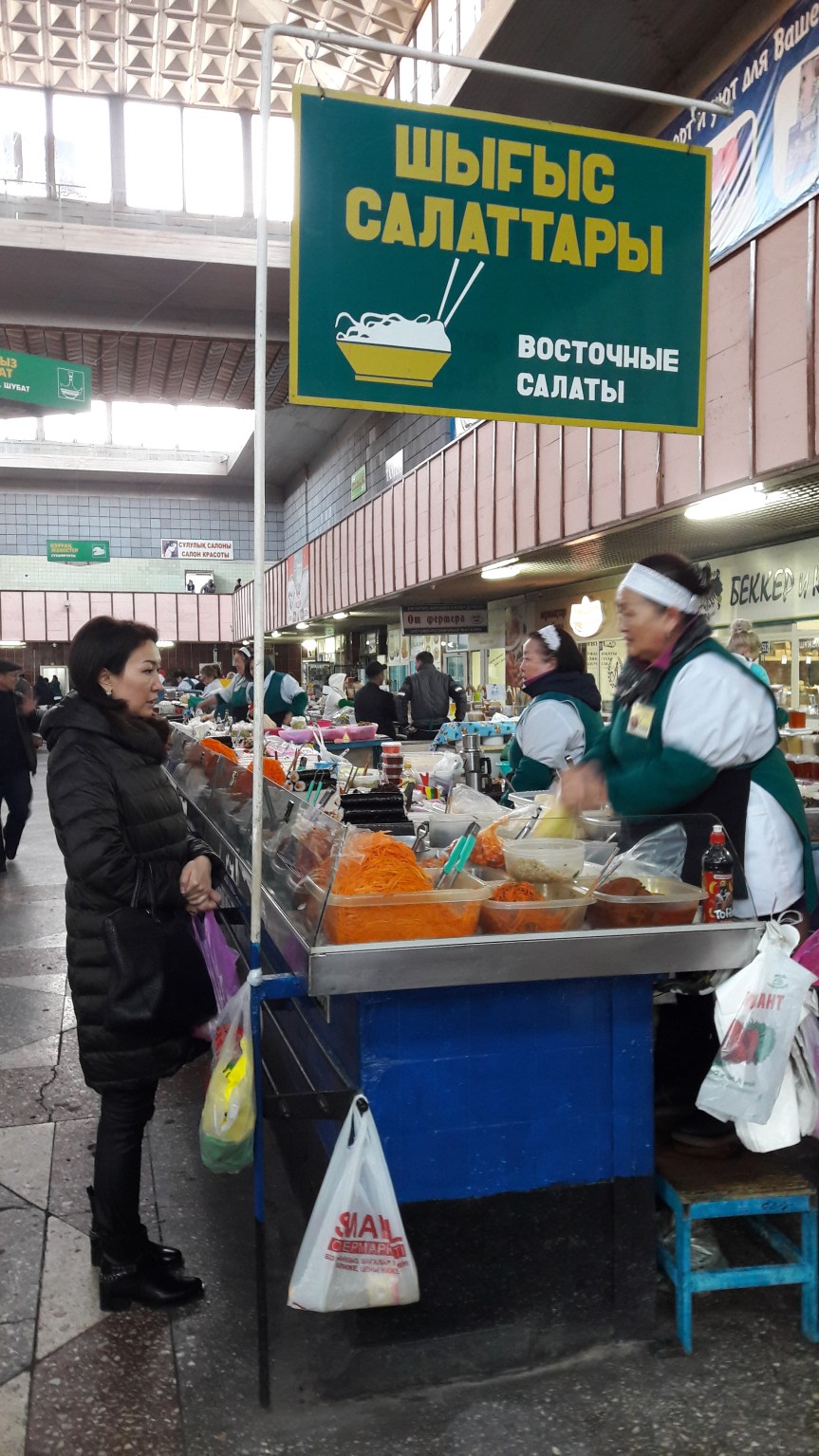
Korean carrots and other salads on sale in Almaty’s Green Bazaar, Kazakhstan

The deportees adapted their cuisine to local conditions and replaced traditional ingredients with carrots to create a spicy, coriander-rich side dish and it remains a popular choice on dinner tables in Central Asian countries such as Uzbekistan, Kazakhstan and Kyrgyzstan, which are still home to around 300,000 ethnic Koreans, descendants of the deportees from the 1930s.

There’s a Turkish connection with the Koreas as well. With Turkey on a war footing once again, wading into battle against the Kurds in northern Syria, a recent film has brought a mostly forgotten war involving Turkey from the 1950s back into the spotlight. Can Ulkay’s “Ayla: The Daughter of War” tells the story of a Turkish soldier who saves a young Korean girl during the Korean War of 1950-53.

Turkey sent troops as part of a United Nations led brigade to defend South Korea against North Korea in the war. The soldier finds himself unable to take the orphan back to Turkey so the pair lose touch after the war, but in a fairytale ending are reunited 60 years later. Put your feet up and enjoy the movie with a bowl of spicy Korean carrots!

Ingredients (serves around 4)

200 g carrots peeled into thin slices – use a julienne peeler or a sharp knife

One garlic clove minced

One small onion minced

One teaspoon crushed coriander seeds

Half teaspoon red chilli flakes

Dash of olive oil

Two teaspoons cider vinegar

Half teaspoon honey

Pinch of salt

One teaspoon sesame seeds

Method

Mix the julienned carrots with the garlic and leave to marinate in a container with a tight-fitting lid (this carrot salad can get quite pungent, so this is important!).

Heat the olive oil and fry the onion until just beginning to brown. Mix the vinegar with the honey and salt and then pour over the carrots, add the coriander and chilli and the fried onions and mix well.

Leave the carrots to marinate in the air tight container in the fridge for at least four hours, the longer the better, to allow the flavours to blend fully.

Sprinkle with sesame seeds and serve as a side dish with fritters such as our mücver.

Christmas Redux – the Party Continues…

4 January 2018

Happy 2018 to all our readers! Just when you thought the festive season was over, here’s a quick reminder that in some parts of the world Christmas is still to come. In Russia and parts of eastern Europe, the Orthodox church uses the Julian calendar, leaving a 13-day lag between the two Christmases.

To mark the big day we’re making our version of borsch – a dish that varies considerably across eastern Europe and the former Soviet Union. The spelling also varies with both borshch and borscht in use.

In Ukraine, borsch forms an integral part of the Christmas Eve table, and it’s often veggie-friendly as this day is also the end of a period of fasting – meat and dairy products are not consumed in the run up to Christmas.

We’ve added some dried mushrooms to the beetrooty mix to give the stock more depth and put a bread topping over the pot to have something handy to tear up and dip into the borsch.

Ingredients (makes 3-4 servings)

500 g beetroot

1 medium- sized onion

1 garlic clove

200 g potato

200 g carrot

250 g red or white cabbage

50 ml olive oil

50 ml tomato puree

5 dried mushrooms

1 litre vegetable stock

2 bay leaves

Juice of one lemon

1 teaspoon red chilli flakes

50 g fresh parsley

For the bread top:

150 g flour

100 ml warm water

15 ml olive oil

Pinch of salt

Method

Clean the beetroot, wrap in tin foil and bake in an oven pre-heated to 180 c for one hour. Pour boiling water over the mushrooms and allow to stand for 30 minutes.

While the beetroot is cooking, heat the olive oil in a heavy-based pan and fry the chopped onion and garlic on a medium heat for ten minutes. Add the bay leaves and chilli flakes and then add the sliced mushrooms. Cook for five more minutes then add the tomato puree and the vegetable stock.

Bring to the boil and then add the diced potato and carrot and cook for 15 – 20 minutes over a low heat. After the beetroot has cooled, peel it and then dice it and add to the soup. Add the finely sliced cabbage, chopped parsley and lemon juice and cook for another 15 minutes.

Prepare the bread topping by combining the flour, water and oil and knead until you have an elastic mixture. Cover with cling film and leave to stand for 30 minutes.

Pour the borsch into individual serving bowls, place a disc of rolled out bread over the top of the bowl and cook in an oven pre-heated to 200 c until the bread is cooked and starting to go brown on top.

For non-vegans, add a dollop of sour cream after breaking through the bread cover. Use the bread to mop up the borsch.

Adjapsandali Adventures

20 July 2017

Knidos Cookery Club would like to say a big thank you to all its readers who voted for the site in the 2017 Saveur Food Blog awards!

This time round we’re looking once again to Turkey’s north-eastern neighbour Georgia for some culinary inspiration. Adjapsandali, a popular  dish in this mountainous former Soviet country, is Georgia’s spicier take on ratatouille.

20170613_220905
Adjapsandali with green beans and potato

This summer stew relies on a holy trinity of aubergine, tomato and peppers with whatever else is in season thrown into the mix.  We’ve added some green beans and some potato to give the dish a heartier edge, but these can be omitted and other seasonal veggies like courgettes and carrots can be used – there’s no hard and fast rules, it’s up to you!

20170613_185152
The adjapsandali ingredients in the raw

It can be served up  with all the veggies collapsing into a sublime sauce-rich stew or the veggies can be left on the firmer side, as in our example. Served with rice, it makes a meal on its own, but it is also great with salads and other Georgian staples such as pkhali.

Ingredients (makes 4 generous servings)

300 g potatoes

300 g aubergines

250 g tomatoes

2 red peppers

200 g green beans

1 onion

2 garlic cloves

50 ml olive oil

1 teaspoon coriander

1 teaspoon red chili flakes

2 teaspoons fresh basil

3 bayleaves

Method

Roughly chop up all the vegetables and throw them into a large, heavy-based pan. Pour the olive oil over the vegetables, add the herbs and spices and cook over a medium heat for 10 minutes or so stirring occasionally. Turn the heat down to low and cook for another 20-30 minutes until all the vegetables are cooked and beginning to break up.

Sprinkle with fresh basil and serve with crusty bread or rice and a selection of salads such as tomato, cucumber and onion with a walnut dressing and starters such as pkhali.

The Mücver Variations

29 June 2017

This time round on Knidos Cookery Club we’re revisiting an old favourite – mücver, Turkey’s tasty courgette fritter.

20170531_132309
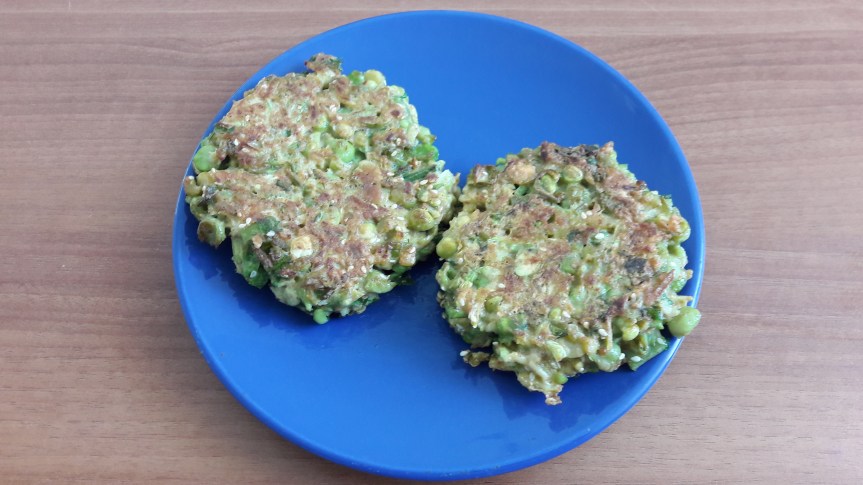
Could this be called a pea fritter?

The mücver usually served up in Turkish eateries are made from grated courgettes, so we’ve decided to spice up this old favourite by adding some other ingredients. Why not try them with fresh peas or grated carrot? Mushrooms work well, as do green beans.

20170609_133418
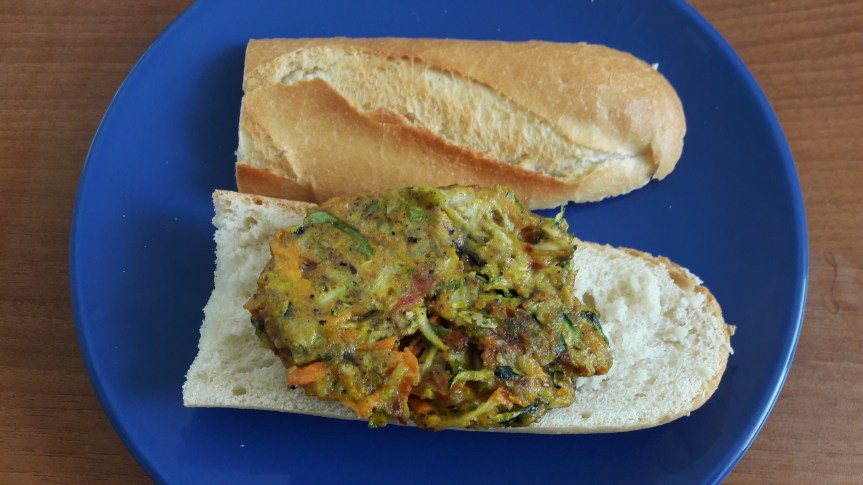
Putting some carrots in the mix

You can even add all these ingredients to the basic mix, chuck in a few chopped almonds or walnuts and, hey presto, you have a chunky veggie nut burger!

Serve the fritters in a pita, on a baguette, in a burger bun, rolled up in flat lavaş bread or just plain with a salad and condiments of your choice.

Ingredients (for around 8 fritters)

Two medium-sized courgettes

One small onion

One egg (or 15 ml of olive oil for vegan version)

Choose one or more from: 100 g chopped mushroom / grated carrot / peas (fresh if you have them, otherwise frozen or tinned) / sliced green beans (use 50 g of each if using more ingredients)

50 g of plain flour

Bunch of parsley, mint and/or dill (if you like that sort of thing)

Dried herbs to taste

A generous sprinkle of sesame seeds

An  optional dusting of chili flakes and grated cinnamon

Salt and pepper

A dash of olive oil for frying

Plain yogurt for serving

Method

Grate or chop up the courgettes and the extra of your choice (mushroom, carrot  peas, green beans or even all three) finely and mix with the chopped onion. Add fresh parsley, mint and/or dill, dried herbs, chili flakes, cinnamon, sesame seeds salt and pepper and blend well.

Make a well in the centre of the mix and break the egg into it. Sprinkle in the crumbled white cheese. Mix well. (Vegan readers should skip the egg and add 25 ml of olive oil instead)

Gradually add the plain flour and blend  until the mixture has quite a thick consistency – you don’t want it to be too wet and sloppy.

Drizzle some olive oil in a frying pan and put over a medium heat.

Place golf ball-sized scoops of the courgette mixture into the pan and flatten with a spatula or fork.

After a few minutes turn the fritter. Keep cooking until both sided are a golden-brown colour.

Serve hot with a dollop of yogurt on top.

Barbunya Bean Therapy

22 June 2017

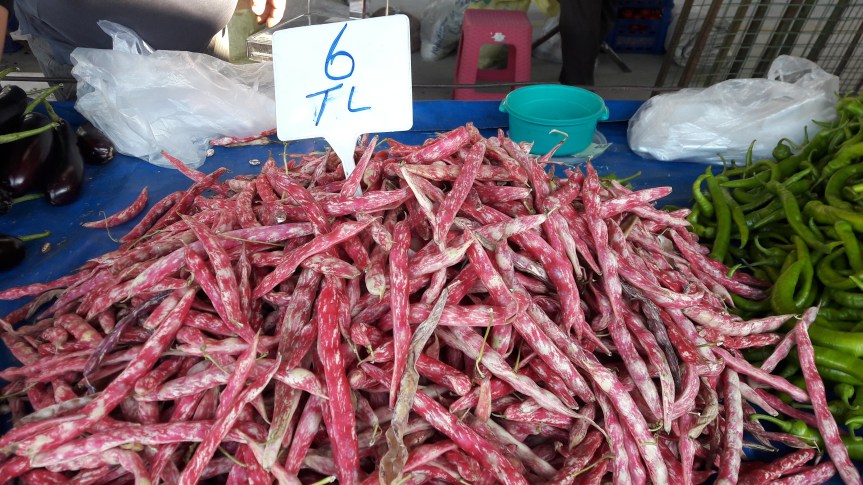
Last week in Datça market piles of psychedelic pink-podded barbunya beans arrayed against their green-podded cousins caught our eye. In Turkey these distinctive beans, also known as borlotti or cranberry beans, are made into a starter called barbunya pilaki, which is always high on our list when ordering a spread of mezeler.

20170616_183758
Psychedelic pink barbunya beans piled high in Datça market

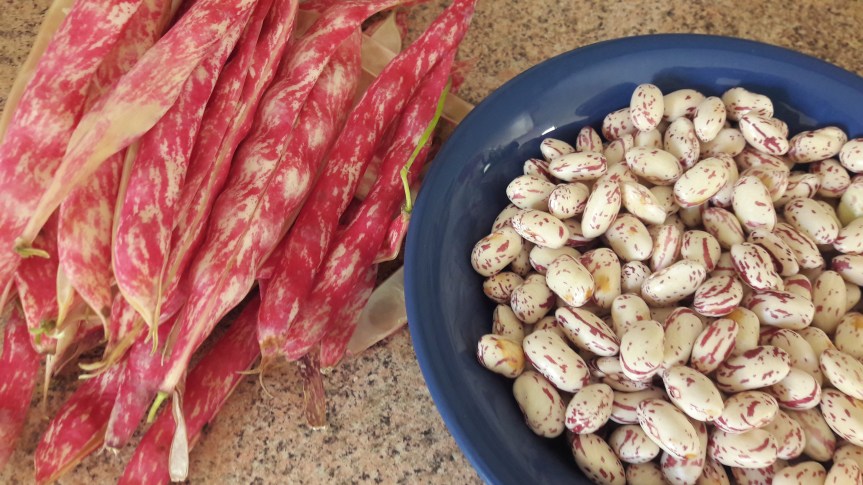
There’s something very therapeutic about podding these beans, like a beanish mindfulness moment!  Our kilo of beans in their pods yielded around 600 g of pink-marbled white beans.

20170616_194034
Bean therapy!

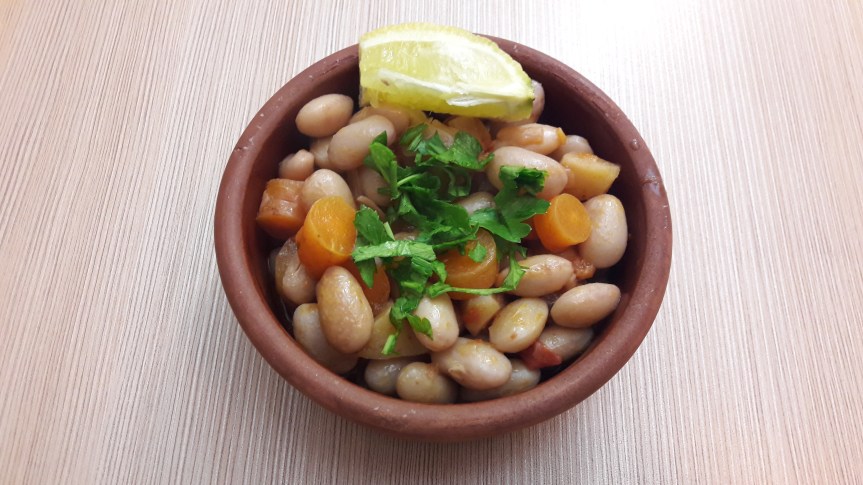
When cooked and allowed to cool, the pink colour leaches out and the beans take on a delicate brown hue. They’re delicious stewed with olive oil, onion, carrot, potato and lemon juice, served with a sprinkling of fresh parsley and a chunk of lemon. Some recipes omit the potato, but we think this gives the dish more oomph and means you don’t need to cook up any additional carbs.

20170616_220421
Barbunya pilaki all ready to go

They can be served hot as a less sugary take on baked beans, or served cold as part of the aforementioned selection of starters – Knidos Cookery Club recommends its carrot and walnut tarator, creamy almond and courgette dip, peppery muhammara and stuffed courgette flowers for a scrumptious feast of Turkish mezeler.

Ingredients (for 4-6 servings)

600 g shelled barbunya beans (or dried borlotti beans soaked overnight)

1 onion (around 100 g)

100 g carrot

100 g potato

100 g tomato

1 garlic clove

1 lemon

1 teaspoon honey

1 teaspoon red chili flakes

Fresh parsley to garnish

50 g olive oil

400 ml hot water

Method

Heat the olive oil into a heavy-based pan, chop the onion and garlic finely and fry over a medium heat for five minutes or so. Add the chopped tomatoes, lower the heat and cook for another five minutes.

Dice the carrot and potato into small cubes and then add these along with the beans, the juice of half a lemon, the honey, chili flakes and hot water to the pan and bring to a boil. Simmer for 30-45 minutes, stirring occasionally, until the beans are cooked but not going mushy.

Serve hot or allow to cool and garnish with fresh parsley and lemon slices.

A Passion for Pkhali

20 April 2017

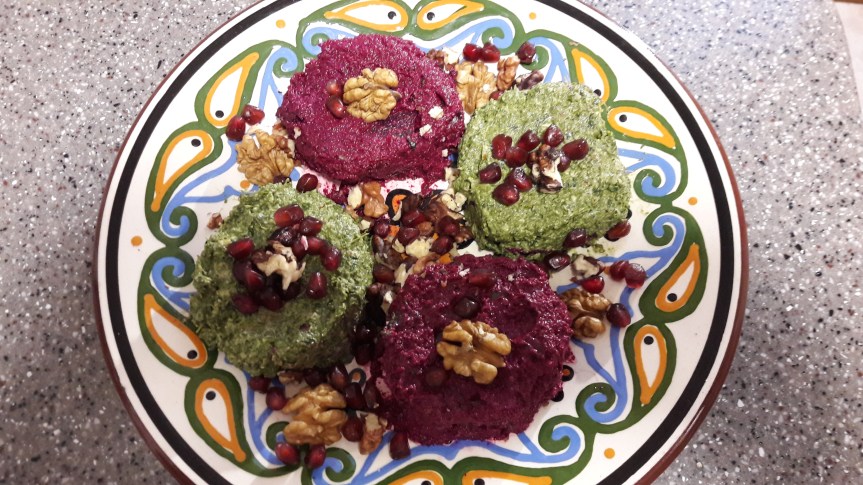
This time round on Knidos Cookery Club we’re returning to Georgia for some culinary inspiration in the form of pkhali, a type of starter made from walnuts, herbs, spices and whatever vegetable happens to be in season, such as spinach, beetroot, aubergine, cabbage or carrot.

20170415_200229

Walnuts are widely used in Georgian cooking – besides pkhali, they can be turned into  satsivi, a thick paste similar to hummus, and  bazhe, a sauce made with the holy trinity of Georgian herbs – blue fenugreek, ground coriander (cilantro) and crushed marigold flowers. These combos can be mixed with fresh cucumbers and tomatoes as a salad dressing or stuffed into tongues of fried aubergine (eggplant).

IMG-20170415-WA0000

Staying on the walnut theme, on a recent visit to the former home of famous Kazakh writer Mukhtar Auezov in Almaty, Kazakhstan, the guide gave me a handful of walnuts from the gnarled old tree in the garden of the writer’s house. These nuts were used in the making  of today’s pkhali recipe.

Auezov was famous in Soviet times for writing The Path of Abai, an epic historical novel based on the life and teachings of Kazakhstan’s most famous poet and composer Abai Qunanbayuli, who had been a neighbour and friend of Auezov’s grandfather.

It was said in the Soviet era that all were equal, but some were more equal than others – and this was certainly the case for Auezov after he won the Lenin Prize in 1959 for his four-volume epic novel about Abai.

The prize came with a sackful of roubles which he invested in a two-storey house, which is now a museum dedicated to his life and work. The house was lavish by the standards of the time and was designed by the architect who designed Almaty’s Abai Opera Theatre.

Ingredients (Makes around four generous servings of each pkhali – see photo above)

For the beetroot pkhali

  • 300 g cooked beetroot
  • 100 g walnuts
  • One garlic clove
  • 5 g fresh parsley
  • 5 g fresh coriander
  • One teaspoon blue fenugreek powder
  • One teaspoon black pepper
  • 20 ml wine vinegar
  • A scattering of pomegranate seeds and walnuts


For the spinach pkhali

  • 250 g fresh spinach
  • 100 g walnuts
  • One small onion (around 75 g)
  • One garlic clove
  • 5 g fresh parsley
  • 5 g fresh coriander
  • One teaspoon blue fenugreek powder
  • One teaspoon black pepper
  • 20 ml wine vinegar
  • A scattering of pomegranate seeds and walnuts


Method

  • For the beetroot pkhali:
  • Boil the beetroot for 30 minutes or so until you can pierce it with a knife easily.
  • Leave to cool and then peel and chop into small chunks.
  • Toast the walnuts over a low heat for 5-10 minutes and then add to the garlic and herbs and spices in a bowl. Add the vinegar and use a blender to make a smooth paste. Add the beetroot chunks and keep blending until you have a gloopy mixture.
  • Leave overnight in the fridge and then serve with a scattering of pomegranate seeds and walnuts.

Method

  • For the spinach pkhali:
  • Cook the spinach in boiling water for 5 minutes until it begins to wilt. Remove and place in cold water and then drain.
  • Finely chop the onion and put it in a mixing bowl with the garlic, herbs and spices. Toast the walnuts over a low heat for 5-10 minutes and then add to the bowl. Add the vinegar and use a blender to make a smooth paste. Add the spinach and keep blending until you have a gloopy mixture.
  • Leave overnight in the fridge and then serve with a scattering of pomegranate seeds and walnuts.


Operation Lentil

23 February 2017

It was on this day back in 1944  that the Chechen and Ingush  people of the North Caucusus had one of the darkest moments in their troubled history. Accused by the Soviets of siding with the Nazi forces, the entire population was herded onto cattle trucks and deported by force to Central Asia.

The mission was codenamed ‘Operation Lentil’ – after chechevitsa, the Russian word for lentil, which shares its first two syllables with Chechen. By way of commemoration of this tragedy that befell the Chechen and Ingush communities, who refer to the deportations as Aardakh, the exodus, this time around we’ll be sharing a recipe for the Turkish dish mercimek köftesi – a versatile red lentil patty.

lentil-patties
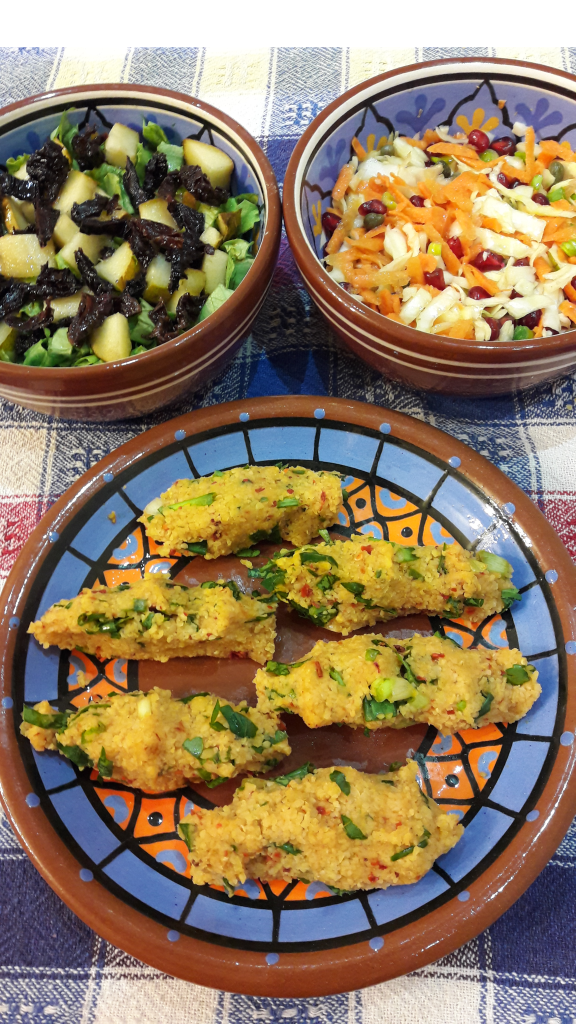
Mercimek köftesi – red lentil patties, served with green salad and cole slaw

These spicy, lentil patties are easy to prepare and are delicious when rolled up in flatbread, like lavash, with fresh cole slaw and a green salad. We used ajika sauce from Georgia on the other side of the Caucasus mountains, a fiery blend of red chili peppers and tomatoes, to flavour the patties – but if you can’t find this locally, then a mix of tomato paste with chili flakes will do nicely.

Ingredients (Makes around 20-24 lentil patties)

100 g red lentils (one cup)

150 g fine bulgur wheat (1.5 cups)

500 ml water

6-8 teaspoons of ajika sauce (see above)

5 spring (green) onions – chopped

A handful of fresh flat leaf parsley, roughly chopped

One teaspoon of cumin seeds

One teaspoon red chili flakes

Black pepper

25 ml olive oil

Juice of one lemon

Method

Wash the lentils until the water goes clear and then place in a pan with the water. Bring to the boil and simmer over a low heat for 20 minutes or so. The lentils should be going mushy and there should be about 1 cm of water covering the lentils – add more water if necessary.

Add the washed bulgur wheat to the cooked lentils and the ajika sauce and blend well. Allow to stand for 30 minutes or so and then add the olive oil, lemon juice, spring onions, parsley, cumin, red chili flakes and black pepper and mix well.

Allow to stand for a few hours to let the flavours combine and then mould a walnut-sized piece of the mix in the palm of your hand and use your fingers to form a  sausage-shape (see picture above).

Serve rolled in flatbread or stuffed into a pita with a cole slaw made from shredded cabbage, grated carrot, pomegranate seeds, spring onion and capers and  a salad of lettuce, sun dried tomatoes, pear and spring onion.


Getting Down to the Nuts and Roots

26 January 2017

This time round on Knidos Cookery Club we’re getting back to the roots with a comforting winter soup made from some of our favourite root vegetables, a leek or two and some roasted chestnuts.

20170124_204349
Roasted chestnuts – a winter treat

One of the big events in the world of Knidos Cookery Club so far in 2017 has been the relocation of Datça’s weekly market to a new, purpose-built site. Previously, when the market came to town on Friday and Saturday, it would spill down the hill in the centre of town, causing considerable congestion with the stallholders looking for parking spots and the customers squeezed in-between.

The new site has a covered area for the local fruit and vegetable growers with the other stalls – spices and nuts, clothes, household goods etc., setting up around the covered market. It’s a lot more user-friendly, with plenty of space for shoppers and stall holders.

The last few visits to the market have entailed searching for some of our regular suppliers in the new layout, and we’re pleased to report that most of them have been accounted for!

20170108_222106
A warming bowl of rooty, chestnut pureed soup

In season at the moment are chestnuts – anyone who’s visited Istanbul in winter will probably remember trying fresh roasted chestnuts while on the move around the centre, a delicious snack that epitomises the city in the colder months of the year to me.

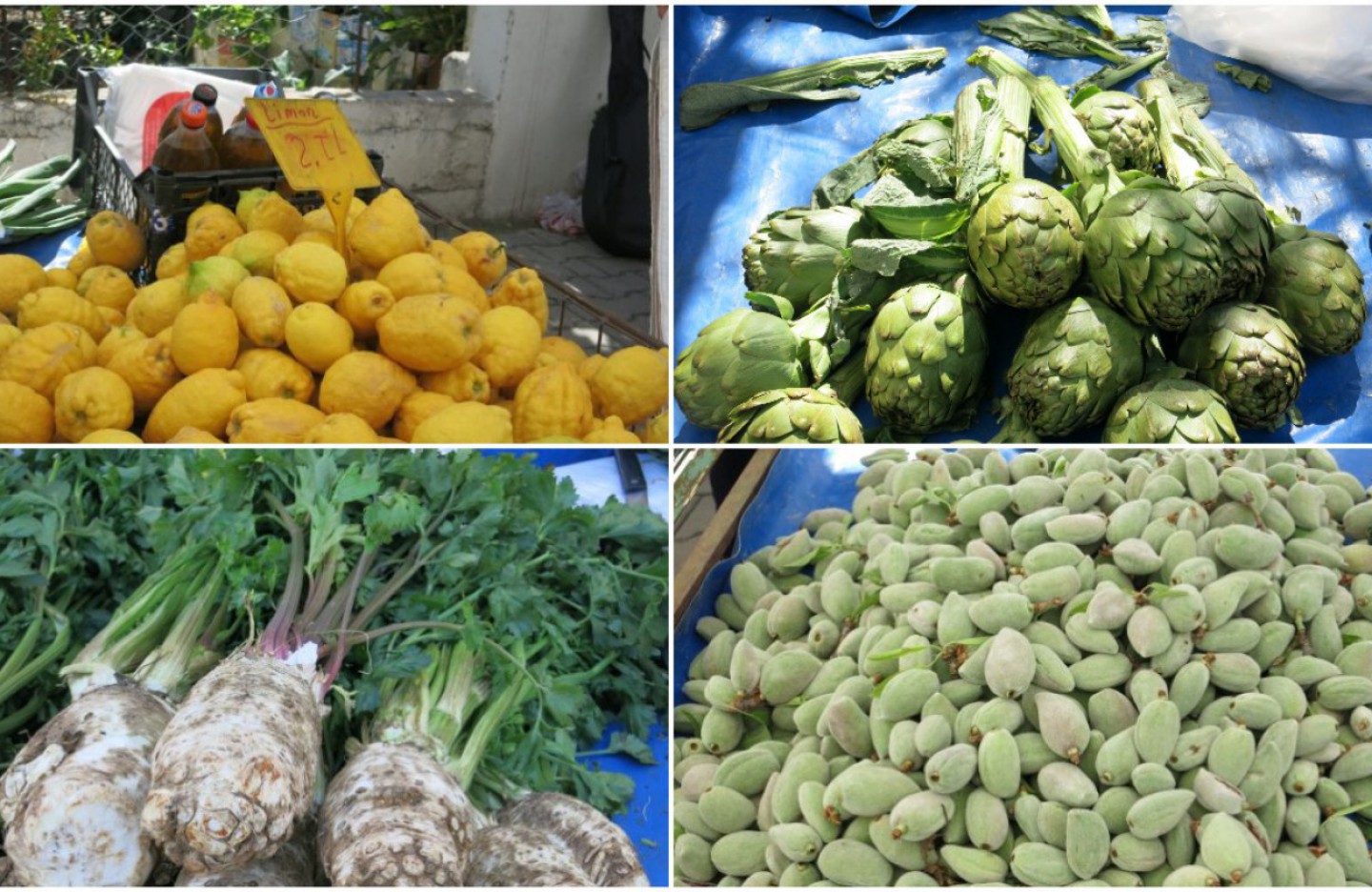
There were also root vegetables aplenty – including black carrots (these root vegetables were first cultivated in Afghanistan and were yellow and purple in colour) and celeriac, lengthy leeks and lashings of oranges and lemons. So this week we’ll be making a rooty nutty soup containing celeriac, potato, carrot, leek, shallots and chestnuts.

Ingredients (serves 3-4)

75 g shallots

250 g leeks

250 g celeriac

one medium-sized potato

100 g carrot (black if you can find them!)

500 ml vegetable stock

25 ml olive oil

150 g chestnuts

one teaspoon dried thyme

salt and pepper for seasoning

juice of one lemon

Method 

Fry the finely sliced leeks and chopped shallots in the olive oil, which has been seasoned with dried thyme, over a medium-high heat until just beginning to brown. Peel and dice the celeriac, potato and carrot into 1 cm cubes  and add to the pan of leeks and shallots.

Stir in well to coat the cubed root vegetables with oil and thyme and then add the stock and the juice of the lemon and simmer for 20 minutes over a low-medium heat. While this is bubbling away, score the outside of each chestnut with a cross shape (on one side) and roast the chestnuts in an oven pre-heated to 220 c /gas mark 7.

Check the chestnuts after 20 minutes or so – if they are easy to peel and are roasted sufficiently, then they are ready for use. If not, check every 5 minutes until the shell comes off easily.

Add the peeled chestnuts to the soup pan, stir well and season with salt and pepper to taste. Then use a hand blender to make a smooth, thick soup and serve straight away with hunks of wholemeal bread.

Olivier with an Edge

12 January 2017

Welcome to the first Knidos Cookery Club of the new year. While many of us have returned to the daily grind, it’s still party-time in some parts of the world.

in Russia, people are preparing to celebrate New Year’s Eve on 13 January – the Orthodox Church still follows the Julian calendar rather than the Gregorian calendar, which Russia adopted after 1917’s October Revolution. This switch created a 13-day lag between the calendars so, for followers of the Orthodox faith, Christmas Eve falls on 6 January and 13 January marks the end of the old year.

20170107_183144
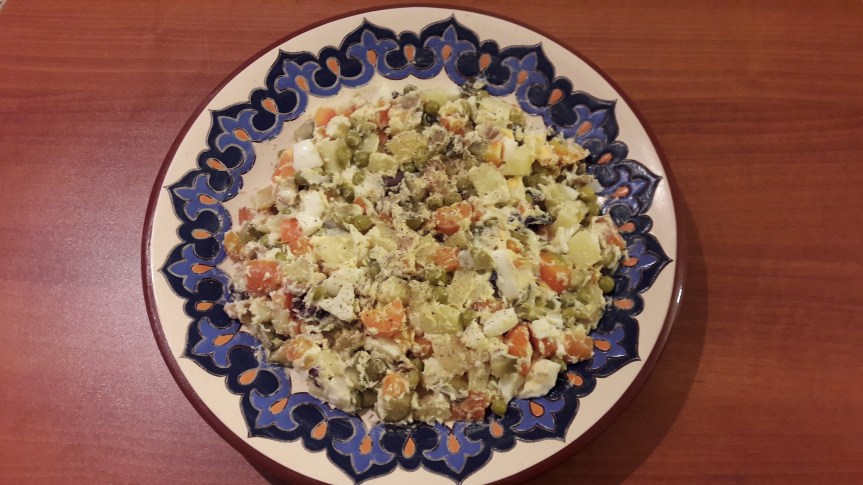
KCC’s take on Russia’s classic Olivier salad

A centre-piece of Russian tables on this day, as people prepare to welcome in novy god, is the Olivier salad – a concoction of boiled potatoes, pickled cucumbers, peas, eggs, carrots and boiled beef or chicken in a mayonnaise dressing. This version dates from Soviet times as all the ingredients could usually be procured even in the depths of winter and despite chronic shortages.

A version of the salad, omitting the meat and eggs, is made in Turkey where it’s known as Rus Salatası – we’ve made our own veggie version that replaces the meat (Olivier purists look aside now, please) with black and green olives and uses sour cream in place of mayonnaise.

When I lived in Moscow in the 1990s I got it into my head that Olivier salad should include olives (mistakenly thinking that Olivier referred to olives rather than the salad’s originator!) and I was disappointed when it came minus olives – so now I finally have a chance to put this right!

Ingredients (serves 3-4)

  • 150 g potatoes
  • 150 g carrots
  • 150 g peas
  • 150 g pickled cucumbers
  • 150 g black and green olives
  • two hard boiled eggs
  • 150 ml sour cream or natural yogurt
  • pinches of salt and black pepper

Method

  • Boil the whole carrots and potatoes until cooked but not going mushy and boil the eggs for 5 minutes or so. While they’re all cooking, chop the pickled cucumbers and olives into small cubes.
  • Drain the potatoes and carrots and cover with cold water to stop them cooking. Do the same with the eggs. Chop the potatoes, carrots and eggs into small cubes and arrange around the side of a large serving dish in separate sections with the olives, peas and cucumbers.
  • Pour the sour cream or yogurt into the middle of the bowl and season with salt and pepper. Now mix all the ingredients thoroughly, making sure they all get a good coating of sour cream or yogurt.
  • Leave in the fridge before serving alongside other Russian-themed salads, such as this veggie take on caviar made from beluga lentils, and wish a hearty S Novym Godom with shots of vodka and/or a glass of chilled Sovyetskoye Shampankskoye (if you can get hold of it in your local offie!) as you prepare to welcome Old New Year in true Russian-style!