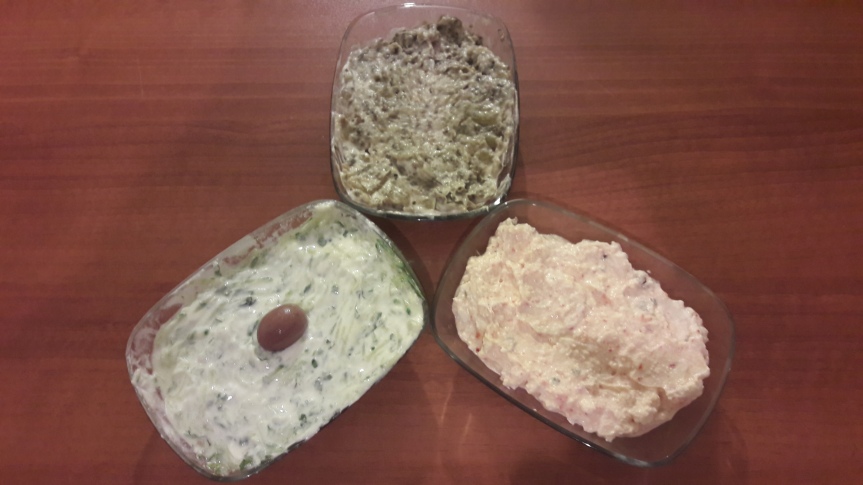
Amorgoan Delight: smoky aubergine dip, Psimeni Raki and feta dip and tsatsiki
You can serve this simple to prepare red Lentil Pâté alongside these other dishes for a great spread of mezeler for a light feast that’s perfect for sharing with friends on a balmy summer’s night.
Ingredients (makes around 200g)
125 g red lentils
One bayleaf
300 ml cold water
Two tablespoons fine bulgur wheat
4 or 5 spring onions
10 g fresh parsley
25 ml olive oil
One teaspoon mustard seeds
One teaspoon cumin seeds
Two teaspoons paprika
One teaspoon ground coriander seeds
One teaspoon black pepper
Half a teaspoon turmeric
Method
Clean the lentils in cold water and then put them in a pan with the bayleaf. Pour 300 ml of water over the lentils and bring to a boil. Reduce the heat and simmer until the lentils are beginning to go mushy and most of the water has been absorbed.
Remove the bayleaf and add the fine bulgur wheat to the lentils and mix well. Leave covered for 30 minutes. heat the oil in a heavy-based pan and add the mustard and cumin seeds. Fry for a few minutes and then add the paprika, coriander, black pepper and turmeric, cook for a minute stirring constantly and then add the finely chopped spring onion and parsley and cook for five more minutes over a medium heat.
Stir this into the lentil and bulgur mix and leave to stand for a few hours in the fridge. Garnish with a sprig of fresh mint and serve with crusty bread.
With Nikol Pashinyan, leader of the largest political protests in Armenia’s post-Soviet history, looking likely to become this impoverished Caucasus Mountains nation’s next prime minister, Knidos Cookery Club is celebrating this momentous event with an Armenian recipe cooked up by our friend Bagila.
Bagila’s Armenian (Revolutionary) Peppers take centre stage
This mountainous, landlocked country sandwiched between Turkey, Iran, Azerbaijan and Georgia, has a rich cuisine that draws on an array of fresh vegetables such as aubergines and peppers, pulses and beans and fruits and nuts.
Bagila’s recipe uses red peppers that are fried and then marinated overnight in her signature marinade and they taste amazing served alongside a platter of other dips and salads as in the picture above.
Ingredients (serves 4-6)
500 gr red peppers, cut lengthwise in quarters
50 ml olive oil
For the marinade:
2 fresh tomatoes, skinned and grated
5 crushed/mashed garlic cloves
75 ml of lemon juice
1 bunch of fresh coriander, chopped
1 bunch of fresh parsley, chopped
1.5 tablespoons of sugar
a little less than 1 tablespoon spoon of salt
black pepper to taste;
oil left over from frying
Method
Fry the quartered peppers in hot olive oil until soft and then set aside. While they’re cooking, mix all the marinade ingredients together in a bowl.
Combine it all together: a layer of peppers, followed with a layer of marinade and so on.
Put something heavy on top for pressure (a saucer with a stone on top, or a jar of honey (jam), or whatever you can think of), and keep in the fridge for at least several hours (better one night/day) before eating. Enjoy!
“April is the cruellest month” as TS Eliot put it, but I’ve always thought there’s a case for February to be considered crueller. As winter drags on interminably in the northern hemisphere – we’re still six months away from August and the height of summer – those long, lazy days all seem so far away, especially with the mercury plunging into serious minus territory as in Knidos Cookery Club’s winter HQ in Almaty, Kazakhstan.
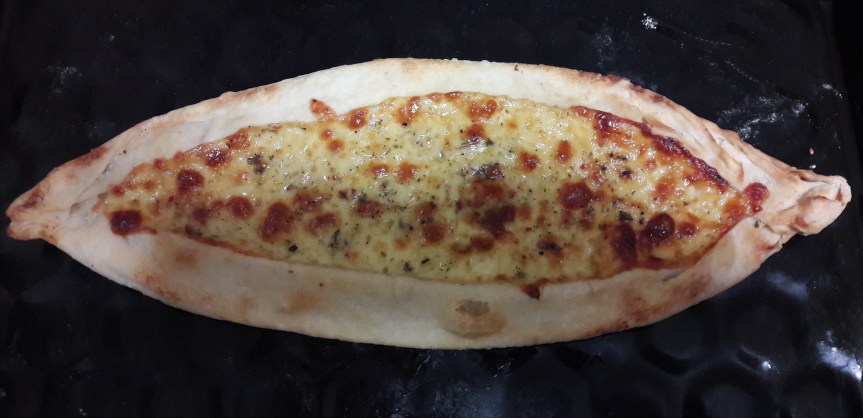
Yum yum – Kaşarlı Pide
So, thoughts have been turning to warmer times and to distant memories of eating pide, Turkey’s take on pizza, under the shade of mandarin trees in Datça.
or maybe Otlu Pide?
With KCC’s new oven up and running in Almaty, it’s high time for a Great Turkish Bake Off as we take on the pide challenge and bring a slice of the Turkish summer into the winter gloom of Kazakhstan.
Stage one – ready to shape
Stage two – first fold
Stage three – final fold
We’ll be making a standard Kaşarlı Pide, an open one made with a yellow cheese such as cheddar – See the three stages for assembling this pide above.
And here is an Otlu Pide, a covered one made with various greens such as spinach and parsley and a ricotta-like cheese called lor as seen above.
Ingredients (Makes four pides)
For the base:
300 g flour
One teaspoon dried, instant yeast
125 ml cold water
30 ml olive oil
For the filling:
KaşarlıPide (makes 2)
200 g grated yellow cheese such as a mild cheddar
Pinch of red chilli flakes
Pinch of dried thyme
Pinch of freshly ground black pepper
Otlu Pide (makes 2)
One small onion
125 g spinach
25 ml olive oil
One bunch fresh parsley (around 25 g)
One bunch fresh coriander (around 25 g)
100 g ricotta cheese (or similar)
One teaspoon cumin seeds
One teaspoon red chilli flakes
Pinch of dried thyme
Pinch of freshly ground black pepper
Sprinkling of sesame seeds (or black, nigella seeds if you can find them)
Method:
Sieve the flour into a large, ceramic bowl, add the dried yeast, make a well in the middle and pour in the olive oil and slowly add the water and mix well so that all the flour is used up.
Knead for ten minutes or so until you have a stretchy, elastic dough. Put in an oiled bowl and cover with a tea towel and then leave it to rise in a warm place for 30 minutes or so until it is doubled in size.
While the dough is rising, prepare the filling for the Otlu Pide. Heat the olive oil in a frying pan and add the cumin seeds, chilli flakes, dried thyme and black pepper and then add the finely chopped onion. Cook for five minutes and then add the chopped spinach, parsley and coriander and cook until it all begins to wilt. Allow to cool and then stir in the lor (ricotta) cheese.
Divide the dough into four and roll each ball into a 30 cm by 20 cm oblong about 1 mm thick on a lightly floured surface. For the Kaşarlı Pide, spread the grated cheese over the middle leaving 2 cm around the edges and season with thyme, chilli flakes and black pepper. Fold the edges over and then fold again and pinch the ends together to make a boat shape. Glaze the dough with olive oil.
For the Otlu Pide, place half the filling in the bottom half of the rolled out dough then fold the top over and make into a parcel shape (as in the picture above). Glaze with olive oil and sprinkle with sesame seeds.
Bake the pides in an oven pre-heated to 200 c for 20-30 minutes or so until the cheese bubbles and is starting to go brown and the dough is also starting to go a golden-brown colour. Serve straight from the oven with a salad of your choice.
This week on Knidos Cookery Club we’re going to be bucking the January detox trend with this super-rich, calorie-laden Iranian stew, Fesenjan (pronounced fesenjoon), that combines three of our favourite go-to ingredients – pomegranate, walnut and pumpkin.
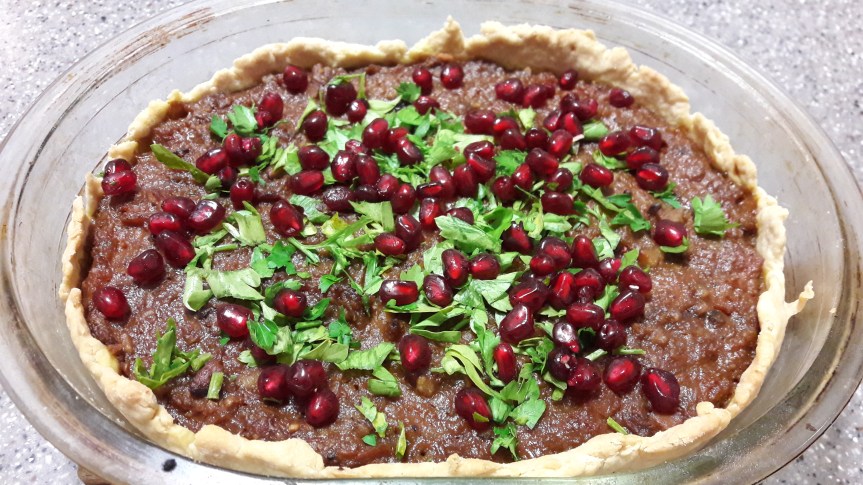
KCC’s Fesenjan Tart
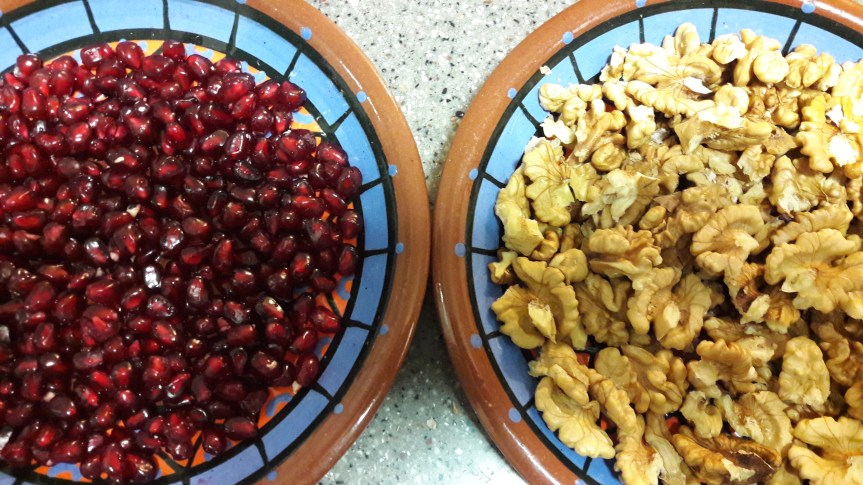
Usually served as a thick stew with rice, we’ve decided to put it in a pie case to make a tasty walnut and pomegranate infused tart. Making this stew can be quite labour-intensive – shelling the walnuts, toasting them, crushing them, extracting the pomegranate seeds and so on, but the end result makes it well worth all the effort.
Can’t get much fresher than this!
Look out for Nar Ekşisi (pomegranate syrup)or the sweeter Nar Ekşili Sos (pomegranate sauce) in your local Middle-Eastern shop or make your own. If using Nar Ekşisi, add a teaspoon or two of honey to the stew to make it a bit sweeter.
To save time you can use shop-bought pastry, but we think it tastes better with a homemade pie crust. To keep it vegan, we’ve used olive oil instead of butter to make our shortcrust pastry.
Ingredients (serves 4)
125 g shelled walnuts
one medium onion
500 g pumpkin or butternut squash
300 ml vegetable stock
30 ml olive oil
2-3 tablespoons pomegranate syrup or sauce (Nar Ekşisi or Nar Ekşili Sos in Turkish)
0.5 teaspoon cumin seeds
0.25 teaspoon cinnamon and turmeric
Black pepper
Handful of pomegranate seeds
Bunch of fresh parsley
200 g shortcrust pastry
Method
Toast the walnuts for 10 minutes over a low heat and then mince in a blender. Heat the olive oil and fry the onion in a heavy-based pan over a medium heat for ten minutes. Add the spices and then add the cubed pumpkin and stir to cover.
Pour over the vegetable stock, add the pomegranate molasses and the minced walnuts and cook over a medium heat for 30 minutes until the pumpkin is cooked. Make sure the sauce is quite thick – if it’s runny, boil it until it starts to thicken.
Roll out the pastry and place it in a greased baking tray. Bake blind for ten minutes at 180c and then put the filling into the pie case. Cook for 40 minutes or so until the pastry starts to go golden brown.
Garnish the tart with chopped parsley and pomegranate seeds and serve with saffron rice and a green salad.
Happy 2018 to all our readers! Just when you thought the festive season was over, here’s a quick reminder that in some parts of the world Christmas is still to come. In Russia and parts of eastern Europe, the Orthodox church uses the Julian calendar, leaving a 13-day lag between the two Christmases.
To mark the big day we’re making our version of borsch – a dish that varies considerably across eastern Europe and the former Soviet Union. The spelling also varies with both borshch and borscht in use.
In Ukraine, borsch forms an integral part of the Christmas Eve table, and it’s often veggie-friendly as this day is also the end of a period of fasting – meat and dairy products are not consumed in the run up to Christmas.
We’ve added some dried mushrooms to the beetrooty mix to give the stock more depth and put a bread topping over the pot to have something handy to tear up and dip into the borsch.
Ingredients (makes 3-4 servings)
500 g beetroot
1 medium- sized onion
1 garlic clove
200 g potato
200 g carrot
250 g red or white cabbage
50 ml olive oil
50 ml tomato puree
5 dried mushrooms
1 litre vegetable stock
2 bay leaves
Juice of one lemon
1 teaspoon red chilli flakes
50 g fresh parsley
For the bread top:
150 g flour
100 ml warm water
15 ml olive oil
Pinch of salt
Method
Clean the beetroot, wrap in tin foil and bake in an oven pre-heated to 180 c for one hour. Pour boiling water over the mushrooms and allow to stand for 30 minutes.
While the beetroot is cooking, heat the olive oil in a heavy-based pan and fry the chopped onion and garlic on a medium heat for ten minutes. Add the bay leaves and chilli flakes and then add the sliced mushrooms. Cook for five more minutes then add the tomato puree and the vegetable stock.
Bring to the boil and then add the diced potato and carrot and cook for 15 – 20 minutes over a low heat. After the beetroot has cooled, peel it and then dice it and add to the soup. Add the finely sliced cabbage, chopped parsley and lemon juice and cook for another 15 minutes.
Prepare the bread topping by combining the flour, water and oil and knead until you have an elastic mixture. Cover with cling film and leave to stand for 30 minutes.
Pour the borsch into individual serving bowls, place a disc of rolled out bread over the top of the bowl and cook in an oven pre-heated to 200 c until the bread is cooked and starting to go brown on top.
For non-vegans, add a dollop of sour cream after breaking through the bread cover. Use the bread to mop up the borsch.
This time round on Knidos Cookery Club we’ll be looking at a spice called sumac that is ubiquitous in Turkish cooking. Sumac comes from the flowering plants of the genus Rhus and its powdered purple-reddish berries give a tart but tangy boost to everything from soups and dips to grilled vegetables and kebabs. It also gives a rich dark burgundy hue to the dishes it flavours.
Sumac
We’ve decided to use it in acili ezme, a fiery tomato, onion and pepper dip that is delicious eaten on it’s own with bread, used as a sauce to accompany dishes such as pide, Turkey’s take on pizza, as part of a meze plate with our carrot and walnut tarator and our creamy almond and courgette dip or with mücver, Turkey’s courgette fritter.
A fearsome acili ezme
The secret to a successful acili ezme is to chop the ingredients as finely as you can with the sharpest knife you have and to chill it for a few hours before serving so the flavours have a chance to blend.
We’ve added red chilli flakes and sumac to give it a kick and used mint and parsley to balance out the flavours. If you like your dips hot, then use green chillies in place of green peppers in this recipe.
Ingredients (serves 3-4)
One medium-sized onion
Three medium-sized plum tomatoes
One medium-sized green pepper
One garlic clove
One bunch of parsley
One teaspoon dried mint
Three teaspoons red chilli flakes
Two teaspoons sumac
One teaspoon flavoured vinegar (such as apple or fig)
Three teaspoons pomegranate sauce
Method
Peel the tomatoes and de-seed (to peel: plunge the tomatoes into boiling water for 30 seconds then place in cold water – the skin should now come off easily). Chop the tomatoes, green pepper, onion, garlic and parsley as finely as you can.
Put all the ingredients into a bowl, add the herbs and spices, vinegar and pomegranate sauce and mix well. Leave to chill in the fridge for at least two hours before serving with flat bread.
Welcome to Knidos Cookery Club’s 50th post! To mark this momentous milestone, we’ve recreated a dish we discovered while visiting Ovabükü, a quiet beach on the Knidos peninsula – stuffed potato balls.
Spicy potato balls stuffed with haydari
If you’ve enjoyed reading Knidos Cookery Club as much as we’ve enjoyed producing it, then could we ask a favour – please nominate us in the Saveur Blog Awards for 2017. This is a special award for food blogs and if you could spare a couple of minutes to nominate then enter our URL – https://knidoscookeryclub.wordpress.com – and choose the Best New Voice category. Your support would be much appreciated – thanks in advance!
Haydari with walnuts
For Knidos Cookery Club one of the most enjoyable things about the local food scene is finding a new restaurant and checking out the dishes in the vitrine. There are always some surprise dishes lurking in the glass display cabinets that are made from fresh, seasonal ingredients.
In Ovabükü one of the dishes on the mixed meze plate was the aforementioned potato ball stuffed with cream cheese. We’ve put some delicious haydari, made from mint and strained yogurt, in our version, and spiced up the potato balls with some chilli flakes. Strained yogurt is thicker than normal yogurt as the liquid whey and lactose has been strained off – it’s also known as Greek style yogurt in the UK.
Haydari
200 ml strained yogurt
20 g crumbly white cheese
1 garlic clove
3 teaspoons dried mint
1 teaspoon red chili flakes
2 walnuts
Mix the yogurt, cheese, garlic and mint together and leave in the fridge for a couple of hours. Decorate the haydari with walnut pieces and dust with chilli flakes before serving.
Spicy Potato Balls
500 g baked or boiled potatoes
Handful of fresh parsley
1 teaspoon red chili flakes
Black pepper
50 ml unstrained yogurt
Mash the potato and mix in the other ingredients. Form into round, golf ball-sized shapes, make an indentation in the top with a teaspoon and fill the gap with haydari and top with a walnut half.
This time round on Knidos Cookery Club we’re revisiting an old favourite – mücver, Turkey’s tasty courgette fritter.
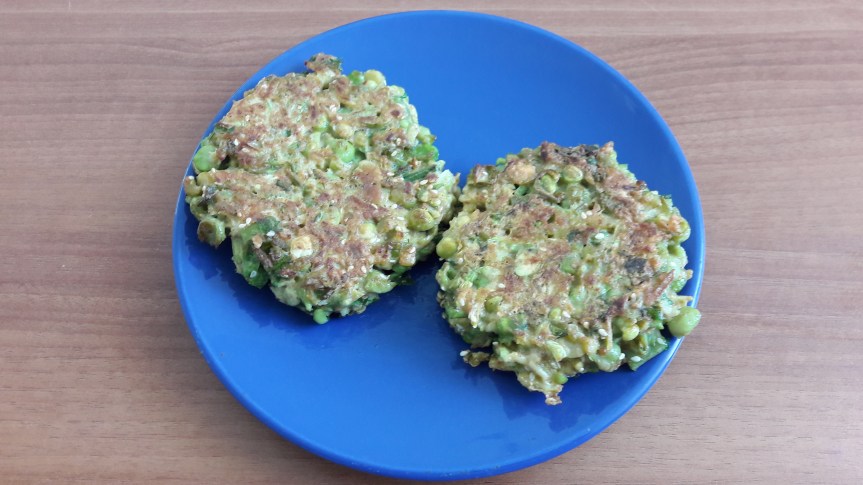
Could this be called a pea fritter?
The mücver usually served up in Turkish eateries are made from grated courgettes, so we’ve decided to spice up this old favourite by adding some other ingredients. Why not try them with fresh peas or grated carrot? Mushrooms work well, as do green beans.
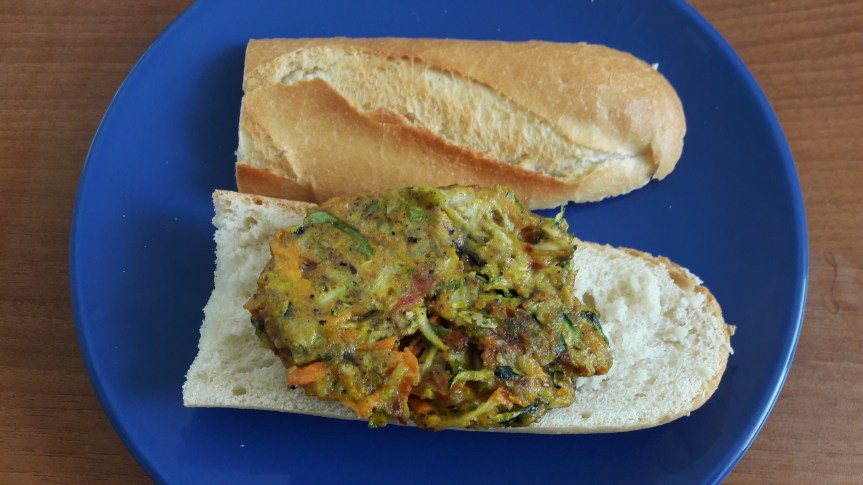
Putting some carrots in the mix
You can even add all these ingredients to the basic mix, chuck in a few chopped almonds or walnuts and, hey presto, you have a chunky veggie nut burger!
Serve the fritters in a pita, on a baguette, in a burger bun, rolled up in flat lavaş bread or just plain with a salad and condiments of your choice.
Ingredients (for around 8 fritters)
Two medium-sized courgettes
One small onion
One egg (or 15 ml of olive oil for vegan version)
Choose one or more from: 100 g chopped mushroom / grated carrot / peas (fresh if you have them, otherwise frozen or tinned) / sliced green beans (use 50 g of each if using more ingredients)
50 g of plain flour
Bunch of parsley, mint and/or dill (if you like that sort of thing)
Dried herbs to taste
A generous sprinkle of sesame seeds
An optional dusting of chili flakes and grated cinnamon
Salt and pepper
A dash of olive oil for frying
Plain yogurt for serving
Method
Grate or chop up the courgettes and the extra of your choice (mushroom, carrot peas, green beans or even all three) finely and mix with the chopped onion. Add fresh parsley, mint and/or dill, dried herbs, chili flakes, cinnamon, sesame seeds salt and pepper and blend well.
Make a well in the centre of the mix and break the egg into it. Sprinkle in the crumbled white cheese. Mix well. (Vegan readers should skip the egg and add 25 ml of olive oil instead)
Gradually add the plain flour and blend until the mixture has quite a thick consistency – you don’t want it to be too wet and sloppy.
Drizzle some olive oil in a frying pan and put over a medium heat.
Place golf ball-sized scoops of the courgette mixture into the pan and flatten with a spatula or fork.
After a few minutes turn the fritter. Keep cooking until both sided are a golden-brown colour.
To celebrate this spring equinox festival, we’ll be serving up kok samsa, deep-fried pies filled with a selection of spring greens.
Seven tastes of spring: parsley, spinach, coriander, celeriac leaves, spring onion, garlic and mint
Originating in Persia some 3,000 years ago, Nowruz, or New Day, is a celebration of the end of winter and the start of a new year on the date when day and night are equal in the Northern Hemisphere. This date usually falls on or around 21 March.
The holiday is still widely celebrated in Iran and Iraq, across Central Asia, Russia, Afghanistan, Albania, Azerbaijan, in eastern Turkey and in parts of Syria, India, Pakistan and China. Food plays an important role in these celebrations – in Iran the table is set with seven items, as explained in this article from Iran Wire:
A few weeks before Nowruz, Iranians begin setting up their haft sin, or “seven Ss,” a ceremonial display of symbolic items whose names begin with the Persian letter “sin” or “s.” They include “sabzeh,” or green sprouts grown from lentils, which symbolize rebirth; “samanu,” a sweet pudding that represents affluence, “senjed,” or dried wild olives, which symbolize love; “seer,” or garlic, which symbolizes medicine; “seeb,” an apple, which represents health; “somaq” or sumac fruit, which symbolizes the color of sunrise, and “serkeh,” or vinegar, which symbolises maturity.
Kok samsa, a close relative of India’s samosa, are prepared in Uzbekistan, where the holiday is called Navruz. These tasty pies are filled with fresh spring greens.
We’ve developed our own take on the kok samsa using the Iranian magic number of seven ingredients: parsley, spinach, coriander, celeriac leaves, spring onion, garlic and mint. As fully signed-up members of Dillwatch, we omitted that scurrilous weed, dill, from this recipe.
KCC’s Kok samsa with seven spring herbs inside
Ingredients (makes 8-10 pies)
For the Pastry
300 g plain flour
75 ml olive oil
Pinch of salt
Up to 75 ml cold water
Two – three teaspoons of sesame seeds
2. For the Filling
150 g spring onions
2 garlic cloves
50 g fresh coriander
50 g fresh parsley
150 g spinach
25 g the leafy bits from the top of a celeriac
15 g fresh mint
Two teaspoons of cumin seeds
25 ml olive oil
3. For Deep Frying
1 litre sunflower oil (for deep frying)
Method
1.For the Pastry
Pour the flour into a large mixing bowl and add the salt. Pour in the olive oil and stir with a fork. The mixture should form into small clumps of flour and oil. Pour some of the cold water and continue mixing. Continue adding water until the mixture forms into a large ball shape. Cover with cling film and leave in the fridge until you’re ready to use it.
2. For the Filling
Heat the olive oil in a heavy-based pan and add the chopped spring onions and minced garlic. Fry for five minutes over a medium heat, stirring occasionally. Add the coriander and parsley and cumin and fry for two to three minutes. Add the torn up spinach leaves, chopped celeriac leaves and mint and continue cooking until the spinach has wilted, about 10 more minutes or so, stirring every now and then.
3. For Deep Frying
Heat the sunflower oil in a heavy-based pan. For deep frying you need to get the oil to around 180 c – to check the temperature use this tip from Delishably:
When the oil has preheated, dip the handle of a wooden spoon or a chopstick into the oil. If the oil starts steadily bubbling, then the oil is hot enough for frying. If the oil bubbles very very vigorously, then the oil is too hot and needs to cool off a touch. If no or very few bubbles pop up, then it’s not hot enough.
While the oil is heating, prepare the pies. Form the pastry into 8-10 walnut-sized balls. Put the pastry ball onto a lightly floured surface and roll out into a 1 mm thick circle. Sprinkle with sesame seeds and turn the circle over.
Place three teaspoons of filling on half of the pastry round and then close the other half over the top of the filling. Use a fork to mould the edges of the pie together. Prick the pie’s top to allow air to escape.
Place two or three pies at a time in the hot oil and fry for around 8 minutes or until the pie is golden brown in colour. Remove with a slotted spoon and drain on kitchen roll. Serve the kok samsa either hot or cold.








 Knidos Cookery Club