Welcome to the 80th edition of your favourite veggie food blog Knidos Cookery Club – we’re celebrating with a glass or two of Tinto de Verano, a close cousin to Sangria that’s a lot easier to make.
Tinto de Verano with lazy patatas bravas
It’s a drink that sums up the lazy, hazy days of summer. Put some ice cubes in glass, add a glass of red wine and a slice of lemon and top up with soda water or lemonade, no need to chop up all that pesky fruit like in Sangria.
Green Paella
KCC is currently on a fact-finding mission on the Iberian peninsula, taking in the tapas trail in Andalucia and walking the paella path on the Costa Blanca – we’ll be decoding some dishes from these trips at a later date on KCC, in the meantime enjoy the last days of summer with a lazy pinto of Tinto de Verano.
As the market stalls overflow with fresh spring produce, this time round on Knidos Cookery Club we’ve selected some zingy greens to make a zesty, lemony piccata sauce to go with pasta and some other leafy greens.
KCC’s Chick Pea Picatta on a bed of sorrel
The piccata sauce comes from Italy and is a lemon-fuelled accompaniment to a variety of dishes. The name derives form the Italian word for ‘annoyed’, piccato, and it is from the same root as the word used in English expressions such as ‘a fit of pique’ or ‘to pique your interest’.
We’ve used jusai, garlic chives, to add more flavour to the sauce, along with white wine, capers and lemon zest and juice to give it a picquant bite. Add some chick peas and serve on a mound of pasta placed on top of a bed of fresh sorrel leaves for a tangy treat.
Ingredients (serves 3-4)
250 g cooked chick peas
25 ml olive oil
50 g garlic chives
2 tablespoons flour
100 ml white wine
500 ml vegetable stock
12 capers
Zest and juice of one lemon
1 teaspoon dried thyme
black pepper
250g dried pasta (we used spirals) cooked according to instructions on pack
Bunch of fresh sorrel
Method
Heat the olive oil in a heavy-bottomed pan over a medium heat and then add the chopped garlic chives. Cook for five minutes and then add the flour and stir well. Pour in the wine and mix to a paste and then slowly add the stock, stirring all the while.
Simmer over a low heat until the sauce starts to thicken, then add the chick peas, capers and thyme and cook for three minutes. While the sauce is simmering, cook the pasta. Grind a generous amount of black pepper into the sauce along with the lemon juice and zest.
Tear up the sorrel leaves and scatter over a plate. Place a pile of pasta in the middle of the plate on the leaves, and then pour the piccata sauce over the pasta and serve immediately.
This week saw the 100th anniversary of Russia’s October Revolution, which led to the creation of the Soviet Union. To mark this momentous occasion in world history, Knidos Cookery Club has turned to a soup made from the close relative of a vegetable that was at the heart of Soviet cuisine – the humble cabbage.
KCC’s cabbage soup with brown bread
The cabbage, and soups such as shchi that were made from it, was a mainstay of the Soviet diet. I remember hearing jokes about it when I was a lad such as this gem:
Q. What’s three miles long and eats cabbage?
A. A Soviet meat queue.
We’ve used Chinese cabbage as a twist on the traditional recipe that uses the more familiar member of the Brassica family and spiced up the mix with a few Shiitake mushrooms and some chilli powder.
It makes a great accompaniment, along with a few shots of vodka, to October: Ten Days that Shook the World, the classic 1928 Soviet silent classic directed by Sergei M. Eisenstein and Grigori Aleksandrov (which is available on BBC iPlayer until the end of this November).
The film was based on John Reed’s book of the same name, which told the story of the revolution from the abdication of the last Czar to the Bolshevik seizure of power. Another good read on the same topic follows Lenin on the Train, an account by Catherine Merridale of Lenin’s trip back to Petrograd on the eve of the revolution.
Ingredients (serves 4)
300 g shredded Chinese cabbage
2 medium onions
1 green pepper
4 dried mushrooms (rehydrated)
2 garlic cloves
2 medium tomatoes
25 ml cooking oil (sunflower or another neutral, refined oil)
1 litre vegetable stock
1 bayleaf
Pinch of black pepper
One teaspoon red chilli flakes
Dash of soy sauce
Rye bread (or a similar hearty brown bread)
Method
You’ll need a good hearty stock for this soup, so prepare some in advance or use stock cubes. Heat the oil in a heavy-based pan and then add the chopped onions and garlic. Cook for 10 minutes or so over a medium heat – while it’s cooking chop up the mushrooms and green pepper and then add to the mix,
Stir and cook for five more minutes then add the chopped tomatoes, black pepper, chilli flakes and bayleaf and cook until the tomatoes start to collapse. Then add the vegetable stock and bring to the boil.
Next add the shredded cabbage and cook for ten minutes or so until the cabbage is tender. Add soy sauce, remove the bay leaf and serve with brown or black bread and a shot of vodka!
Welcome to the 60th post on Knidos Cookery Club – to celebrate we took a tour to Datça’s very own vineyard to check out some of the local vintages on offer.
The vineyard is located on a hilltop on the main road into Datça and has a reserve range of delicious reds, going under the name of Cnidus, an alternative spelling of Knidos, and some excellent red and white blends along with a superb blush wine.
This slideshow requires JavaScript.
It has been in its present site since 2011 and has both south and north-facing rows of vines to take advantage of the sun’s rays from both sides. Look out for the round brick windmill on a hillside on the left as you drive into Datça – the vineyard’s on the main road just before the turn off to the town.
This boutique vineyard produces around 40 – 50,000 bottles of wine a year – using Cabernet Sauvignon, Merlot, Syrah (Shiraz) and the indigenous Öküzgözü and Boğazkere grape varieties to produce red wines and a blush, and Chardonnay, Sauvignon Blanc and the local Sultaniye grape to make white wine.
You can taste the wines in the windmill or in the beautiful garden with its spectacular views over the Mediterranean Sea and Greek islands on the horizon. You can also take a tour of the vineyard and buy wine in the shop at competitive prices.
Datça Vineyard’s wines are on sale in some restaurants in town and in two supermarkets – Erdi on the harbour front, and Dilge on the road to the town’s Saturday market.
Green beans roasted with walnuts
With all this wine tasting to do, something simple was called for so this week we’re going to make a a quick pasta dish with roasted green beans and walnuts. It’s really easy to cook and there’s not much washing up either, leaving more time to enjoy the fruits of Datça’s vineyard!
Ingredients (serves 2-3)
250 g green beans
50 g walnuts
200 g pasta (penne, fusilli or spaghetti works well here)
One garlic clove
25 ml olive oil
One teaspoon dried thyme
Method
Top and tail the green beans and cut into 3-4 cm slices. Put the beans in an oven dish, crush the walnuts and mince the garlic and scatter over the beans and then add the thyme and olive oil. Stir well and then put the dish in a pre-heated oven and cook for 30 minutes at 180 c.
While the beans are roasting, cook your favourite pasta as per the instruction on the pack. When cooked to your taste, drain and mix with the roasted beans and walnut and serve immediately on warmed plates with shavings of Parmigiano-Reggiano (Parmesan), if you’re a cheese fan.
As for the wine pairing, we’d recommend either a Silenus Chardonnay or a Silenus Blush – in Greek mythology Silenus was the god of wine making and drunkenness and the foster-father of Dionysos, the god of wine, vegetation, pleasure, festivity, madness and wild frenzy – enjoy!
Knidos Cookery Club is just back from a fact-finding mission to the Greek Islands and is bursting with new recipe ideas. Our main port of call was the island of Amorgos, the most easterly of the Cyclades group – a six-hour ferry trip from Piraeus, near Athens.
Our visit coincided with the Psimeni Raki festival, held annually on 26 July, a wild night of drinking and dancing (click here for video) fuelled by a local grappa-like spirit tempered with sugar, honey and herbs from the island to produce a drink that is around 20% alcohol by volume.
Dancing the night away in Amorgos
The drink is based on Rakomelo, which is served by monks to people visiting the amazing Panagia Hozoviotissa Monastery – a spectacular white building carved high onto the side of an imposing cliff face.
Working hard to keep the Psimeni raki flowing at the festival in Amorgos
For a small island Amorgos produces a significant quantity of alcoholic beverages – check out the site of this local producer, Amorgion, to see what’s on offer. As well as Psimeni Raki and Rakomelo, they also make an interesting local version of tequila, known as Mekila, from prickly pears.
Another interesting place to visit on the island is the Amorgos Botanical Park, a great project that is reviving a traditional garden that had been left derelict for decades. Here’s a link to their Instagram page.
A group of volunteers are aiming to bring the garden, complete with its own cistern fed by a spring, back to life by cultivating herbs endemic to Amorgos. The project is funded by grants and by the proceeds from the sale of herbs such as their intensely-flavoured oregano, teas such as rockrose, and tinctures made from produce grown on the island and dried and processed by the volunteers.
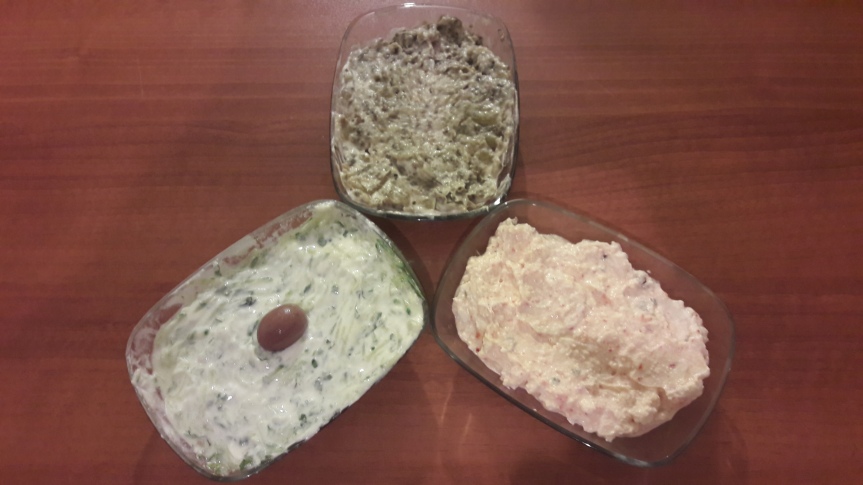
Knidos Cookery Club’s Greek trio with (clockwise from the top) smoky aubergine dip, Psimeni Raki and feta dip and tsatsiki, yogurt and cucumber.
One of the delicacies eaten during the Psimeni Raki festival to help soak up the booze are anevates, cheese pies baked with the aforementioned beverage. Unfortunately, Knidos Cookery Club couldn’t track down any of these pies but the use of Psimeni Raki has inspired us to make a boozy take on Greece’s spicy tirokefteri cheese dip.
Ingredients (serves 4-6 as part of a dip platter)
100 g feta cheese
100 ml Greek-style yogurt
25 ml Psimeni Raki
One teaspoon dried oregano
One teaspoon red chili flakes
Method
Crumble the feta with a fork, add the yogurt, psimeni raki (use sherry or vermouth if you don’t have access to psimeni raki!)and herbs and spices. Mix all the ingredients together thoroughly with the fork and chill for a couple of hours before serving with other dips such as tsatsiki (yogurt, cucumber and garlic) and a dip of roasted aubergines served with yogurt.
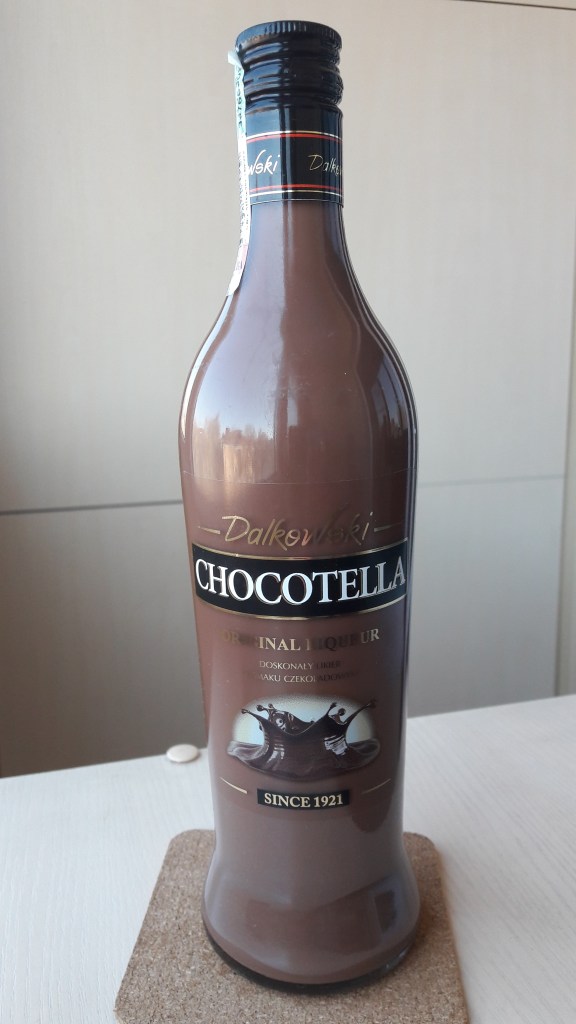
To celebrate this momentous milestone, we’ve gone back to our roots in Datça, Turkey and come up with our second ever cocktail – the Brandy Almonzanda, a very close relative to the Brandy Alexander, a creamy combination of brandy, homemade almond milk and Dalkowski Chocotella (we couldn’t find Creme de Cacao)with a dusting of grated nutmeg on top.
Dalkowski Chocotella – a chocolate liqueur from Poland
Datça’s tasty almonds, badem in Turkish, are rightly famous all over Turkey – I remember sitting on a terrace in Istanbul’s Beyoğlu district, back in the days when it still had tables on the street, when a guy came round selling ice-chilled Datça almonds.
A cup of frothy almond coffee served up at Karia Cafe, Datça, Turkey
Not content with selling the raw nuts, adding them to rice in a stuffed melon or adding them to local mezes, many enterprising cafes along the town’s beachfront have started offering Datça almond coffee – a frothy concoction made from the peninsula’s staple product.
Almond coffee came about because of the isolated position of Datça and the Knidos Peninsula. Sometimes bad weather would mean that supplies of coffee beans could not make it onto the peninsula so the locals made do with something they had in abundance – almonds.
For our Brandy Almonzanda we’ve prepared our own almond milk – it’s pretty easy to do: just soak the raw (unsalted) nuts overnight (or up to 48 hours – the longer you leave them, the better the milk tastes), adding a pinch of salt, a cinnamon stick and a date (we didn’t have any dates so we used some dried apricots).
After soaking overnight, drain and rinse the nuts in fresh water and then put in a blender with 400 ml of cold water and blend to a smooth paste. Strain the almond milk to remove any remaining bits in a metal strainer, using a wooden spoon to press out all the liquid – this will produce around 450 ml – and, hey presto, your almond milk is ready!
To make the cocktail, pour one part of brandy, one part of Creme de Cacao (or similar) and two parts almond milk into a cocktail shaker filled with ice. Shake vigorously and pour into suitable glasses, sprinkle nutmeg over the top, add a straw and serve immediately.
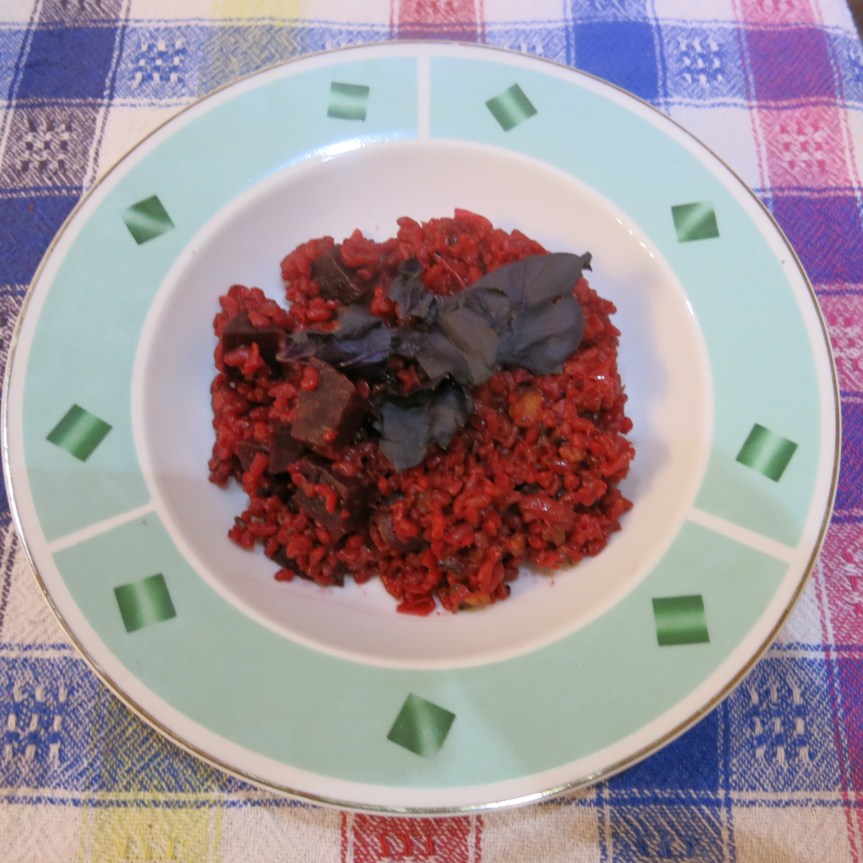
This week on Knidos Cookery Club, we’re featuring beetroot as the basis for a rip-roaringly red risotto.
In Turkish, if you want to say something is, for instance, very blue, then you add a prefix. By adding mas to mavi (blue) you end up with masmavi. As an example, to talk about the deep blue sea you could say masmavi engin deniz.
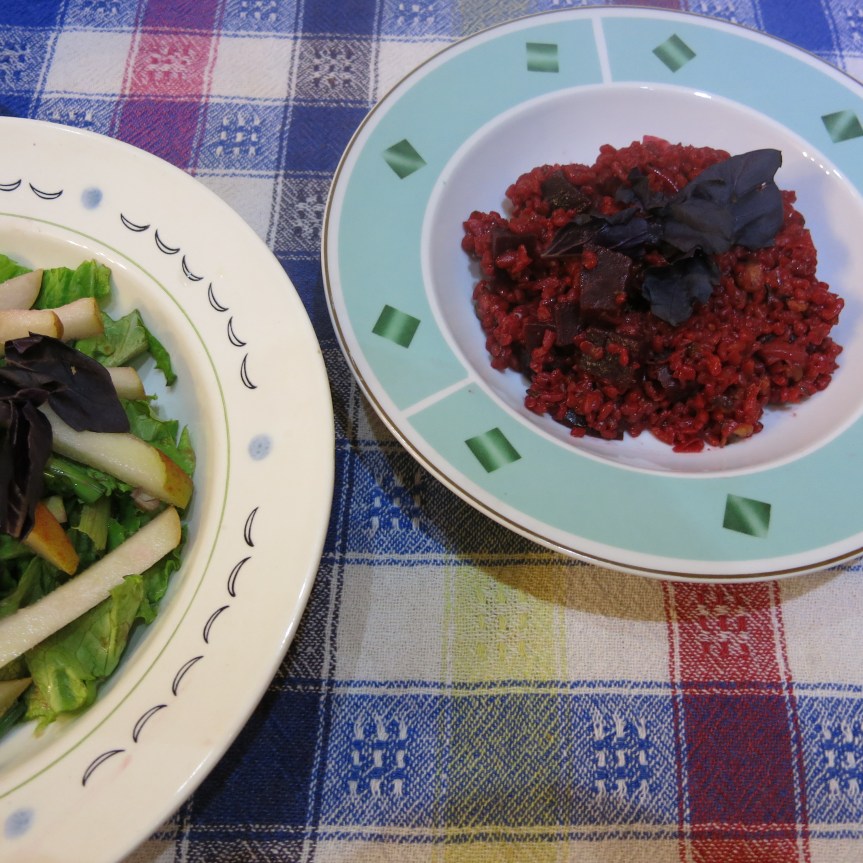
A rich red colour, such as that imparted by beetroot, would come out as kıpkırmızı, or, in English, rip-red, which seems a perfect way to describe out beetroot risotto. To add a Turkish-edge to the dish, we used coarse bulgur wheat, but you can use arborio rice if you prefer.
We added some walnuts to the mix, as they combine so well with the sweet edge of beetroot. This is quite a common combination – in Georgia walnuts are blended with grated beetroot to make pkhali.
Ingredients (serves 3-4)
250 g whole, uncooked beetroot
50 g walnuts
100 g coarse bulgur wheat
150 ml red wine
500 ml beetroot cooking water
25 ml olive oil
one medium-sized onion
one garlic clove
one teaspoon dried thyme
one teaspoon dried rosemary
one teaspoon cumin seeds
black pepper and salt to taste
sprig of fresh basil leaves
Method
Boil the washed but unpeeled beetroot in a saucepan for 30 minutes. Put the beetroot in cold water, keeping the water you used to cook the beetroot separate, and then peel and top and tail the beetroot when cool. Put to one side.
Heat the olive oil in a heavy-based pan and add the cumin seeds. Cook until the seeds are beginning to burn and then add the diced onion and garlic, dried thyme and rosemary and season with salt and pepper. Cook until the onion is going translucent.
Add the washed bulgur wheat and stir to coat the grains. Add the glass of wine and stir occasionally until the liquid is absorbed. Add a third of the vegetable stock and keep cooking and stirring until the liquid is absorbed. Add more stock until the bulgur wheat is cooked and the risotto has a creamy consistency and then turn off the heat.
Meanwhile, gently toast the walnut pieces in a small frying pan and chop the beetroot into small, 1 cm cubes. Mix the beetroot and toasted walnut into the bulgur wheat risotto.
Garnish with fresh basil leaves -green ones make a better contrast to the red of the risotto, but we could only find the mauve coloured variety. Serve with a green salad.
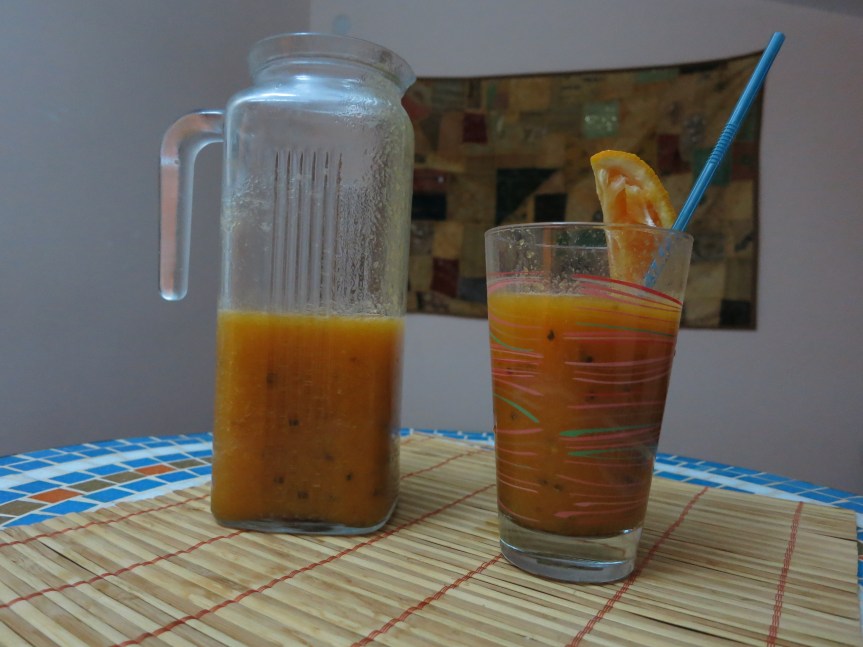
Move aside Bloody Mary – there’s a new hair of the dog on the block: Lord Venal’s Prickly Pear Pick-Me-Up!
Lord Venal’s Prickly Pear Pick-Me-Up
After overindulging while celebrating Ukraine’s 25th anniversary of independence from the Soviet Union, Knidos Cookery Club was in need of a little kickstart to the day. This was provided by Lord Venal with his patent Prickly Pear Pick-Me-Up.
Prickly pears growing wild in south-west Turkey
Apparently, the prickly pear, which grows in arid regions on the Opuntia cactus, has properties that make it a perfect antidote to a hangover. This spiny fruit is full of vitamin C, so that may explain some of its health-giving powers.
Peeling the prickly pear
Care must be taken to peel the pear properly as the spines are painful if ingested. Top and tail the prickly pear then slice the peel off with a sharp knife. Halve the pear and scoop out the seeds, or leave them in for a crunchier cocktail.
Lord Venal recommends the following for his pick-me-up:
Ingredients (makes two large cocktails)
3 prickly pears
200g honeydew melon
100 ml white rum
2 cm fresh ginger
Ice
100 ml cold water
Method
Peel the pears and slice the melon into small cubes. Put into a plastic container with the water and the chopped ginger and use a hand blender to juice the fruit.
Pour in the rum and ice and stir well. Serve with a slice of orange.
Welcome to the tenth edition of Knidos Cookery Club! This calls for a celebration and this week we’ll be looking at some snacks and starters commonly associated with Turkey’s favourite alcoholic tipple, rakı.
A classic sundowner set with rakı, white cheese and cucumber
Rakı is a member of the family of anise-flavoured drinks common to many countries with coastlines on the Mediterranean Sea – ouzo in Greece, pastis in France, sambuca in Italy, arak in Lebanon and chinchón in Spain.
When rakı is diluted with water, it turns a milky white colour leading to its Turkish nickname, aslan sütü, or lion’s milk. It’s drunk as an aperitif and is accompanied by white cheese and cucumber. In spring and early summer, it’s often served with tart, sour green plums, known as can erik.
Sour plums
Rakı also accompanies a long, lazy lunch or evening meal with the drink served alongside a selection of mezeler, or appetizers that include, among many others, a spicy tomato and chili paste, acılı ezme, yogurt, grated cucumber and crushed garlic, cacık, and semizotu, purslane mixed with yogurt. These starters are usually followed by a grilled fish course and the meal is finished with slices of fresh melon.
The new season’s carrots have arrived!
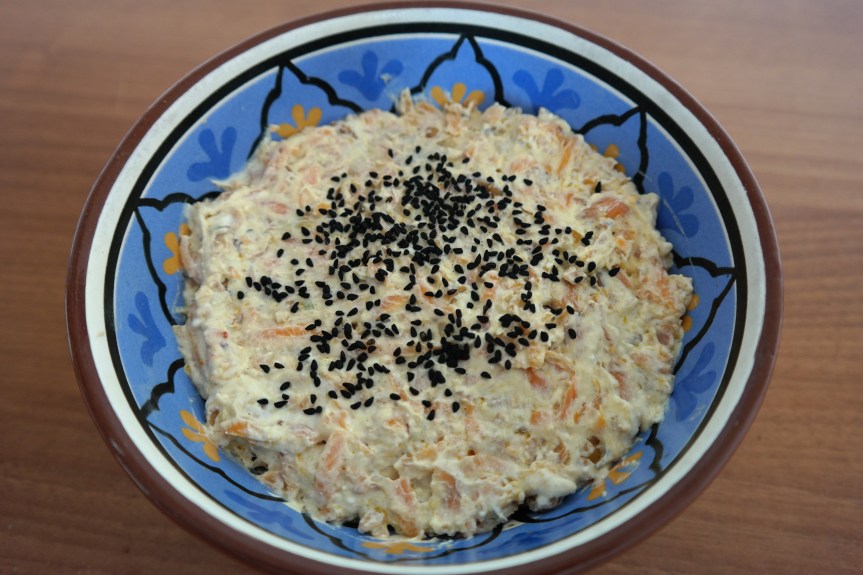
We couldn’t resist these great carrots in the market last week, and they’ve inspired this meze to go with a glass or two of lion’s milk. This week’s recipe is for cezizli havuç tarator, a combo of walnuts, carrots and yogurt.
Carrot and Walnut Tarator
Ingredients (serves 3-4)
200 g baby carrots
Eight walnuts
200 ml Greek (strained) yogurt
One or two garlic cloves
Splash of olive oil
Salt, black pepper, dried oregano, chili flakes, cumin and nigella seeds
Method
Heat the olive oil in a frying pan. Clean and grate the carrots (keep the carrot tops to make this pesto) then cook the grated carrot over a low heat for ten minutes or so to help release the natural sugars in the carrots. While it’s cooking, keep stirring and add pinches of salt, black pepper, dried oregano, chili flakes and cumin.
Allow the carrots to cool then add the crushed walnuts (use a blender or a rolling pin to crush them), as much garlic as you prefer and the yogurt. Blend together well and drizzle with nigella seeds.
Serve as a dip with crackers and slices of red pepper and cucumber along with a glass of rakı, water and ice.










 Knidos Cookery Club