A Badass Peach and Halloumi Salad

23 August 2019

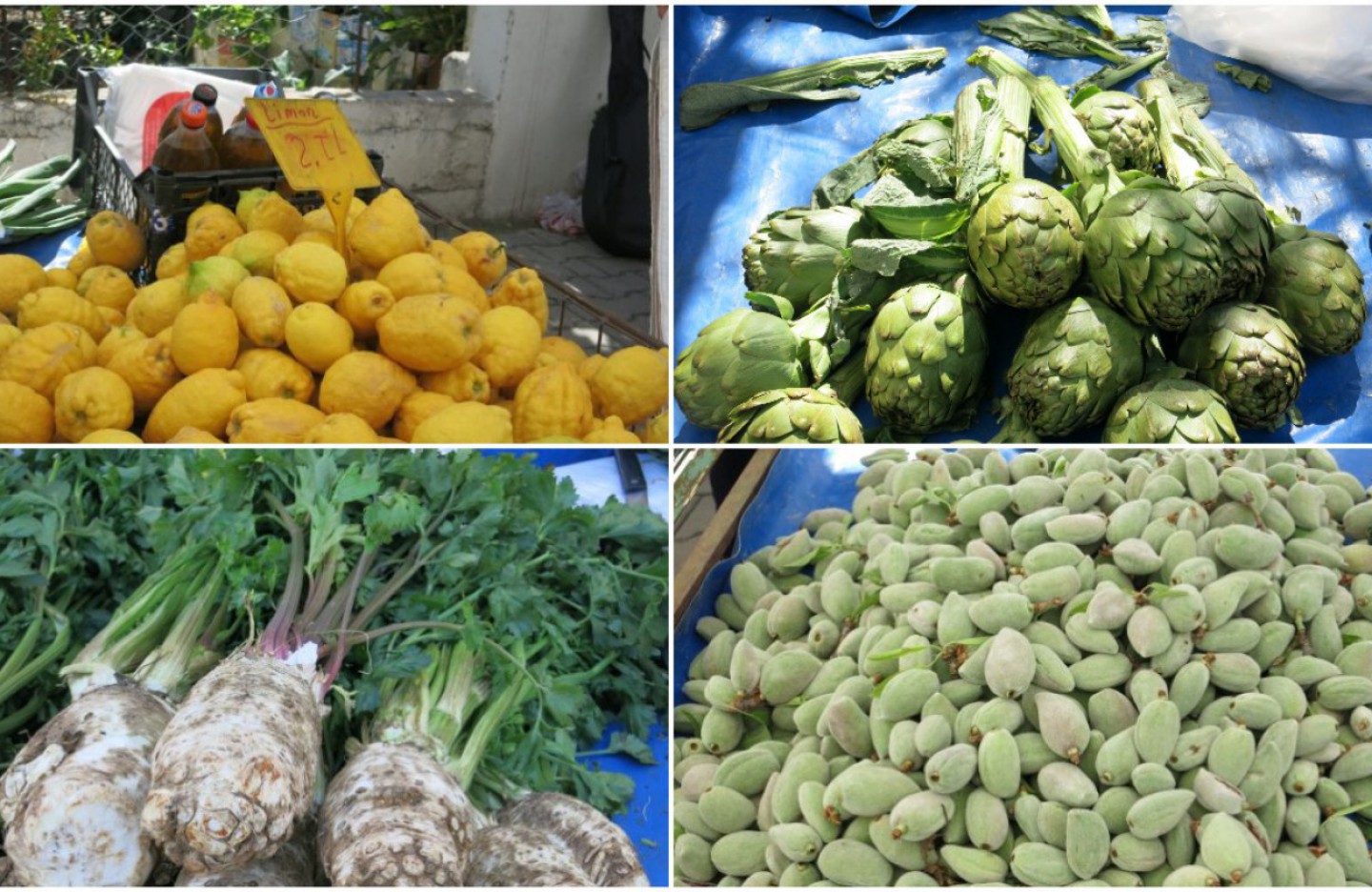
In the dog days of summer, a persistent tap-tapping sound can be heard resounding around the Datca Peninsula. Look for people huddled over piles of green shells to find the source of the tapping. This summer’s almond crop is in and the best way to get to the badass nuts is by hammering the shell open – labourious but ultimately worthwhile work!

A Nutcracker of Knidos beavering away in the summer haze in Turkey

The almond, badem in Turkish, is an important crop on the peninsula – check out this post from a few years ago on the many uses for almonds. We got hold of some of this year’s crop and combined them with some grilled peaches and halloumi cheese to make a super-tasty summer salad.

20190810_214141.jpg
A badass peach and halloumi salad

We got the idea for the grilled peaches from a salad we had in Kaş, Turkey. We grilled the peach and halloumi slices on the barbecue until they took on the required charred appearance. The combination of the sweetness of the peach with the saltiness of the cheese is a winning one.

Ingredients (serves 3-4)

  • 12 almonds
  • 250 g halloumi
  • One large peach
  • One large tomato
  • One bunch of rocket leaves
  • One cucumber
  • Two green peppers
  • Four spring onions
  • One teaspoon capers
  • One teaspoon dried thyme
  • Olive oil
  • Pomegranate sauce

Method

  • Cut the peach into eight slices and grill until just starting to char. Cut the halloumi cheese into eight pieces and grill until it goes a golden-brown colour.
  • Roughly chop the rocket leaves and slice the cucumber and green peppers and mix together with the capers. Dress with the thyme, olive oil and pomegranate sauce.
  • Slice the tomato into wedges and arrange with the peach and halloumi slices on top of the green salad. Just before serving, place an almond on top of each halloumi slice and put four in the middle.
Putting on the Piyaz: Turkey’s Versatile White Bean Salad

2 August 2019

Knidos Cookery Club has just arrived back at its home base on the Datça Peninsula in Turkey. We’re going to soak up some more culinary inspiration from the place where the Mediterranean and Aegean Seas meet around the ancient Greek settlement of Knidos.

20190802_125534-e1564740306182.jpg
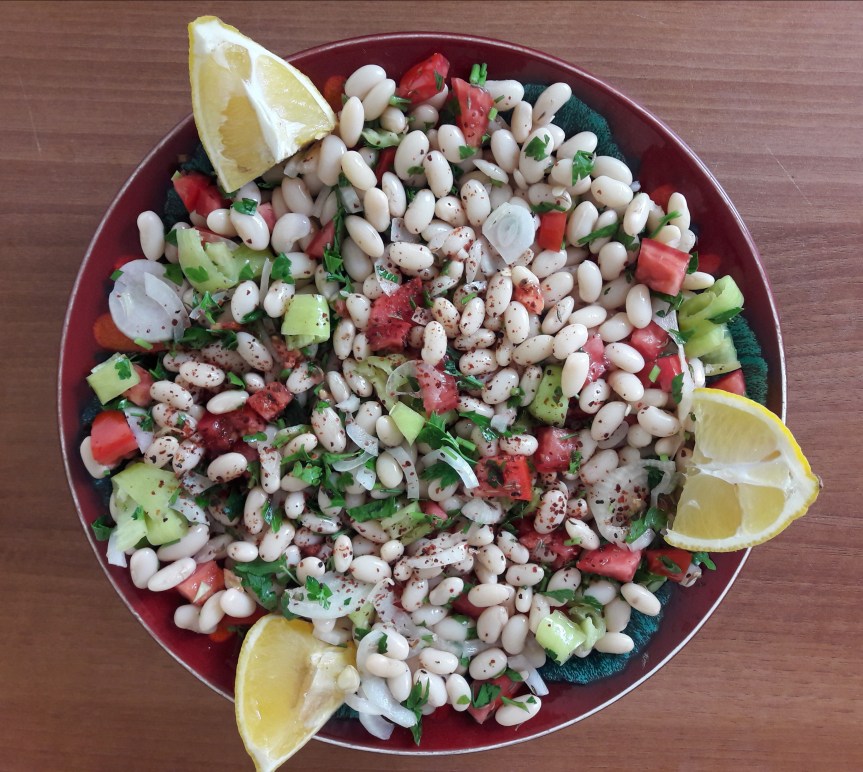
Piyaz – Turkish White Bean salad

To celebrate being back in Turkey, we’ve prepared a piyaz salad, one of the classic dishes of Turkish cooking, that combines small white beans with some readily available staples of the local kitchen; namely tomatoes, onions, green peppers, parsley and lemons.

20190801_160820.jpgTurkey’s çarliston peppers aka banana peppers

The secret of this dish is in getting the beans just right – not too mushy but not too firm either. They need a good, long overnight soak and some slow cooking to achieve the required consistency.

The dressing used varies across Turkey from the basic lemon, olive oil and apple vinegar one favoured in Istanbul to the tahini-infused one from Antalya, paying tribute to the Arabian influence from the Middle East on the city’s cuisine. We have opted for the creamy, nutty taste of the latter.

Ingredients (makes 3-4 servings)

  • 200 g dried haricot beans or other small white beans soaked overnight
  • 1 medium-sized plum tomato
  • 1 long, green pepper (e.g. çarliston pepper – see photo above)
  • 1 small onion
  • 2 lemons
  • Small bunch of parsley
  • 50 ml olive oil
  • 50 ml apple vinegar
  • 25 ml tahini
  • 2 teaspoon dried thyme
  • 1 teaspoon red chilli flakes
  • Optional: Two boiled eggs or one avocado

Method

  • Cook the beans over a low heat until tender but not starting to go mushy. When cooked, drain off the cooking water, reserving 100 ml to make the dressing. Pour the vinegar and sprinkle the thyme over the beans and leave to cool.
  • After leaving for a few hours, add the vinegar the beans were soaking in to the reserved bean juice and then blend with the olive oil, tahini and the juice of one lemon to make a smooth sauce.
  • Finely dice the tomato, slice the pepper and onions into rings and chop the parsley finely. Add these to the beans.
  • Cover the salad and put it in the fridge for a few hours. Serve with wedges of the second lemon and sprinkle the red chilli flakes over the salad.
  • Just before serving, pour the dressing over the bean salad and season with black pepper and gently mix all the ingredients together with a wooden spoon.
  • You can garnish with quarters of boiled egg if you wish or, for a vegan twist, you can garnish the salad with slices of avocado.

Lemony Artichoke and Avocado Pasta

4 July 2019

This time round on Knidos Cookery Club we’re serving up a lemony pasta that combines artichoke hearts with avocado slices in a tomato sauce.

20190703_221559

The earthy flavour of the artichoke goes well with the zingy lemon zest in this healthy and easy-to-prepare pasta dish.  We hadn’t tried artichoke and avocado in the same recipe before, but, on this evidence, we can assure you that it works perfectly!

Ingredients (serves 3-4)

  • Two green peppers
  • Six small tomatoes
  • 25 ml olive oil
  • One lemon
  • Four artichoke hearts
  • One avocado
  • 150 g dried pasta
  • 50 ml water

Method

  • Heat the olive oil over in a heavy-based pan a medium heat and fry the sliced green peppers for five minutes. Add the diced tomatoes and cook for five more minutes. Add the water and reduce the heat so the sauce is simmering. Place the artichoke hearts on top of the sauce, cover the pan and steam for 30 minutes.
  • While the artichokes are steaming, cook the pasta according to instructions. Prepare the zest of one lemon by grating the skin. Squeeze the lemon into the pasta sauce. Remove the artichoke hearts when cooked. When the pasta is ready, drain it and mix with the sauce.
  • Put a layer of pasta and sauce in a bowl, place an artichoke heart in the middle, arrange avocado slices around the artichoke and sprinkle lemon zest over the dish before serving.

Welcoming Uzbekistan with a Royal Feast of Oyster Mushrooms with Buckwheat Noodles

16 May 2019

This time round on Knidos Cookery Club were welcoming cookery fans in Uzbekistan who can finally enjoy unfettered access to our superior vegan and vegetarian recipes after the government unblocked a host of websites, including WordPress, last week.

To celebrate this unprecedentedly momentous occasion, we’ll be riffing on laghman, a classic noodle dish from Uzbekistan. A friend recently turned up at KCC’s Almaty HQ with a proliferation of King Oyster Mushrooms (see the photo below), providing us with a challenge to come up with something tasty.

A quick root around the kitchen cupboards produced a pack of soba (buckwheat) noodles and some sesame seeds so we put a pan of water on to boil and chopped up some leek, celery and tomatoes and added a dash of wine for a rapid-fire stir fry involving the funky-looking mushrooms.

Ingredients (serves 4)

  • 50 ml olive oil
  • two teaspoons cumin seeds
  • 100 g celery
  • 100 g leek
  • 600 g king oyster mushrooms
  • 400 g tomatoes
  • 25 ml soy sauce
  • 100 ml dry white wine
  • Sesame seeds
  • 300 g Soba (buckwheat) noodles

Method

  • Heat the olive oil in a frying pan and add the cumin seeds. Cook over a medium heat for a minute and then add the diced leek. After a few minutes add the chopped celery and cook for five minutes, stirring occasionally.
  • Put the leek and celery mixture to one side and put the diced king oyster mushrooms into the frying pan, add the soy sauce and cook over a low heat for ten minutes or so. If the mushrooms start to go dry, add a dash of water and stir.
  • Add the chopped tomatoes to the mushrooms and cook for five minutes, stirring occasionally. Add the leek and celery mixture and the wine and stir well. Braise everything for ten minutes or so until most of the liquid is absorbed.
  • While the mushroom mix is braising, put the soba noodles in a pan of boiling, salted water and simmer for four to five minutes. Drain the noodles and arrange on a bowl with the mushroom mix on top. Add a sprinkle of sesame seeds before serving.

Make Time for Tabbouleh

2 May 2019

This time round on Knidos Cookery Club we’re taking advantage of some fresh, seasonal ingredients to make one of our favourite springtime salads, tabbouleh.

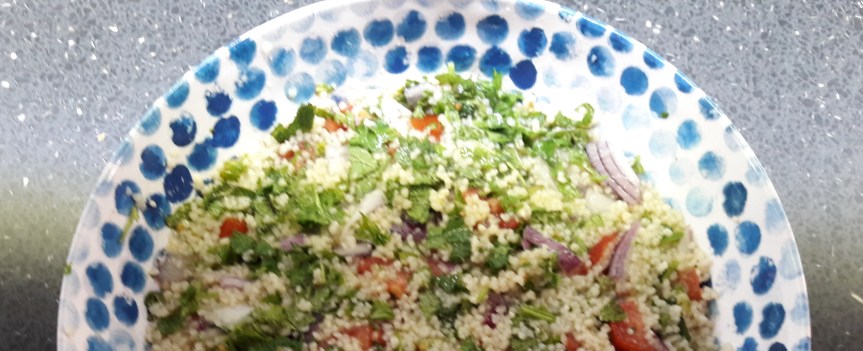
This winning combination of freshly-picked herbs, vegetables, lemon and olive oil with a grain such as couscous or bulgur wheat, that origianets on the eastern shores of the Mediterranean Sea, makes for a light, fresh-tasting dish that works well as part of a meze platter or alongside a selection of barbecued food.

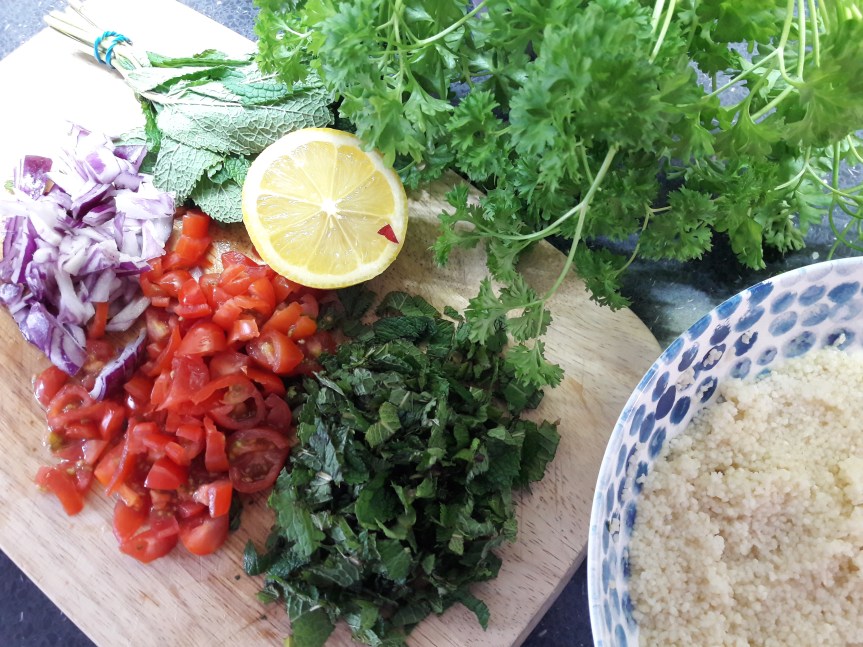
20190419_185838-1.jpg

It’s easy to prepare, giving you more time to lounge in the sun with a glass of chilled wine while making the most of the long evenings.

Ingredients (serves 3-4)

  • 100g grain – couscous or bulgur wheat (coarse or fine both work well here)
  • 200 ml vegetable stock
  • One medium red onion
  • 12 cherry tomatoes
  • One bunch of fresh parsley
  • One bunch of fresh mint
  • Juice of one lemon
  • 25 ml olive oil

Method

  • Heat the vegetable stock until it’s boiling and then pour it over the couscous or bulgur wheat. Cover and leave to stand for 30 minutes or until all the liquid is absorbed.
  • While the couscous or bulgur wheat is soaking, prepare the rest of the ingredients. Dice the onion, quarter the tomatoes, finely chop the mint and parsley and squeeze the lemon.
  • Mix all the ingredients together and then add the olive oil and stir well. Leave to stand in the fridge for 30 minutes and then serve.


Say Aloo to Broccoli

28 February 2019

After touring through North America and Mexico, we’re finally back at KCC’s winter HQ in Almaty, Kazakhstan. We’ve been craving for something spicy and Asian and, with broccoli in season, decided on this take on the Indian classic aloo gobi.

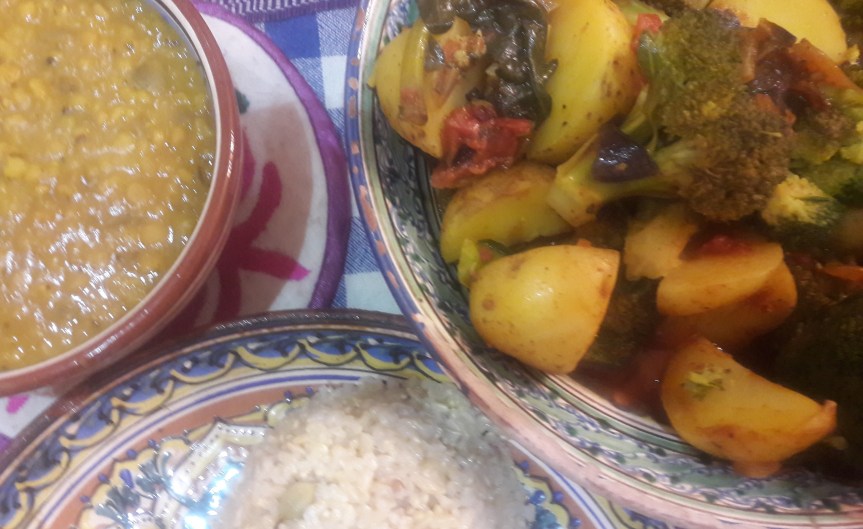
20190223_215808.jpg
Aloo broccoli, rice and dal

You’ll probably be familiar with aloo gobi, which combines potato and cauliflower in a spicy sauce, if you’re a fan of food from the Indian sub-continent. Having eaten the cauliflower version numerous times, we started to wonder why we’d never come across the dish made with broccoli instead.

It turns out that broccoli is a fairly recent arrival to the tables of India – it was first brought to the country in the early 1990s by a farmer called Jitendra Ladkat, according to this article. So, therefore, there’s no great surprise that it does not feature as a mainstay of Indian cooking.

We served up our aloo broccoli with a split pea dal, brown rice and some flat bread and can thoroughly recommend it as an alternative to the tried and tested aloo gobi.

Ingredients (for 3-4 servings)

  • 400 g small potatoes
  • 400 g broccoli florets
  • One small red onion
  • 200 g tomatoes
  • 50 ml cooking oil
  • Spices: one teaspoon each of cumin seeds, coriander, chilli powder, turmeric, six cloves, one star anise.

Method

  • Cut the potatoes into quarters and put into a pan of boiling water and simmer over a low heat for five minutes, then add the broccoli, cover the pan and cook for another five minutes.
  • Heat the oil in a heavy-based pan and add the cumin seeds, cloves, star anise and cinnamon stick. After five minutes add the chopped onion and cook over a medium heat. Add the coriander, chilli powder and turmeric and mix well.
  • Add the tomatoes and cook for a few minutes over a low heat and then add the cooked broccoli and potatoes. Mix well and cook for ten minutes, stirring occasionally.
  • Serve with rice, dal and flat bread. The dish tastes even better if left overnight and reheated as this allows time for the flavours to blend.

Down Home Arizona Kızartma

14 February 2019

This time round on Knidos Cookery Club we’re swinging through Tucson, Arizona on the way back home. Whilst in Tucson, we met up with some old friends from Kazakhstan (via Turkey and the USA) and were treated to Tolga’s kızartma –  grilled peppers mixed in with fried aubergines and potatoes served in a garlic-infused tomato sauce and garnished with dollops of natural yogurt.

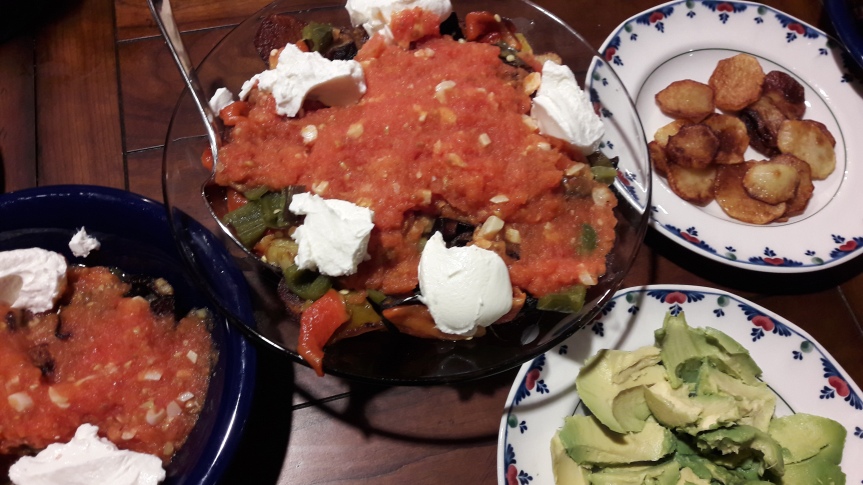
20190204_191319
Tolga’s classic down home Arizona kızartma

Tucson is located on the edge of the Sonora Desert which stretches up into Arizona from northern Mexico. It’s a surreal landscape of towering cacti called saguaro (Carnegiea gigantea), which can grow to be more than 12 m tall.

20190203_163203
There’s a lot of cactus….

The desert is a fascinating place populated with bobcats, coyotes, a variety of snakes and scorpions along with hallucinogenic Sonoran Desert toads (if you’re brave enough to lick them… ).

Having observed the master chef at work closely, here’s KCC’s take on the Turkish classic kızartma.

Ingredients (serves 3-4)

  • Two large potatoes
  • Three medium-sized tomatoes
  • Three garlic cloves
  • one small onion
  • One large aubergine
  • One avocado
  • Four peppers – a mix of green and red
  • Four jalapeño peppers
  • 75 ml olive oil
  • 100 ml natural yogurt

Method

  • Heat 25 ml of oil in a heavy-bottomed pan. Cut the potato into 1mm slices and fry in the oil, turning occasionally, until they are a golden-brown colour on both sides. Remove with a slotted spoon and put on a plate lined with kitchen towel.
  • Prick the peppers a couple of times with a fork and then roast them on a barbecue or over an open flame (here’s some tips on how to do this) until the skin is blackened all over. While the peppers are roasting, put 25ml oil in the pan and cut the aubergine into 1cm cubes and fry until golden brown. Remove with a slotted spoon and put on a plate lined with kitchen towel.
  • Add the rest of the oil to the pan, heat it up and then fry the finely chopped onion and garlic for five minutes over a medium heat and then grate the tomatoes into the pan and cook for 15-20 minutes. Peel the peppers, remove the seeds and chop the roasted peppers roughly.
  • In a large bowl put a layer potatoes, aubergine and peppers alternately. Pour the tomato sauce over the top and garnish with dollops of yogurt. Serve with slices of avocado.

Papa Jack’s Refried Avocado

31 January 2019

We’re continuing in our Mexican groove to make a vegetable take on the refried beans concept. It was meant to be a burger, but it didn’t hold together too well, so here is our refried avocado.

20190119_222556-e1548437819761.jpg

Refried beans are a Mexican staple and served on tortillas or as a side dish – the beans  are mashed up and fried with garlic and spices. We’ve combined mashed potato, with a smashed up avocado, a diced jalapeño pepper and some yaka, or jackfruit. Potatoes are called papas in Mexican Spanish, hence the name for this dish: Papa Jack’s Refried Avocado.

20190120_135003

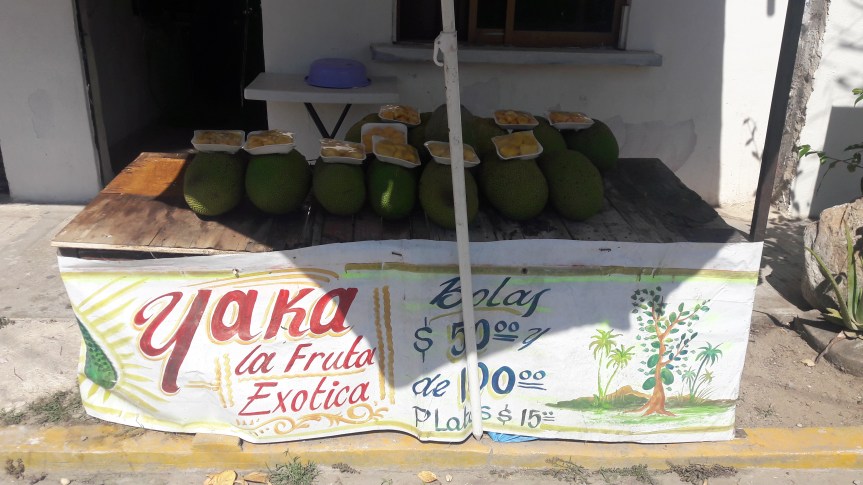
Jackfruit, a giant tropical fruit with a hard green spiky shell, that can grow up to 40kg, is widely available in Mexico. The fruit is a strong tasting yellow fleshy bulb that is somewhere between pineapple and banana.

We served the refried avocado on toast with our own salsa made with tomatoes, courgettes, carrots and chilli peppers.

Ingredients (makes 3-4 servings)

For the refried avocado:

  • Three medium-sized potatoes
  • One avocado
  • One jalapeño pepper
  • One lime
  • One jackfruit bulb
  • 25ml olive oil

For the salsa:

  • Two medium-sized tomatoes
  • One carrot
  • One courgette
  • One jalapeño pepper

Method

  • Cook the potatoes until they can be mashed easily with a fork. Cut the avocado in half, remove the stone and add the flesh to the potato. finely dice the pepper and jackfruit (remove the stone first) and add to the mix, along with the lime juice. Mash everything together with a fork or potato masher.
  • Heat the oil in a heavy-based frying pan. Heat the mashed avocado through in the hot oil and serve on toast with a salsa made of tomato, carrot and courgette – simply dice the tomatoes and cook the chopped up carrot, courgette and jalapeño pepper in the tomato liquid over a low heat for 20 minutes or so.

Artful Artichokes Meet Crafty Celeriac in Solstice Showdown

20 December 2018

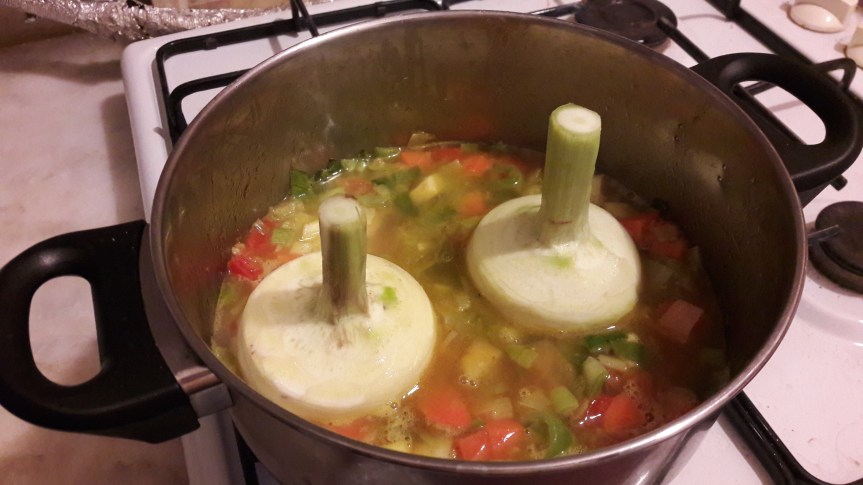
To celebrate the Winter Solstice, we’re combining two of our favourite oddball vegetables  – globe artichokes and celeriac. For the longest night of the year, we’ve come up with phallic artichokes steamed in a hearty winter root vegetable broth – Knidos Cookery Club’s take on the Turkish classic Zeytinyağlı Enginar, a dish of artichokes served with cubed vegetables cooked in olive oil and lemon juice.

20181212_221549
An artful artichoke

To get to the heart of the matter, artichokes need a bit of preparation to reveal the edible heart of the vegetable. If you don’t have a neighbourhood artichoke peeler on the corner of your street, as we do in Istanbul, than check out this link from The Spruce Eats website for some useful tips on removing the fibrous, inedible choke.

20181212_203036
Let the simmering begin

Celeriac, with its bulbous appearance, is an often overlooked root vegetable. It’s nutty taste, with a hint of celery, makes a delicious addition to soups and stews and it’s also great served raw in salads. We’ve used it as a replacement for potato in this Turkish favourite.

Ingredients (for four servings)

  • Four artichoke hearts
  • Two leeks
  • Four small carrots
  • Two small celeriac bulbs
  • Two medium-sized tomato
  • Four green peppers
  • Juice of half a lemon
  • 50 ml olive oil
  • 500 ml cold water
  • Two teaspoons garam masala (or curry powder)
  • Pinch of black pepper

Method

  1. Heat the oil in a heavy based-pan (with a lid) and and  the finely sliced leeks and peppers and cook over a medium heat for five minutes. Cube the carrots and celeriac and stir into the leek and pepper base and cook for a further five minutes. Add the chopped tomato, garam masala and black pepper and cook for five more minutes, stirring frequently.
  2. Pour the water over the vegetables, add the lemon juice and place the artichoke hearts on top of the bubbling veggies. Put the lid on the pan and cook over a low to medium heat for 30 minutes.
  3. Put one artichoke heart on each plate and pour the vegetables and cooking liquid over the top and around the artichoke and serve hot with crusty bread.


Couscous on the Loose

6 December 2018

This week we’ll be making our take on couscous, that staple of North African cooking. Our version uses fine bulgur wheat in place of the more usual durum wheat semolina base as bulgur wheat is easier to find on the supermarket shelves where we are based.

20181002_215336
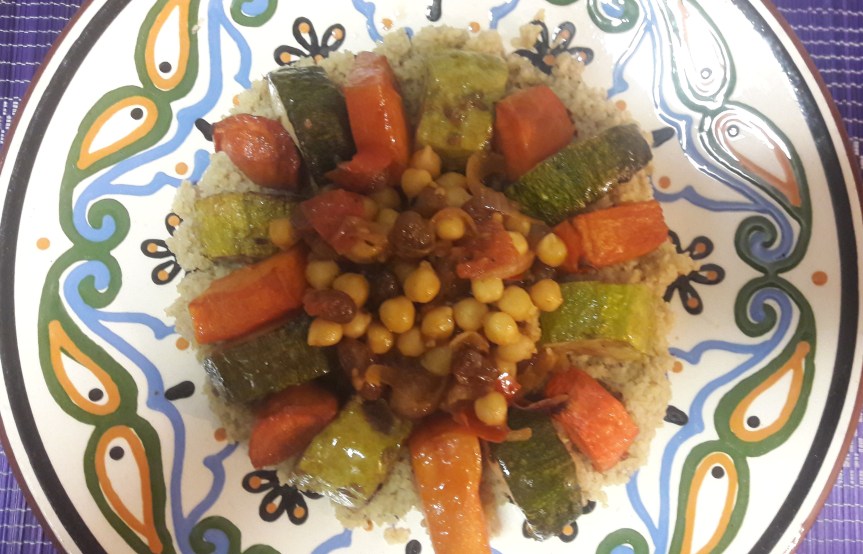
KCC’s couscous with chickpea chutney and roasted vegetables

In our opinion, bulgur works just as well as semolina as a base to soak up the juices from the roasted vegetables and our chickpea chutney. Purists may disagree, but our philosophy is more about adapting recipes by using the ingredients you have at hand.

Ingredients (serves 2)

Roasted vegetables:

  • 300 g pumpkin
  • 2 medium carrots
  • 2 medium courgettes
  • 25 ml olive oil
  • 1 teaspoon cumin seeds
  • 1 cinnamon stick

Chickpea chutney:

  • 25 ml olive oil
  • 1 teaspoon mustard seeds
  • 1 small red onion
  • 2 small tomatoes
  • 50 g currants
  • 250 g chickpeas
  • 1 teaspoon red chilli flakes
  • 1 teaspoon black pepper

Couscous:

  • 100 g fine bulgur wheat
  • 200 ml vegetable stock

Method

Pre-heat the oven to 200c, cut the vegetables into large chunks and put into a baking dish, drizzle with olive oil and add the cumin seeds and cinnamon stick and stir to coat the vegetable chunks. Roast for 30-40 minutes until the vegetables are cooked.

While the vegetables are roasting, prepare the chickpea chutney. Heat the olive oil in a frying pan and add the mustard seeds. When they start to pop, add the finely chopped onion and cook over a low heat for five minutes. Add the spices and the chopped tomato and cook for five more minutes. Then add the currants and chickpeas and cook for fifteen minutes or so.

Bring the vegetable stock to the boil and then cover the bulgur wheat with it and leave it to soak up the liquid for 30 minutes or so, drain off the excess liquid (if there’s any) and than add a dash of olive oil and fluff up with a fork.

Put a layer of couscous on a warmed plate, arrange the roasted vegetables in a circular, wheel-spoke pattern and put a generous dollop of chickpea chutney in the centre and serve immediately.