Unravelling Ravioli on the Path to Pkhali Pierogi

1 March 2018

This time round on Knidos Cookery Club we’ll be unravelling ravioli, one of the many forms of filled pasta pockets found around the world – from Turkey’s manti, Uzbekistan’s chuchvara and Kazakhstan’s tushpara to Russia’s pelmeni, Ukraine’s varenyky and Poland’s pierogi – the list is endless.

20180223_232604
KCC’s beetroot-filled pkhali pierogi

These pasta pockets, which are boiled rather than steamed, can come in a variety of shapes and sizes with a wide range of fillings such as pumpkin, potato, spinach and ricotta cheese, or different types of fruit.

We’ve opted for a semi-circular shaped pierogi which we’ve filled with beetroot and walnut pkhaliclick here for our feature on this classic Georgian dish from last year.

20180225_181745
Three steps to a perfect pierogi!

Ingredients (Makes 16-24 depending on how big you make the pierogi)

For the pasta:

200 g flour

3 teaspoons olive oil

100 ml water

pinch of salt

Method

Make the pasta by sifting the flour into a large mixing bowl and then add the oil, a pinch of salt and half of the water in a well in the middle of the flour. Mix inwards from the outside with a wooden spoon and then add the rest of the water until the dough has absorbed all the flour.

Knead for ten minutes or so and then leave the pasta dough to rest in the fridge for at least one hour. After resting, roll the pasta out onto a lightly-floured surface to a thickness between 0.5 and 1.0 mm.

Use a glass to cut out round shapes from the dough, add a teaspoon of cooled beetroot pkhali in the bottom half of the circle and moisten the inside edge around the filling with a little water and then fold the top over. Use a fork to seal the pasta pocket.

Bring a large pan of water to the boil and then add the pierogi to the water and keep boiling over a low heat until the pierogi float to the surface. Remove the pierogi with a slotted spoon and serve hot – they’re good served with sour cream or melted butter or just plain.

Pidemania: The Great Turkish Bake Off

1 February 2018

“April is the cruellest month” as TS Eliot put it, but I’ve always thought there’s a case for  February to be considered crueller. As winter drags on interminably in the northern hemisphere – we’re still six months away from August and the height of summer – those long, lazy days all seem so far away, especially with the mercury plunging into serious minus territory as in Knidos Cookery Club’s winter HQ in Almaty, Kazakhstan.

20180131_213541
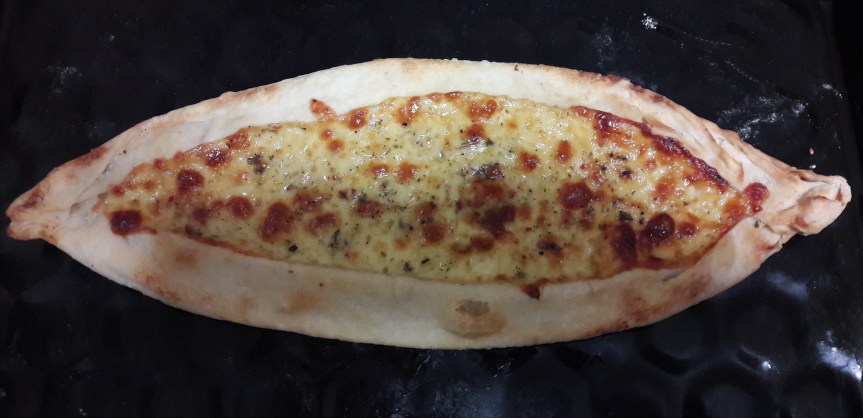
Yum yum – Kaşarlı Pide

So, thoughts have been turning to warmer times and to distant memories of eating pide, Turkey’s take on pizza, under the shade of mandarin trees in Datça.

20180201_125324.jpg
or maybe Otlu Pide?

With KCC’s new oven up and running in Almaty, it’s high time for a Great Turkish Bake Off as we take on the pide challenge and bring a slice of the Turkish summer into the winter gloom of Kazakhstan. 

We’ll be making a standard Kaşarlı Pide, an open one made with a yellow cheese such as cheddar – See the three stages for assembling this pide above. 

And here is an Otlu Pide, a covered one made with various greens such as spinach and parsley and a ricotta-like cheese called lor as seen above.

Ingredients (Makes four pides)

For the base:

300 g flour

One teaspoon dried, instant yeast

125 ml cold water

30 ml olive oil

For the filling:

Kaşarlı Pide (makes 2)

200 g grated yellow cheese such as a mild cheddar

Pinch of red chilli flakes

Pinch of dried thyme

Pinch of freshly ground black pepper

Otlu Pide (makes 2)

One small onion

125 g spinach

25 ml olive oil

One bunch fresh parsley (around 25 g)

One bunch fresh coriander (around 25 g)

100 g ricotta cheese (or similar)

One teaspoon cumin seeds

One teaspoon red chilli flakes

Pinch of dried thyme

Pinch of freshly ground black pepper

Sprinkling of sesame seeds (or black, nigella seeds if you can find them)

Method:

Sieve the flour into a large, ceramic bowl, add the dried yeast, make a well in the middle and pour in the olive oil and slowly add the water and mix well so that all the flour is used up.

Knead for ten minutes or so until you have a stretchy, elastic dough. Put in an oiled bowl and cover with a tea towel and then leave it to rise in a warm place for 30 minutes or so until it is doubled in size.

While the dough is rising, prepare the filling for the Otlu Pide. Heat the olive oil in a frying pan and add the cumin seeds, chilli flakes, dried thyme and black pepper and then add the finely chopped onion. Cook for five minutes and then add the chopped spinach, parsley and coriander and cook until it all begins to wilt. Allow to cool and then stir in the lor (ricotta) cheese.

Divide the dough into four and roll each ball into a 30 cm by 20 cm oblong about 1 mm thick on a lightly floured surface. For the Kaşarlı Pide, spread the grated cheese over the middle leaving 2 cm around the edges and season with thyme, chilli flakes and black pepper. Fold the edges over and then fold again and pinch the ends together to make a boat shape. Glaze the dough with olive oil.

For the Otlu Pide, place half the filling in the bottom half of the rolled out dough then fold the top over and make into a parcel shape (as in the picture above). Glaze with olive oil and sprinkle with sesame seeds.

Bake the pides in an oven pre-heated to 200 c for 20-30 minutes or so until the cheese bubbles and is starting to go brown and the dough is also starting to go a golden-brown colour. Serve straight from the oven with a salad of your choice.

Fesenjan for Beginners

18 January 2018

This week on Knidos Cookery Club we’re going to be bucking the January detox trend with this super-rich, calorie-laden Iranian stew, Fesenjan (pronounced fesenjoon), that combines three of our favourite go-to ingredients – pomegranate, walnut and pumpkin.

20180112_221142
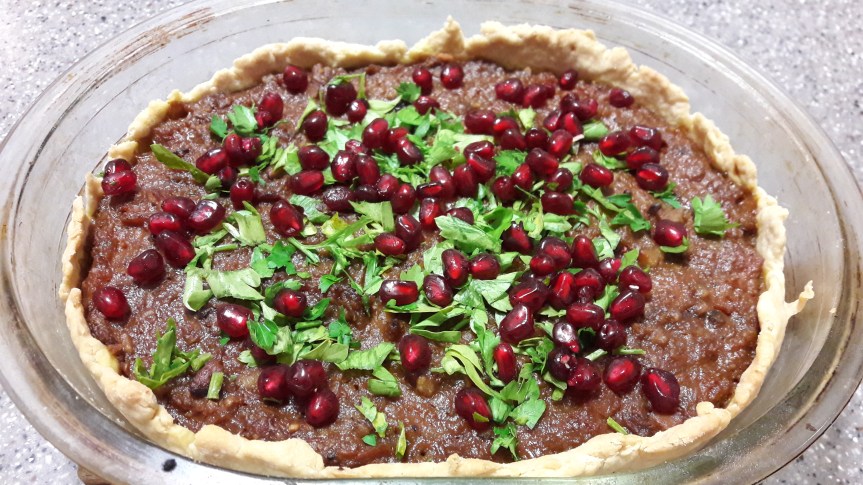
KCC’s Fesenjan Tart

Usually served as a thick stew with rice, we’ve decided to put it in a pie case to make a tasty walnut and pomegranate infused tart. Making this stew can be quite labour-intensive – shelling the walnuts, toasting them, crushing them, extracting the pomegranate seeds and so on, but the end result makes it well worth all the effort.

20180112_185716
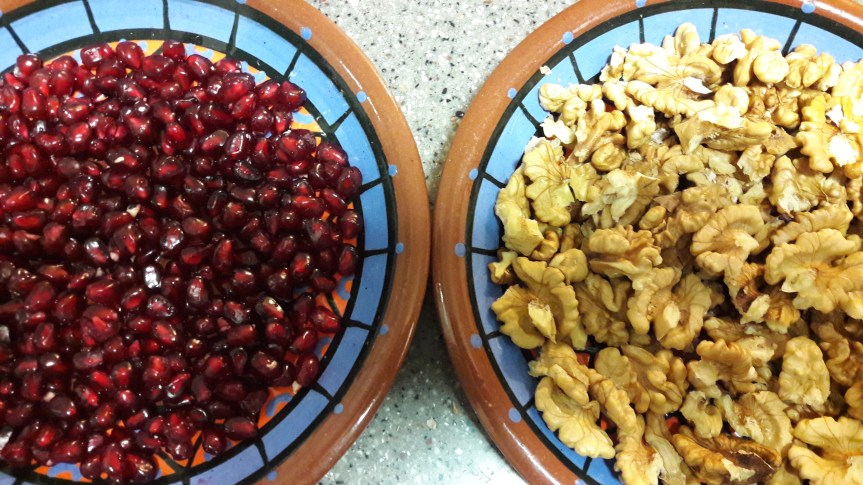
Can’t get much fresher than this!

Look out for Nar Ekşisi (pomegranate syrup) or the sweeter Nar Ekşili Sos (pomegranate sauce) in your local Middle-Eastern shop or make your own. If using Nar Ekşisi, add a teaspoon or two of honey to the stew to make it a bit sweeter.

To save time you can use shop-bought pastry, but we think it tastes better with a homemade pie crust. To keep it vegan, we’ve used olive oil instead of butter to make our shortcrust pastry.

Ingredients (serves 4)

125 g shelled walnuts

one medium onion

500 g pumpkin or butternut squash

300 ml vegetable stock

30 ml olive oil

2-3 tablespoons pomegranate syrup or sauce (Nar Ekşisi or Nar Ekşili Sos in Turkish)

0.5 teaspoon cumin seeds

0.25 teaspoon cinnamon and turmeric

Black pepper

Handful of pomegranate seeds

Bunch of fresh parsley

200 g shortcrust pastry

Method

Toast the walnuts for 10 minutes over a low heat and then mince in a blender. Heat the olive oil and fry the onion in a heavy-based pan over a medium heat for ten minutes. Add the spices and then add the cubed pumpkin and stir to cover.

Pour over the vegetable stock, add the pomegranate molasses and the minced walnuts and cook over a medium heat for 30 minutes until the pumpkin is cooked. Make sure the sauce is quite thick – if it’s runny, boil it until it starts to thicken.

Roll out the pastry and place it in a greased baking tray. Bake blind for ten minutes at 180c and then put the filling into the pie case. Cook for 40 minutes or so until the pastry starts to go golden brown.

Garnish the tart with chopped parsley and pomegranate seeds and serve with saffron rice and a green salad.

Pumpkin, Pear and Pomegranate Potage

21 December 2017

Seasoned greetings to all our readers! To end the year on a high, we’ve come up with a thick and hearty pumpkin and pear soup sprinkled with pomegranate to add a colourful touch to your seasonal table.

Screen Shot 2017-11-16 at 15.56.41

Roasting pumpkin in the oven is a great way to prepare our favourite winter vegetable. After cubing the pumpkin, it’s just a matter of waiting about an hour or so for it all to cook leaving time to enjoy a few glasses of mulled wine or a snowball or 

Knidos Cookery Club would like to say a big thank you for all our readers who voted for us in the Saveur food blog awards – unfortunately we didn’t win this time round…

Wishing you all a creative and tasty 2018 in your kitchen. Have a great time with whatever tickles your festive fancy in what’s left of 2017. See you next year!

Ingredients (serves 3-4)

500 g pumpkin cubed

100 g pear

One small onion (around 75 g)

One teaspoon cumin seeds

Half teaspoon ground cinnamon

Pinch of black pepper

50 ml olive oil

250 ml vegetable stock

50 g pomegranate seeds

Method

Chop the pumpkin into 2 cm cubes, quarter and slice the pear into 1 cm cubes and put in a baking dish. Sprinkle the sliced onion, cumin seeds and cinnamon over the pumpkin and pear and then slosh the olive oil over the top. Bake for 40 minutes at 180 c in a pre-heated oven.

While this is baking, boil up some vegetable stock. Add the pumpkin and other ingredients to the stock, blend with a hand blender and serve immediately in a bowl with a smattering of pomegranate seeds over the soup.


Let them Eat Cabbage!

9 November 2017

This week saw the 100th anniversary of Russia’s October Revolution, which led to the creation of the Soviet Union. To mark this momentous occasion in world history, Knidos Cookery Club has turned to a soup made from the close relative of a vegetable that was at the heart of Soviet cuisine – the humble cabbage.

20171104_235653
KCC’s cabbage soup with brown bread

The cabbage, and soups such as shchi that were made from it, was a mainstay of the Soviet diet. I remember hearing jokes about it when I was a lad such as this gem:

Q. What’s three miles long and eats cabbage?

A. A Soviet meat queue.

We’ve used Chinese cabbage as a twist on the traditional recipe that uses the more familiar member of the Brassica family and spiced up the mix with a few Shiitake mushrooms and some chilli powder.

Screen Shot 2017-11-08 at 17.36.31

It makes a great accompaniment, along with a few shots of vodka, to October: Ten Days that Shook the World, the classic 1928 Soviet silent classic directed by Sergei M. Eisenstein and Grigori Aleksandrov (which is available on BBC iPlayer until the end of this November).

The film was based on John Reed’s book of the same name, which told the story of the revolution from the abdication of the last Czar to the Bolshevik seizure of power. Another good read on the same topic follows Lenin on the Train, an account by Catherine Merridale of Lenin’s trip back to Petrograd on the eve of the revolution.

Ingredients (serves 4)

300 g shredded Chinese cabbage

2 medium onions

1 green pepper

4 dried mushrooms (rehydrated)

2 garlic cloves

2 medium tomatoes

25 ml cooking oil (sunflower or another neutral, refined oil)

1 litre vegetable stock

1 bayleaf

Pinch of black pepper

One teaspoon red chilli flakes

Dash of soy sauce

Rye bread (or a similar hearty brown bread)

Method

You’ll need a good hearty stock for this soup, so prepare some in advance or use stock cubes. Heat the oil in a heavy-based pan and then add the chopped onions and garlic. Cook for 10 minutes or so over a medium heat – while it’s cooking chop up the mushrooms and green pepper and then add to the mix,

Stir and cook for five more minutes then add the chopped tomatoes, black pepper, chilli flakes and bayleaf and cook until the tomatoes start to collapse. Then add the vegetable stock and bring to the boil.

Next add the shredded cabbage and cook for ten minutes or so until the cabbage is tender. Add soy sauce, remove the bay leaf and serve with brown or black bread and a shot of vodka!

Viva la Revolution, comrades!


Fava à la Grecque

12 October 2017

There are a lot of similarities between Turkish and Greek cuisine with both claiming baklava as their own and many other shared dishes, but there are also some striking differences. One variation we’ve noticed on our travels around Turkey and Greece has been with the dish known as fava in both countries.

20171006_134319
Fava à la Grecque

Last week we featured Turkey’s take on fava, made with broad beans, so this week we’re going to balance things up and have a look at Greece’s take on this dish, which is made with yellow split peas.

20171006_131423
Ingredients for fava à la Grecque

These dried peas proved quite hard to track down in Turkey – most supermarkets don’t stock them, but we eventually found them on sale in Datça market, mixed in with a few lentils and whole grains for good measure!

Greece’s version of this dish is runnier than Turkey’s, more like a hummus consistency, so it’s more suitable to use as a dip or spread. We’ve added some sumac to bring together these two esteemed cuisines in a spirit of gastronomic entente cordiale!

Ingredients (makes 6-8 healthy servings)

250 g yellow split peas, soaked in cold water for 1-2 hours

One medium red onion

One garlic clove

One teaspoon dried thyme

25 ml olive oil

500 ml water

Juice of one lemon

Pinches of salt and black pepper

Use a pinch of sumac, slices of red onion and a squeeze of lemon juice to garnish the fava

Method

Fry the finely chopped onion and garlic in the olive oil over a medium to high heat until the onions start to caramelise. Add the split peas and thyme, season with salt and pepper and stir well. Pour in the water, bring to the boil and then reduce the heat and simmer for 30 minutes or so until all the liquid is absorbed.

Allow the cooked mixture to cool for ten minutes and then use a hand blender to make it into a smooth paste. As you’re blending the mix, add the lemon juice to give it a creamier consistency.

Use a pinch of sumac, slices of red onion and a squeeze of lemon juice to garnish the fava and then serve warm with crusty bread and a green salad.


Relish the Radish

3 August 2017

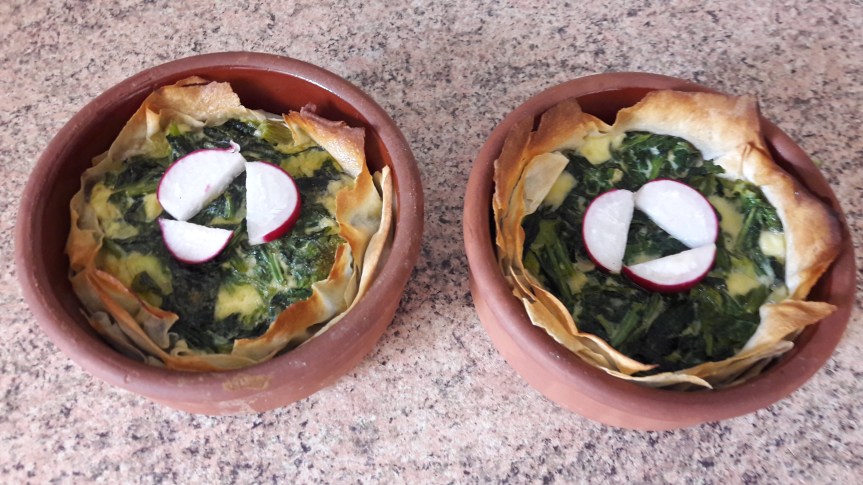
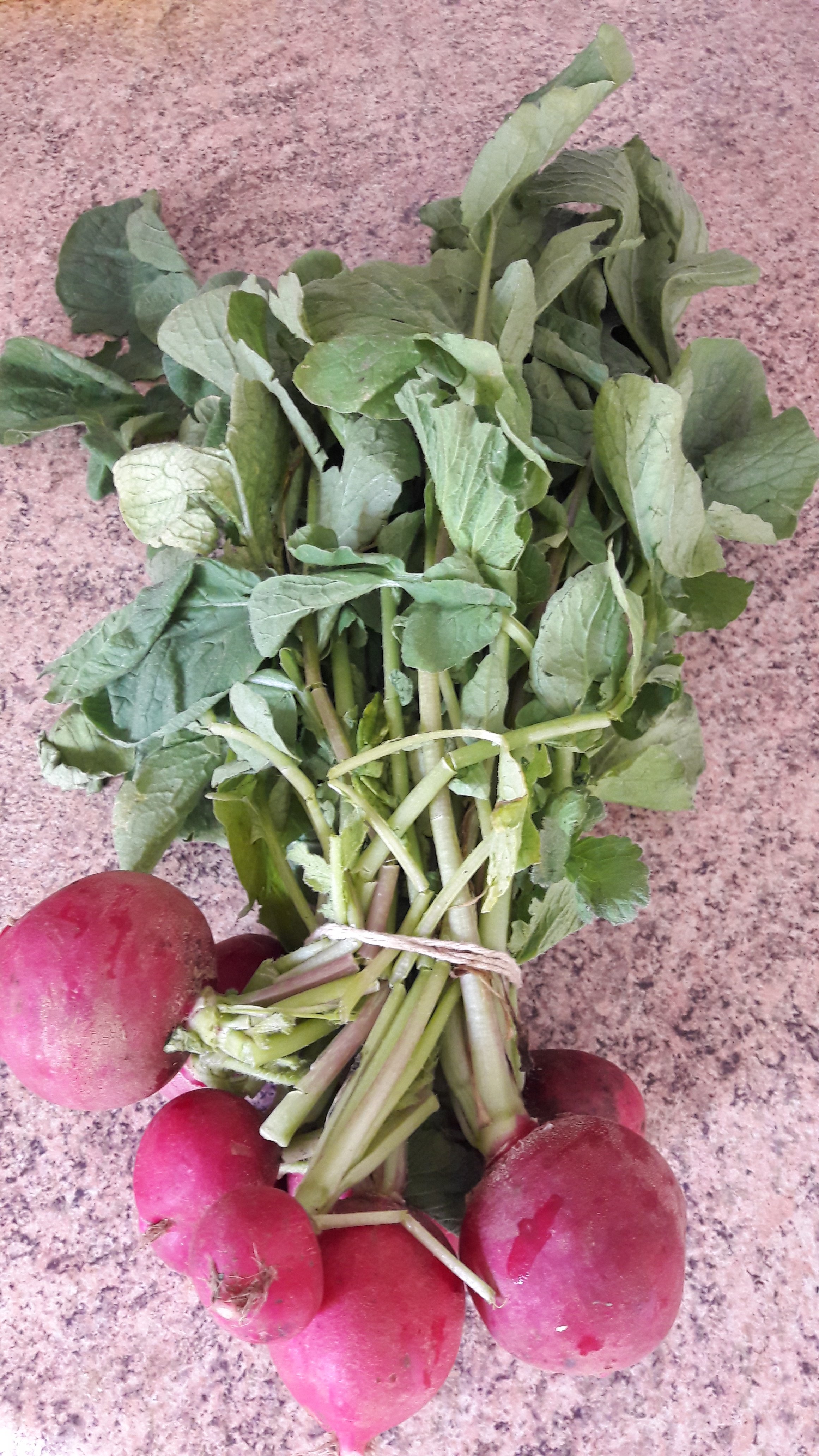
In keeping with the ‘Waste not, want not‘ mantra, this week we’ll be using some radish greens in a mini quiche.

20170624_144252

Often discarded, these peppery leaves taste great when fried up with some spring onion, garlic and a dash of soy sauce.

Ingredients ( makes four mini-quiches)

150 g radish leaves

1 radish (for decoration)

2 spring onions

1 garlic clove

Dash of soy sauce

60 g crumbly white cheese

2 eggs

25 ml olive oil

150 g filo pastry or shortcrust pastry

Method

Saute the chopped onions and garlic in a little olive oil in a heavy-based pan for 2-3 minutes, add a dash of soy sauce and then add the radish leaves and cook for another 2-3 minutes until the leaves start to wilt.

Allow the mix to cool for ten minutes then mix in the eggs and cheese. Prepare cases in small baking dishes with the filo pastry, brushing each filo leaf with olive oil.

Pour the mix into each pastry case to half way and then bake for 20 minutes in an oven pre-heated to 180 c.

Garnish with radish slices and serve with a green salad laced with more sliced radish!

Barbunya Bean Therapy

22 June 2017

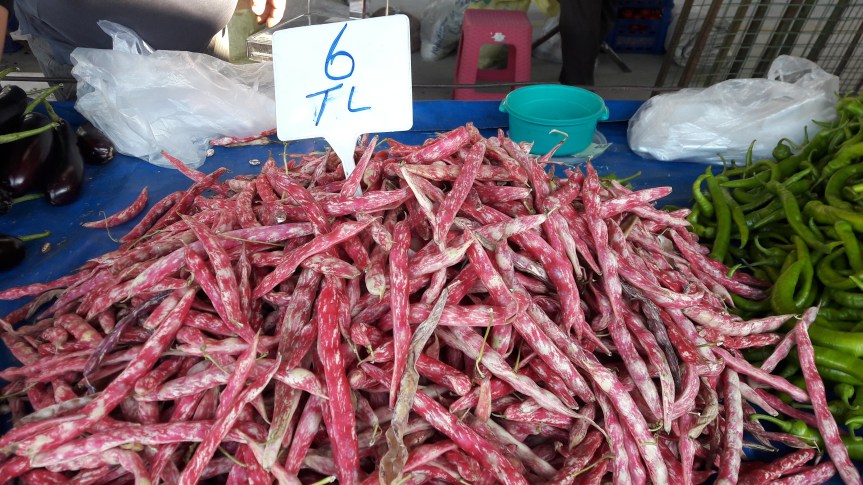
Last week in Datça market piles of psychedelic pink-podded barbunya beans arrayed against their green-podded cousins caught our eye. In Turkey these distinctive beans, also known as borlotti or cranberry beans, are made into a starter called barbunya pilaki, which is always high on our list when ordering a spread of mezeler.

20170616_183758
Psychedelic pink barbunya beans piled high in Datça market

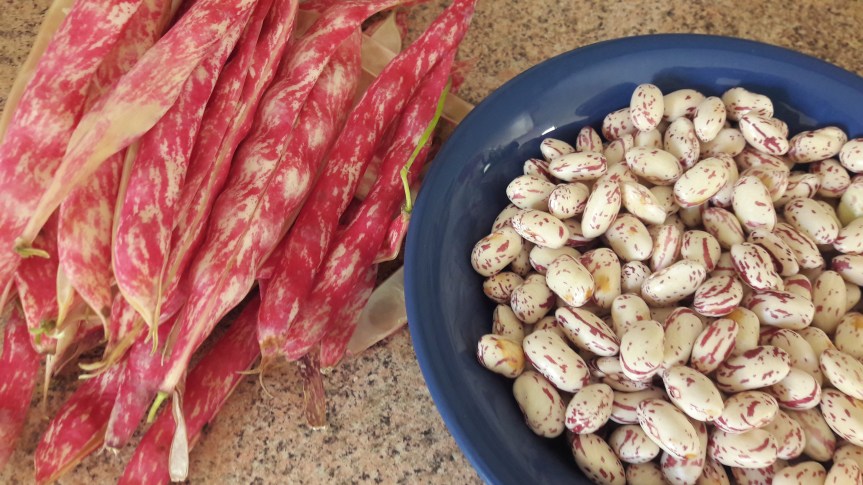
There’s something very therapeutic about podding these beans, like a beanish mindfulness moment!  Our kilo of beans in their pods yielded around 600 g of pink-marbled white beans.

20170616_194034
Bean therapy!

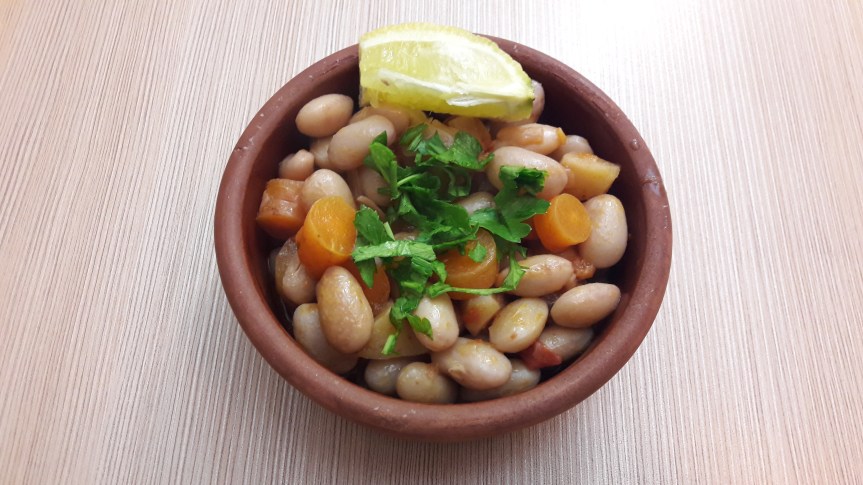
When cooked and allowed to cool, the pink colour leaches out and the beans take on a delicate brown hue. They’re delicious stewed with olive oil, onion, carrot, potato and lemon juice, served with a sprinkling of fresh parsley and a chunk of lemon. Some recipes omit the potato, but we think this gives the dish more oomph and means you don’t need to cook up any additional carbs.

20170616_220421
Barbunya pilaki all ready to go

They can be served hot as a less sugary take on baked beans, or served cold as part of the aforementioned selection of starters – Knidos Cookery Club recommends its carrot and walnut tarator, creamy almond and courgette dip, peppery muhammara and stuffed courgette flowers for a scrumptious feast of Turkish mezeler.

Ingredients (for 4-6 servings)

600 g shelled barbunya beans (or dried borlotti beans soaked overnight)

1 onion (around 100 g)

100 g carrot

100 g potato

100 g tomato

1 garlic clove

1 lemon

1 teaspoon honey

1 teaspoon red chili flakes

Fresh parsley to garnish

50 g olive oil

400 ml hot water

Method

Heat the olive oil into a heavy-based pan, chop the onion and garlic finely and fry over a medium heat for five minutes or so. Add the chopped tomatoes, lower the heat and cook for another five minutes.

Dice the carrot and potato into small cubes and then add these along with the beans, the juice of half a lemon, the honey, chili flakes and hot water to the pan and bring to a boil. Simmer for 30-45 minutes, stirring occasionally, until the beans are cooked but not going mushy.

Serve hot or allow to cool and garnish with fresh parsley and lemon slices.

Fill Yer Lentil Welly Boots!

15 June 2017

Next week should see the start of negotiations on the UK’s future relationship with the European Union as talks are scheduled to get underway on 19 June to hammer out the ultimate shape of Brexit.

In the lead up to this momentous day, this weekend also marks another seminal event in Britain’s troubled relationship with continental Europe – 18 June is the anniversary of the Battle of Waterloo, a battle which saw forces under the command of the Duke of Wellington deliver a fatal blow to Napoleon Bonaparte’s ambitions in 1815.

20170610_214951
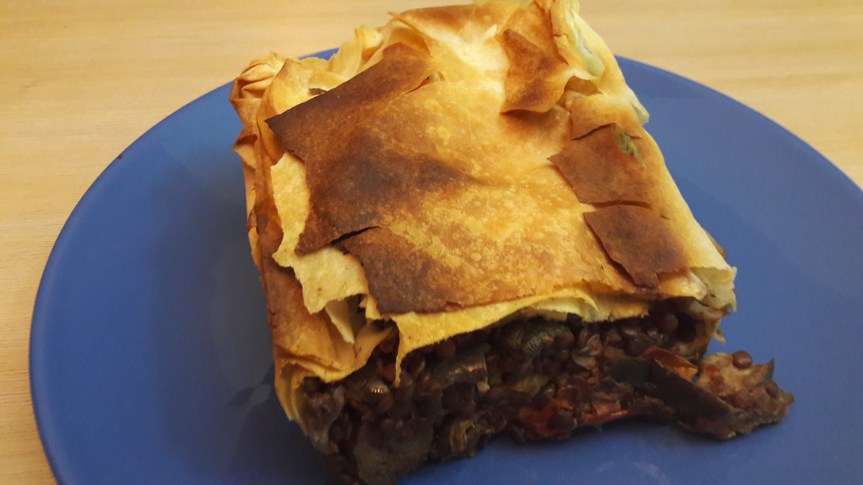
KCC’s Lentil Wellington ready for action

Only time will tell if the Maybot, in cahoots with the Rev Ian Paisely’s successors in the DUP, can produce a victory as decisive as Wellington’s – one thing is clear, some major sustenance is called for and what better than a hearty Lentil Wellington, our veggie take on Beef Wellington, a dish supposedly named after the duke.

Yes, besides giving his name to the wellington boot, the duke is also linked with this dish, which has a rich filling encased in pastry. Leah Hyslop suggests that the name was a patriotic makeover for a popular French dish:

The dish’s clear resemblance to that French specialty, filet de bœuf en croûte, could suggest the name was a timely patriotic rebranding of a trendy continental dish.

In our own era, food-patriotism was to the fore in 2003 when France refused to go along with the invasion of Saddam Hussein’s Iraq, causing some in the USA to call for ‘french fries’ to be rebranded ‘freedom fries’.

20170609_205035
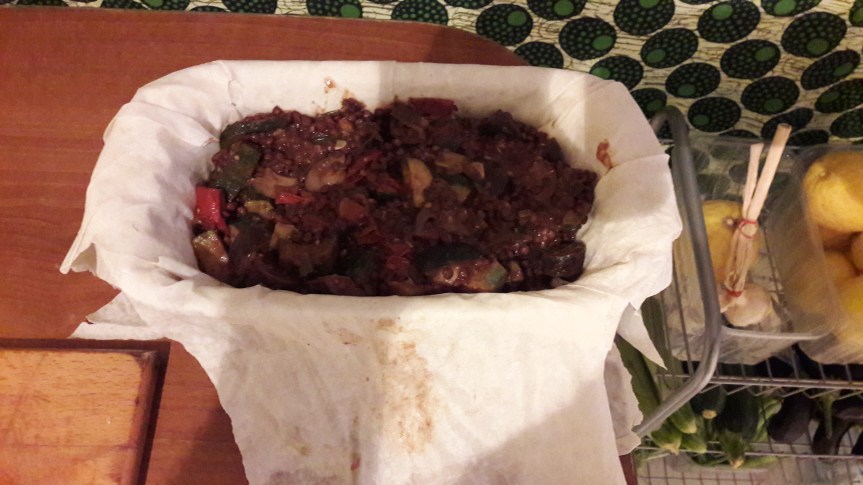
KCC’s Lentil Wellington ready for final assembly before baking

For a Turkish twist, we’ve used layers of yufka, the local version of filo pastry, to cover our rich lentil and vegetable sauce. Make sure you leave on overlap of pastry of about 8-10 cm around the edges of your dish in order to create a top to encase the filling.

Ingredients (serves 4)

250 g aubergines

250 g courgettes

250 g tomatoes

75 g black lentils

2 spring onions

1 garlic clove

1 bayleaf

1 teaspoon cinnamon, cumin, red chili flakes and coriander seeds

Pinches of black pepper and salt

250 ml vegetable stock

100 ml red wine

100 ml olive oil

Filo pastry (around 300 g)

Method

Wash the lentils until the water runs clear, and then cook in a heavy-based pan with the vegetable stock and bayleaf. Bring to the boil and then simmer over a low heat for 20 minutes or so until the liquid is absorbed.

While the lentils are cooking, prepare the vegetables: finely chop the spring onions and garlic, cut the aubergine and courgette into one cm thick slices and then cut into four. Place the vegetables into a heavy-based pan, add the herbs and spices and pour 50 ml olive oil over the veg and then cook over a medium heat for ten minutes, stirring occasionally.

Chop the tomatoes and add to the vegetables and cook for another five minutes, continue stirring every now and then. Now add the cooked lentils and the red wine and cook for another ten minutes or so until the liquid is absorbed.

While this is cooking, prepare the pie case. Grease a large pie dish with olive oil and layer leaves of filo pastry, brushing each layer with olive oil. Make sure you leave a pastry overlap of around 8-10 cm around the edges of the pie dish.

Pour the filling into the pie case and fold over the overlapping filo pastry, brushing with more olive oil to help seal the top of the case. Bake in an oven pre-heated to 180 c /gas mark 5 for 30 minutes or so until the top of the pie begins to turn a golden-brown colour.

Allow to cool for ten minutes and then serve slices of the pie with a crisp green salad and roasted new potatoes.


Moussaka Mania

8 June 2017

As the UK continues its downward plunge to become the latest contender for the mantle of Europe’s most basket case economy, we’re turning our attention to the current holder of that title, Greece, for culinary inspiration this week in the form of moussaka, a great comfort food. We’ll be needing lots of comfort in the coming months as the lucky winner of today’s UK election navigates a course through the choppy waters of Brexit.
20170531_131610

Summer is here, and with Datça market overflowing with an array of fresh produce, Knidos Cookery Club is moving back to weekly posts for the foreseeable future. The aubergine is a vegetable that has had surprisingly little coverage in these pages, so it’s high time that was rectified.
20170530_221006

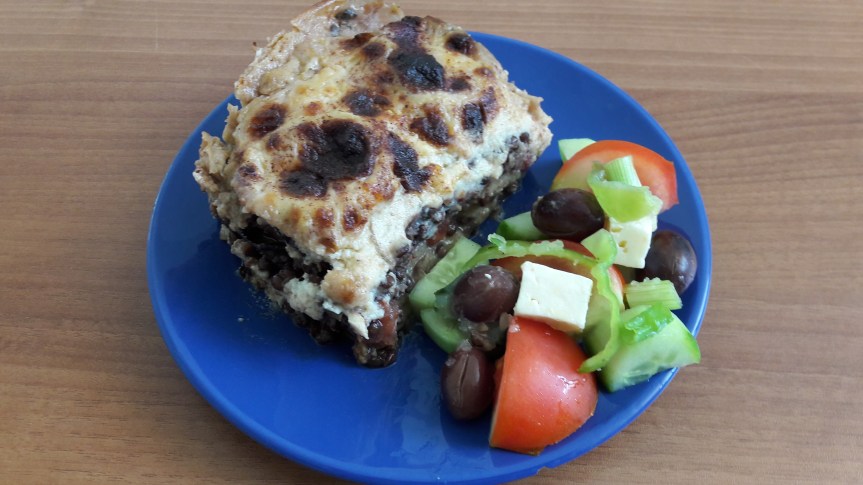
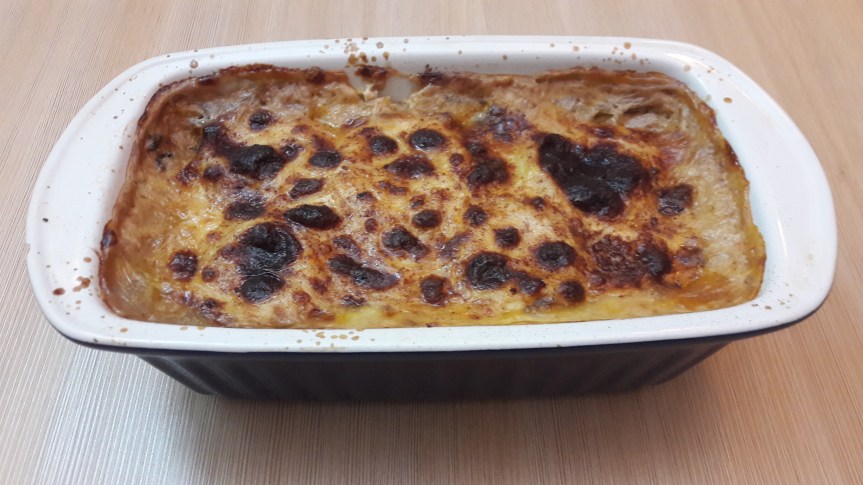
Moussaka is a perennial Greek favourite that is great fresh from the oven or eaten cooled down, allowing the flavours some time to collide. It combines layers of fluffy  potato and silky aubergine covered with a tomato-rich ragù, all topped with a creamy white béchamel sauce.

We’ve used black lentils in place of minced lamb to make our veggie take on moussaka, although any lentils should work well in this dish. It pairs excellently with a classic Greek salad of tomato, cucumber, onion, green pepper, olives and white cheese.

Ingredients (for 3-4 servings)

300 g aubergines

300 g potatoes

250 g tomatoes

100 g black lentils (or any other lentil)

3 spring onions

1 garlic clove

400 ml vegetable stock

100 ml red wine

1 teaspoon of cinnamon

1 teaspoon of dried sage

1 bayleaf

Pinch of black pepper

Pinch of red chili flakes

50 ml olive oil

For the white sauce:

50 ml olive oil

50 g flour

500 ml milk

5 peppercorns

1 bayleaf

75 g cheese (feta or  any crumbly white cheese)

Method

Heat 20 ml of olive oil in a heavy-based pan, chop the spring onions and garlic clove and add to the pan. Cook for five minutes then add the washed lentils and stir. Add the stock, bring to the boil then simmer for 20 minutes or so until most of the liquid is absorbed.

Pre-heat the oven to 200 c / gas mark 6. Cut the potatoes into one cm slices and boil for five minutes in a pan of water. Drain immediately and allow to cool. While the potatoes are boiling, chop the aubergine into 1 cm slices. If you like, you can coat the aubergine slices with a little salt, leave to stand for 10 minutes and then rinse. This should make them less bitter and remove excess moisture.

Place the potato slices in an oven dish and coat with 15 ml olive oil and stir to coat thoroughly. Place the aubergine slices into a separate oven dish and pour 15 ml of olive oil over them. Put both the dishes into the oven and bake for 30-40 minutes or until the potatoes are a golden brown colour and the aubergine slices beginning to char.

Add the peeled, chopped tomatoes, 100 ml red wine, bayleaf, cinnamon, sage and pepper to the lentils and cook over a low heat for 45 minutes until the sauce has reduced by about half.

While this is cooking, make the white sauce. Heat the oil in a heavy-based pan and stir in the flour to make a roux of a runny consistency. Slowly stir in the milk and add the peppercorns and bayleaf, stirring constantly with a wooden spatula or spoon or a whisk over a low heat. When the sauce begins to thicken, add the grated cheese and continue stirring until the sauce sets.

Now it’s time to assemble the moussaka. Pour half the lentil ragù over the potatoes to coat, add a layer of aubergines and pour over the rest of the ragù. Place the remaining aubergine slices over this and then pour the white sauce over these.

Sprinkle with red chili flakes and place in the oven and bake at 180 c /gas mark 5 for an hour or so – the top should be going a nice spotted brown colour as in the photo above.

Allow to cool and serve with a classic Greek salad made from tomato, cucumber, onion, green pepper, olives and white cheese, liberally dressed with olive oil and thyme.