This time round on Knidos Cookery Club we’re combining some of our favourite seasonal ingredients to mark the transition from the hearty stews and soups of winter to some lighter, spring eating.
We’ve paired leeks, the mild-tasting cousin of the onion, with green lentils, coarse bulgur wheat and some spices to make a scrumptious pilaf that’s both cheap and easy to prepare.
Using bulgur wheat in the place of rice means that it can be on the table in less than an hour, which also allows enough time to roast some of our winter faves, pumpkin and beetroot, to add a splash of colour to the plate. Keep any leftovers in the fridge – they can be moulded into patties and fried in oil or baked in the oven to make a tasty brunch or supper.
Ingredients (serves 4)
50 ml olive oil
One leek
250g pumpkin
250g beetroot
125g bulgur wheat (coarse not fine)
125g green lentils
600ml vegetable stock
Two teaspoons cumin seeds
One cinnamon stick
One teaspoon chilli powder
One bayleaf
Method
Pour 25 ml olive oil and one teaspoon of cumin seeds into an oven-proof dish and leave in the oven for 10 minutes at 200c. Cube the pumpkin and beetroot and put into the dish and stir well to coat with oil. Bake for 40 minutes at 200c.
Heat the other 25 ml of oil in a heavy-based pan, add the cumin seeds and then add the diced leek and sauté over a low to medium heat for about ten minutes. Add the cinnamon stick, chilli powder and bayleaf and stir well.
Now add the bulgur wheat and lentils and the vegetable stock and mix it all together. Cook for 30 minutes or so over a low heat, stirring occasionally, until all the liquid has been absorbed. Serve with the roasted beetroot and pumpkin.
With another Nauryz, the spring equinox, just around the corner, we’re looking at this turning point of the year as a good place to start some spring cleaning for the body.
The Mighty Mung Bean
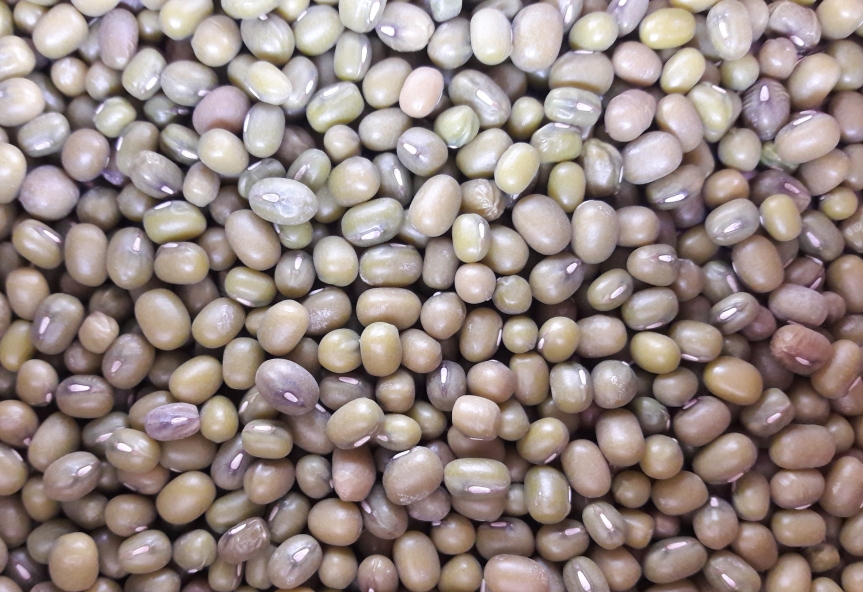
You can detox your digestive system by utilising the mighty mung bean, considered by both traditional Chinese medicine and India’s Ayurvedic medicine as an effective aid to remove toxins from the body.
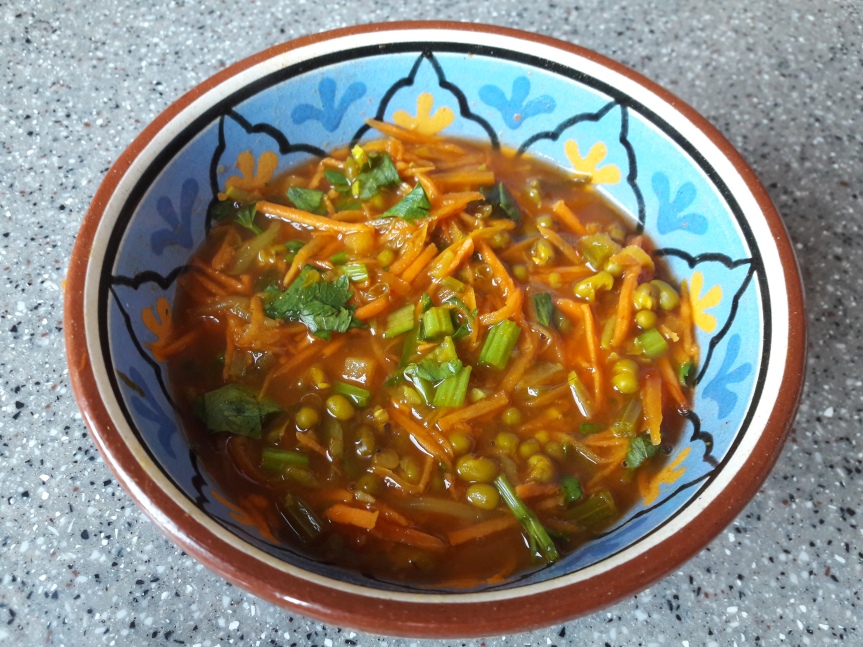
Knidos Cookery Club’s Mung Bean Detox Soup
When combined with spices such as turmeric, cumin, ginger and black pepper, the mung bean can do a lot to help flush out unwanted material from your body. While some practitioners recommend following a detox diet based on mung bean soup for 7-10 days to really cleanse yourself, it’s quite a powerful process so we’d recommend a bowl or two every week as being beneficial to your general well-being.
Ingredients (Makes 3-4 servings)
200 g mung beans
One carrot
One courgette
One stick of celery
1 litre water
Four tablespoons tomato paste
One teaspoon turmeric
One teaspoon cumin
One teaspoon chilli powder
1cm fresh ginger
Black pepper
Method
Wash and then soak the mung beans for at least four hours (the longer you soak them, the quicker they’ll cook). Then put them in a pan, cover with the water and add the turmeric, cinnamon, cumin and chilli powder.
Bring to a boil and then simmer for 30 minutes, add the tomato paste, grated carrot and courgette, the thinly-sliced celery and the minced ginger, stir well and simmer for another ten minutes or so. The mung beans should just be beginning to go soft. Pour into bowls and serve with a generous grind of black pepper.
After touring through North America and Mexico, we’re finally back at KCC’s winter HQ in Almaty, Kazakhstan. We’ve been craving for something spicy and Asian and, with broccoli in season, decided on this take on the Indian classic aloo gobi.
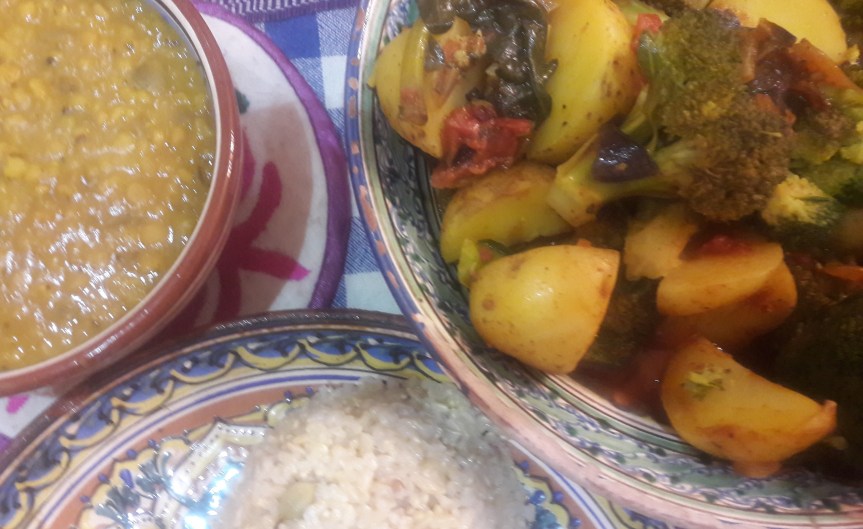
Aloo broccoli, rice and dal
You’ll probably be familiar with aloo gobi, which combines potato and cauliflower in a spicy sauce, if you’re a fan of food from the Indian sub-continent. Having eaten the cauliflower version numerous times, we started to wonder why we’d never come across the dish made with broccoli instead.
It turns out that broccoli is a fairly recent arrival to the tables of India – it was first brought to the country in the early 1990s by a farmer called Jitendra Ladkat, according to this article. So, therefore, there’s no great surprise that it does not feature as a mainstay of Indian cooking.
We served up our aloo broccoli with a split pea dal, brown rice and some flat bread and can thoroughly recommend it as an alternative to the tried and tested aloo gobi.
Ingredients (for 3-4 servings)
400 g small potatoes
400 g broccoli florets
One small red onion
200 g tomatoes
50 ml cooking oil
Spices: one teaspoon each of cumin seeds, coriander, chilli powder, turmeric, six cloves, one star anise.
Method
Cut the potatoes into quarters and put into a pan of boiling water and simmer over a low heat for five minutes, then add the broccoli, cover the pan and cook for another five minutes.
Heat the oil in a heavy-based pan and add the cumin seeds, cloves, star anise and cinnamon stick. After five minutes add the chopped onion and cook over a medium heat. Add the coriander, chilli powder and turmeric and mix well.
Add the tomatoes and cook for a few minutes over a low heat and then add the cooked broccoli and potatoes. Mix well and cook for ten minutes, stirring occasionally.
Serve with rice, dal and flat bread. The dish tastes even better if left overnight and reheated as this allows time for the flavours to blend.
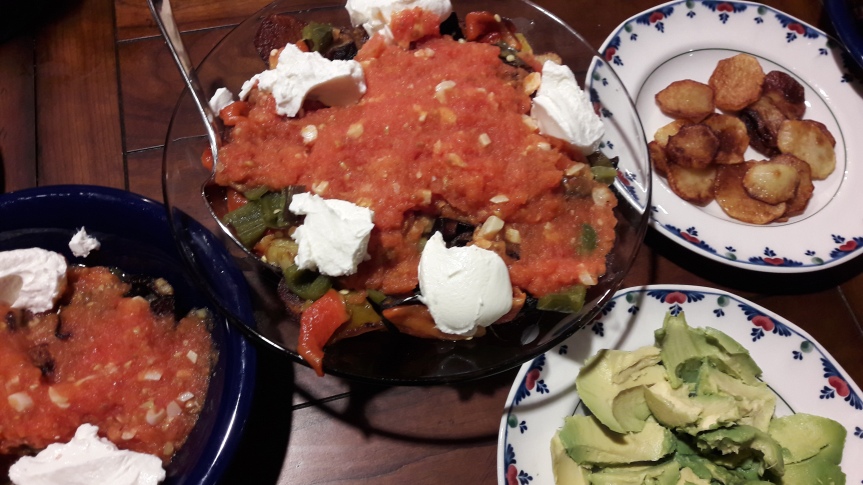
This time round on Knidos Cookery Club we’re swinging through Tucson, Arizona on the way back home. Whilst in Tucson, we met up with some old friends from Kazakhstan (via Turkey and the USA) and were treated to Tolga’s kızartma – grilled peppers mixed in with fried aubergines and potatoes served in a garlic-infused tomato sauce and garnished with dollops of natural yogurt.
Tolga’s classic down home Arizona kızartma
Tucson is located on the edge of the Sonora Desert which stretches up into Arizona from northern Mexico. It’s a surreal landscape of towering cacti called saguaro (Carnegiea gigantea), which can grow to be more than 12 m tall.
There’s a lot of cactus….
The desert is a fascinating place populated with bobcats, coyotes, a variety of snakes and scorpions along with hallucinogenic Sonoran Desert toads (if you’re brave enough to lick them… ).
Having observed the master chef at work closely, here’s KCC’s take on the Turkish classic kızartma.
Ingredients (serves 3-4)
Two large potatoes
Three medium-sized tomatoes
Three garlic cloves
one small onion
One large aubergine
One avocado
Four peppers – a mix of green and red
Four jalapeño peppers
75 ml olive oil
100 ml natural yogurt
Method
Heat 25 ml of oil in a heavy-bottomed pan. Cut the potato into 1mm slices and fry in the oil, turning occasionally, until they are a golden-brown colour on both sides. Remove with a slotted spoon and put on a plate lined with kitchen towel.
Prick the peppers a couple of times with a fork and then roast them on a barbecue or over an open flame (here’s some tips on how to do this) until the skin is blackened all over. While the peppers are roasting, put 25ml oil in the pan and cut the aubergine into 1cm cubes and fry until golden brown. Remove with a slotted spoon and put on a plate lined with kitchen towel.
Add the rest of the oil to the pan, heat it up and then fry the finely chopped onion and garlic for five minutes over a medium heat and then grate the tomatoes into the pan and cook for 15-20 minutes. Peel the peppers, remove the seeds and chop the roasted peppers roughly.
In a large bowl put a layer potatoes, aubergine and peppers alternately. Pour the tomato sauce over the top and garnish with dollops of yogurt. Serve with slices of avocado.
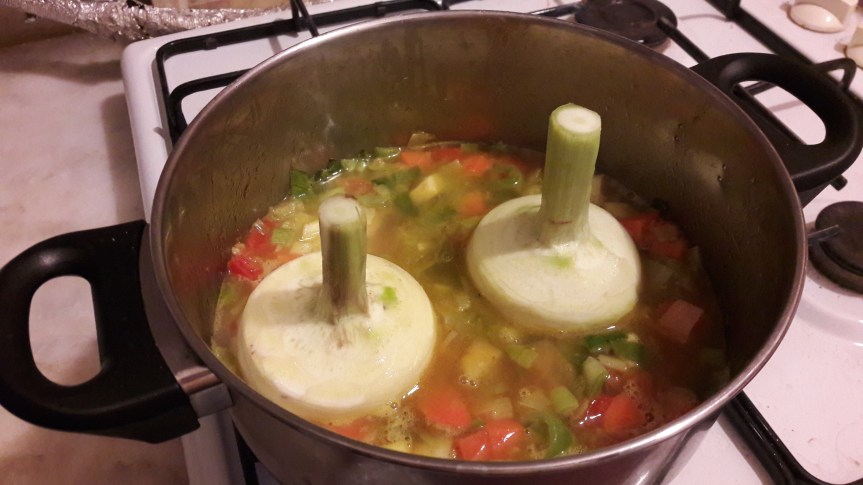
To celebrate the Winter Solstice, we’re combining two of our favourite oddball vegetables – globe artichokes and celeriac. For the longest night of the year, we’ve come up with phallic artichokes steamed in a hearty winter root vegetable broth – Knidos Cookery Club’s take on the Turkish classic Zeytinyağlı Enginar, a dish of artichokes served with cubed vegetables cooked in olive oil and lemon juice.
An artful artichoke
To get to the heart of the matter, artichokes need a bit of preparation to reveal the edible heart of the vegetable. If you don’t have a neighbourhood artichoke peeler on the corner of your street, as we do in Istanbul, than check out this link from The Spruce Eats website for some useful tips on removing the fibrous, inedible choke.
Let the simmering begin
Celeriac, with its bulbous appearance, is an often overlooked root vegetable. It’s nutty taste, with a hint of celery, makes a delicious addition to soups and stews and it’s also great served raw in salads. We’ve used it as a replacement for potato in this Turkish favourite.
Ingredients (for four servings)
Four artichoke hearts
Two leeks
Four small carrots
Two small celeriac bulbs
Two medium-sized tomato
Four green peppers
Juice of half a lemon
50 ml olive oil
500 ml cold water
Two teaspoons garam masala (or curry powder)
Pinch of black pepper
Method
Heat the oil in a heavy based-pan (with a lid) and and the finely sliced leeks and peppers and cook over a medium heat for five minutes. Cube the carrots and celeriac and stir into the leek and pepper base and cook for a further five minutes. Add the chopped tomato, garam masala and black pepper and cook for five more minutes, stirring frequently.
Pour the water over the vegetables, add the lemon juice and place the artichoke hearts on top of the bubbling veggies. Put the lid on the pan and cook over a low to medium heat for 30 minutes.
Put one artichoke heart on each plate and pour the vegetables and cooking liquid over the top and around the artichoke and serve hot with crusty bread.
This time round on Knidos Cookery Club we’re stuffing again to make one of favourite summertime snacks – dolma (stuffed vine leaves).
These stuffed vine leaves are great as part of a barbecue spread or to add some rice oomph to a selection of dips and mezes.
Ready to roll…
Rolling the leaves can be a bit fiddly at first, but you’ll soon find yourself getting into the rhythm. it’s best to make a big batch of these little stuffed marvels so you’ve got some ready-made snacks giving your more time at the beach.
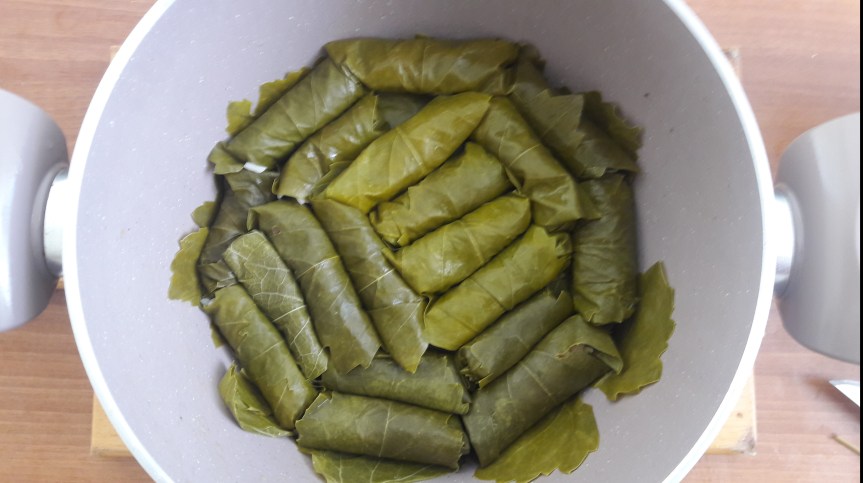
Layer the cylinders tightly in the pan
If you have any vine leaves left over, then hang on to them as we’ll be featuring another vine leaf recipe next time round on KCC.
Ingredients (makes 48 dolmas)
One onion
200 g long grain rice
50 ml olive oil
750 ml water
One lemon (zested and juiced)
50 g chopped almonds
two teaspoons dried thyme
one teaspoon cinnamon
one teaspoon cumin
10 g fresh mint
Pack of preserved vine leaves (or fresh leaves if you can get them)
Method
Fry the finely chopped onion in 25 ml of oil for five minute over a medium heat. While this is cooking, wash the rice until the water runs clear. Now soak the vine leaves for 30 minutes and then rinse well to remove any taste of brine or other preserving agents.
Add the thyme, cinnamon and cumin to the onion and stir. Now add the rice, mixing well to coat the grains. Cover with 375 ml of water and cook until the water is absorbed. The rice does not need to be fully cooked at this stage. When ready, add the chopped almonds, lemon zest and mint and mix well.
Now it’s time to stuff. Take a vine leaf, cut off the stalk and place a teaspoonful of rice mix on the leaf (see picture above). Tuck in the sides of the leaf and roll into a tight cylinder.
Put a layer of unstuffed vine leaves on the bottom of the pan to stop the stuffed ones sticking to the bottom. Layer the dolmas tightly in a heavy-based pan, putting another layer on top if you run out of space. Pour 25 ml of olive oil, the juice of the lemon and 375 ml of water over the vine leaf parcels.
Put a plate on top of the vine leaves and then put the lid on the pan and cook over a low heat for 45 minutes or until all the liquid is absorbed. Allow to cool before serving. If left in the fridge for a few hours, the stiffed vine leaves will firm up nicely.
Knidos Cookery Club is just back from a foodie fact-finding mission to uncover some new recipes along the Silk Roads. While on the expedition, we inadvertently fell foul of Kazakhstan’s strict zero tolerance laws while munching on a local delicacy, sunflower seeds.
Sunflower seed munchers are not welcome in this park in Shymkent, Kazakhstan
It turns out that eating this tasty little snack in public is an offence, classified as “petty hooliganism”, and punishable by watching a video of Kazakhstan’s president Nursultan Nazarbayev railing against this social evil and the payment of a fine (4 x the Monthly Calculation Index (MCI) that is used to calculate benefits and fines – approx £25).
After this contribution was made to the Shymkent Police Nauryz party fund, the situation was resolved amicably and we were all able to go on our merry way, suitably chastised!
The road trip also took in a visit to Uzbekistan, which has inspired KCC to attempt Mastava a traditional Uzbek rice and chunky vegetable soup – it’s usually prepared with lamb or beef but we’ve used lentils and red beans instead of meat to add the protein in our version.
A hearty bowl of mastava and a cup of green tea
Mastava uses whatever seasonal vegetables are to hand – we had carrots, potatoes, tomatoes, pumpkin and some red peppers for our version. We’ve liberally spiced it with cumin, coriander seeds, red chilli flakes and black pepper as well as some fresh coriander to garnish the soup.
Ingredients (makes around 4 – 6 servings)
150 g green lentils or similar
250 g red beans
150 g pumpkin
150 g rice
200 g cherry tomatoes
Four small potatoes
One large carrot
One red pepper
Six spring onions
30 ml olive oil or other vegetable oil
1 litre vegetable stock
One teaspoon cumin seeds
One teaspoon coriander seeds
One teaspoon black pepper
One teaspoon red chilli flakes
One bunch fresh coriander
Method
Heat the oil in a heavy based pan and add the crushed black pepper, cumin and coriander seeds and chopped spring onions. fry for five minutes over a medium heat and then add chunks of carrots, tomatoes and red pepper. Cook for 10 minutes and then add the vegetable stock, red chilli flakes, potatoes and rice and bring to a boil.
Simmer over a low heat for 20 minutes, and then add the cooked green lentils and red beans and chunks of pumpkin. Keep simmering until the rice is cooked, stirring occasionally. Serve in bowls and garnish with fresh coriander.
We’re back and, with Orthodox Easter just around the corner, this time round on Knidos Cookery Club we’ll be making our own version of pastitsio, a Greek take on Italy’s lasagne. Our version comes with a red wine, tomato and lentil ragu and a leek infused béchamel sauce.
KCC’s Leeky Pastitsio
A few weeks ago, I left some beans soaking overnight and when I checked them in morning the pan was mysteriously filled with soaked penne rigate pasta! A quick look online to determine if the pasta was usable led me to this post on the Ideas in Food blog, and this confirmed pre-soaking in cold water as an effective way of preparing dried pasta.
Leeky pastitsio and salad
Pastitsio is one of those dishes that tastes great straight from the oven but improves with age as the cinnamon, nutmeg and other flavours have time to blend properly. It works well heated up the next day or even tastes good cold. We served ours with a crisp salad of rocket leaves, carrot. radish and tomato.
Ingredients (For 3-4 hearty servings)
200 g penne rigate pasta
For the ragu:
25 ml olive oil
4 spring onions
200 g cherry tomatoes
2 tablespoons tomato paste
100 g red lentils
175 ml red wine
1 teaspoon of cinnamon, cumin, black pepper and red chilli flakes
For the Béchamel sauce:
50 ml olive oil
250 g leek
3 tablespoons flour
400 ml milk (dairy or non-dairy)
60 g cheese (dairy or non-dairy)
One teaspoon of nutmeg
Method
Soak the pasta in a pan of cold water for two hours and while it’s soaking cook the red lentils in 200 ml water until mushy and all the liquid is absorbed. Then prepare the ragu and after that the béchamel sauce.
For the ragu, heat the oil in a heavy-based pan and then fry the chopped spring onions for a few minutes. Add the quartered cherry tomatoes, tomato paste and spices and mix well. Add the wine and when it starts to bubble add the cooked and drained lentils. Cook for ten minutes over a low heat.
For the béchamel sauce, heat the oil in a heavy-based pan and then add the sliced leeks and cook for five minutes over a medium heat. Add the flour and mix well and then ad the milk slowly, stirring continuously with a wooden spoon. Add half the grated cheese and nutmeg and cook until the sauce is just starting to boil, stirring all the while.
Layer half the soaked penne in the bottom of an oven proof dish and pour the ragu over. then layer the rest of the pasta on top of this and pout the béchamel sauce over. Add the remainder of the grated cheese and bake in a pre-heated oven at 200c for thirty minutes.
Serve straight away with a green salad or let it sit overnight in the fridge for a tastier pastitsio that can be served hot or cold.
This time round on Knidos Cookery Club we’ll be unravelling ravioli, one of the many forms of filled pasta pockets found around the world – from Turkey’s manti, Uzbekistan’s chuchvara and Kazakhstan’s tushpara to Russia’s pelmeni, Ukraine’s varenyky and Poland’s pierogi – the list is endless.
KCC’s beetroot-filled pkhali pierogi
These pasta pockets, which are boiled rather than steamed, can come in a variety of shapes and sizes with a wide range of fillings such as pumpkin, potato, spinach and ricotta cheese, or different types of fruit.
We’ve opted for a semi-circular shaped pierogi which we’ve filled with beetroot and walnut pkhali – click here for our feature on this classic Georgian dish from last year.
Three steps to a perfect pierogi!
Ingredients (Makes 16-24 depending on how big you make the pierogi)
For the pasta:
200 g flour
3 teaspoons olive oil
100 ml water
pinch of salt
Method
Make the pasta by sifting the flour into a large mixing bowl and then add the oil, a pinch of salt and half of the water in a well in the middle of the flour. Mix inwards from the outside with a wooden spoon and then add the rest of the water until the dough has absorbed all the flour.
Knead for ten minutes or so and then leave the pasta dough to rest in the fridge for at least one hour. After resting, roll the pasta out onto a lightly-floured surface to a thickness between 0.5 and 1.0 mm.
Use a glass to cut out round shapes from the dough, add a teaspoon of cooled beetroot pkhaliin the bottom half of the circle and moisten the inside edge around the filling with a little water and then fold the top over. Use a fork to seal the pasta pocket.
Bring a large pan of water to the boil and then add the pierogi to the water and keep boiling over a low heat until the pierogi float to the surface. Remove the pierogi with a slotted spoon and serve hot – they’re good served with sour cream or melted butter or just plain.
“April is the cruellest month” as TS Eliot put it, but I’ve always thought there’s a case for February to be considered crueller. As winter drags on interminably in the northern hemisphere – we’re still six months away from August and the height of summer – those long, lazy days all seem so far away, especially with the mercury plunging into serious minus territory as in Knidos Cookery Club’s winter HQ in Almaty, Kazakhstan.
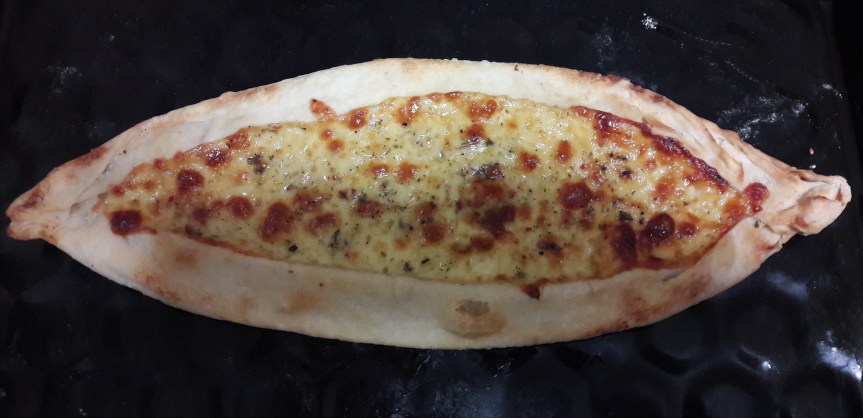
Yum yum – Kaşarlı Pide
So, thoughts have been turning to warmer times and to distant memories of eating pide, Turkey’s take on pizza, under the shade of mandarin trees in Datça.
or maybe Otlu Pide?
With KCC’s new oven up and running in Almaty, it’s high time for a Great Turkish Bake Off as we take on the pide challenge and bring a slice of the Turkish summer into the winter gloom of Kazakhstan.
Stage one – ready to shape
Stage two – first fold
Stage three – final fold
We’ll be making a standard Kaşarlı Pide, an open one made with a yellow cheese such as cheddar – See the three stages for assembling this pide above.
And here is an Otlu Pide, a covered one made with various greens such as spinach and parsley and a ricotta-like cheese called lor as seen above.
Ingredients (Makes four pides)
For the base:
300 g flour
One teaspoon dried, instant yeast
125 ml cold water
30 ml olive oil
For the filling:
KaşarlıPide (makes 2)
200 g grated yellow cheese such as a mild cheddar
Pinch of red chilli flakes
Pinch of dried thyme
Pinch of freshly ground black pepper
Otlu Pide (makes 2)
One small onion
125 g spinach
25 ml olive oil
One bunch fresh parsley (around 25 g)
One bunch fresh coriander (around 25 g)
100 g ricotta cheese (or similar)
One teaspoon cumin seeds
One teaspoon red chilli flakes
Pinch of dried thyme
Pinch of freshly ground black pepper
Sprinkling of sesame seeds (or black, nigella seeds if you can find them)
Method:
Sieve the flour into a large, ceramic bowl, add the dried yeast, make a well in the middle and pour in the olive oil and slowly add the water and mix well so that all the flour is used up.
Knead for ten minutes or so until you have a stretchy, elastic dough. Put in an oiled bowl and cover with a tea towel and then leave it to rise in a warm place for 30 minutes or so until it is doubled in size.
While the dough is rising, prepare the filling for the Otlu Pide. Heat the olive oil in a frying pan and add the cumin seeds, chilli flakes, dried thyme and black pepper and then add the finely chopped onion. Cook for five minutes and then add the chopped spinach, parsley and coriander and cook until it all begins to wilt. Allow to cool and then stir in the lor (ricotta) cheese.
Divide the dough into four and roll each ball into a 30 cm by 20 cm oblong about 1 mm thick on a lightly floured surface. For the Kaşarlı Pide, spread the grated cheese over the middle leaving 2 cm around the edges and season with thyme, chilli flakes and black pepper. Fold the edges over and then fold again and pinch the ends together to make a boat shape. Glaze the dough with olive oil.
For the Otlu Pide, place half the filling in the bottom half of the rolled out dough then fold the top over and make into a parcel shape (as in the picture above). Glaze with olive oil and sprinkle with sesame seeds.
Bake the pides in an oven pre-heated to 200 c for 20-30 minutes or so until the cheese bubbles and is starting to go brown and the dough is also starting to go a golden-brown colour. Serve straight from the oven with a salad of your choice.









 Knidos Cookery Club