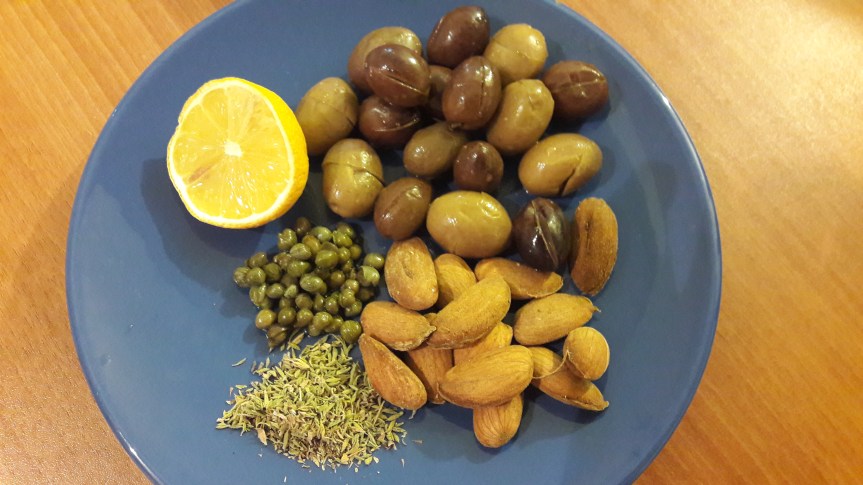
As promised a few weeks back on Knidos Cookery Club, here’s another use for those tasty vine leaves. While jetting down to KCC HQ in Datça recently, we spotted a Cypriot recipe in an airline magazine for halloumi cheese wrapped in vine leaves and we decided to adapt it by using some of the Datça Peninsula’s key ingredients:
Yep, that’s almonds, olives, thyme, capers and lemon. We mixed all these up to make our 5-star Datça paste which we then used to coat slices of our favourite squeaky cheese. After applying the paste, wrap the cheese slices with the leaves and then bake in the oven for 30 minutes or so until they look like this:
Ingredients (makes four servings)
200 g halloumi
12 vine leaves
75 g almonds
150 g olives
One lemon
two teaspoons dried thyme
25 g capers
Method
Soak and wash the vine leaves to remove any taste of brine, and then cut the stalk from the bottom of the leaf. You’ll need about three vine leaves for each slice of halloumi.
Now prepare the paste – stone the olives and place the bits of olive in a small dish. Soak the almonds in hot water for a minute or so and then put in cold water and peel off the skin. Break and add to the olives.
Add the capers and lemon juice and the thyme and use a hand blender to make a smooth paste. Cut the halloumi into four slices and smear each slice generously with the paste. Wrap the vine leaves around the cheese and then place in a baking dish or on a baking tray.
Bake in the oven at 180 c for thirty minutes or so and serve while hot with a seasonal salad and a selection of mezes.
This time round on Knidos Cookery Club we’re taking inspiration again from our recent Balkan odyssey. While on our mission to Albania, we tasted the local take on stuffed peppers and on returning to KCC H.Q. we decided to recreate this delicious dish with a few time saving tricks of our own devising.
Hasty tasty stuffed peppers with baked cauliflower and tomato
Rice is the usual go-to base for stuffing peppers, but it can be a bit time-consuming to prepare properly. With the World Cup reaching its conclusion, we didn’t fancy spending too much time slaving away in the kitchen so we’ve used some coarse bulgur wheat, which just needs soaking in hot water for a short while before it’s ready to use.
We cooked the peppers alongside some cauliflower, broken up into large florets, and some quartered tomatoes to make a ready made meal for two with only a green salad needed to complete the show, allowing plenty of time to sit down and enjoy what’s left of the football!
Ingredients (for two people)
Two medium-sized green peppers
Two medium-sized tomatoes
Half a cauliflower
50 g cooked green lentils
50 g coarse bulgur wheat
200 ml hot water
25 ml olive oil
One teaspoon cumin seeds
One teaspoon dried thyme
25 g raisins or currants
Black pepper (a generous twist)
Method
Cook the green lentils in twice the amount of water (put the lentils in a cup and then measure out twice as much water) until they start to go mushy. Put the bulgur wheat in a bowl and add the lentils and 200 ml hot water, stir and leave until the water is absorbed (20-30 minutes). Add the cumin, thyme, raisins and black pepper to the bulgur wheat and stir in well.
Pre-heat the oven to 180 c and prepare the peppers by slicing the top off and scooping out the seeds. Fill the hollowed-out peppers with the bulgur lentil mix, place the top back on and place in an oven dish. Arrange the cauliflower florets and quartered tomatoes around the pepper.
Drizzle the olive oil over the vegetables, add 50 ml water and bake in the oven for 40-50 minutes until the pepper skins start to burn and the florets are turning golden brown. Serve with a green salad.
As the market stalls overflow with fresh spring produce, this time round on Knidos Cookery Club we’ve selected some zingy greens to make a zesty, lemony piccata sauce to go with pasta and some other leafy greens.
KCC’s Chick Pea Picatta on a bed of sorrel
The piccata sauce comes from Italy and is a lemon-fuelled accompaniment to a variety of dishes. The name derives form the Italian word for ‘annoyed’, piccato, and it is from the same root as the word used in English expressions such as ‘a fit of pique’ or ‘to pique your interest’.
We’ve used jusai, garlic chives, to add more flavour to the sauce, along with white wine, capers and lemon zest and juice to give it a picquant bite. Add some chick peas and serve on a mound of pasta placed on top of a bed of fresh sorrel leaves for a tangy treat.
Ingredients (serves 3-4)
250 g cooked chick peas
25 ml olive oil
50 g garlic chives
2 tablespoons flour
100 ml white wine
500 ml vegetable stock
12 capers
Zest and juice of one lemon
1 teaspoon dried thyme
black pepper
250g dried pasta (we used spirals) cooked according to instructions on pack
Bunch of fresh sorrel
Method
Heat the olive oil in a heavy-bottomed pan over a medium heat and then add the chopped garlic chives. Cook for five minutes and then add the flour and stir well. Pour in the wine and mix to a paste and then slowly add the stock, stirring all the while.
Simmer over a low heat until the sauce starts to thicken, then add the chick peas, capers and thyme and cook for three minutes. While the sauce is simmering, cook the pasta. Grind a generous amount of black pepper into the sauce along with the lemon juice and zest.
Tear up the sorrel leaves and scatter over a plate. Place a pile of pasta in the middle of the plate on the leaves, and then pour the piccata sauce over the pasta and serve immediately.
With Nikol Pashinyan, leader of the largest political protests in Armenia’s post-Soviet history, looking likely to become this impoverished Caucasus Mountains nation’s next prime minister, Knidos Cookery Club is celebrating this momentous event with an Armenian recipe cooked up by our friend Bagila.
Bagila’s Armenian (Revolutionary) Peppers take centre stage
This mountainous, landlocked country sandwiched between Turkey, Iran, Azerbaijan and Georgia, has a rich cuisine that draws on an array of fresh vegetables such as aubergines and peppers, pulses and beans and fruits and nuts.
Bagila’s recipe uses red peppers that are fried and then marinated overnight in her signature marinade and they taste amazing served alongside a platter of other dips and salads as in the picture above.
Ingredients (serves 4-6)
500 gr red peppers, cut lengthwise in quarters
50 ml olive oil
For the marinade:
2 fresh tomatoes, skinned and grated
5 crushed/mashed garlic cloves
75 ml of lemon juice
1 bunch of fresh coriander, chopped
1 bunch of fresh parsley, chopped
1.5 tablespoons of sugar
a little less than 1 tablespoon spoon of salt
black pepper to taste;
oil left over from frying
Method
Fry the quartered peppers in hot olive oil until soft and then set aside. While they’re cooking, mix all the marinade ingredients together in a bowl.
Combine it all together: a layer of peppers, followed with a layer of marinade and so on.
Put something heavy on top for pressure (a saucer with a stone on top, or a jar of honey (jam), or whatever you can think of), and keep in the fridge for at least several hours (better one night/day) before eating. Enjoy!
This time round on Knidos Cookery Club we’ll be unravelling ravioli, one of the many forms of filled pasta pockets found around the world – from Turkey’s manti, Uzbekistan’s chuchvara and Kazakhstan’s tushpara to Russia’s pelmeni, Ukraine’s varenyky and Poland’s pierogi – the list is endless.
KCC’s beetroot-filled pkhali pierogi
These pasta pockets, which are boiled rather than steamed, can come in a variety of shapes and sizes with a wide range of fillings such as pumpkin, potato, spinach and ricotta cheese, or different types of fruit.
We’ve opted for a semi-circular shaped pierogi which we’ve filled with beetroot and walnut pkhali – click here for our feature on this classic Georgian dish from last year.
Three steps to a perfect pierogi!
Ingredients (Makes 16-24 depending on how big you make the pierogi)
For the pasta:
200 g flour
3 teaspoons olive oil
100 ml water
pinch of salt
Method
Make the pasta by sifting the flour into a large mixing bowl and then add the oil, a pinch of salt and half of the water in a well in the middle of the flour. Mix inwards from the outside with a wooden spoon and then add the rest of the water until the dough has absorbed all the flour.
Knead for ten minutes or so and then leave the pasta dough to rest in the fridge for at least one hour. After resting, roll the pasta out onto a lightly-floured surface to a thickness between 0.5 and 1.0 mm.
Use a glass to cut out round shapes from the dough, add a teaspoon of cooled beetroot pkhaliin the bottom half of the circle and moisten the inside edge around the filling with a little water and then fold the top over. Use a fork to seal the pasta pocket.
Bring a large pan of water to the boil and then add the pierogi to the water and keep boiling over a low heat until the pierogi float to the surface. Remove the pierogi with a slotted spoon and serve hot – they’re good served with sour cream or melted butter or just plain.
“April is the cruellest month” as TS Eliot put it, but I’ve always thought there’s a case for February to be considered crueller. As winter drags on interminably in the northern hemisphere – we’re still six months away from August and the height of summer – those long, lazy days all seem so far away, especially with the mercury plunging into serious minus territory as in Knidos Cookery Club’s winter HQ in Almaty, Kazakhstan.
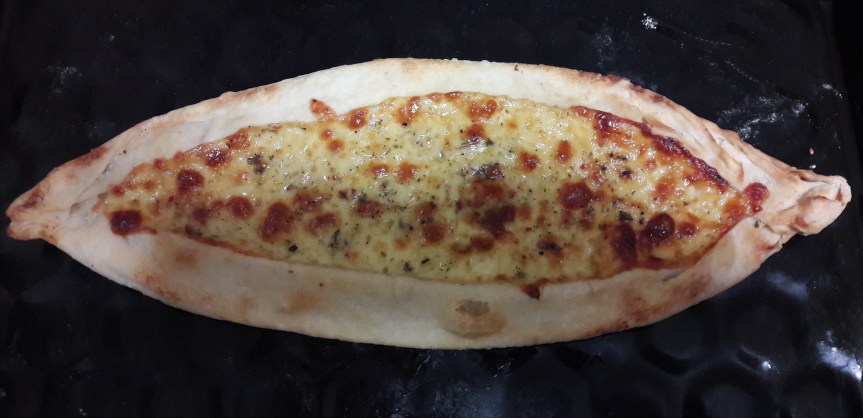
Yum yum – Kaşarlı Pide
So, thoughts have been turning to warmer times and to distant memories of eating pide, Turkey’s take on pizza, under the shade of mandarin trees in Datça.
or maybe Otlu Pide?
With KCC’s new oven up and running in Almaty, it’s high time for a Great Turkish Bake Off as we take on the pide challenge and bring a slice of the Turkish summer into the winter gloom of Kazakhstan.
Stage one – ready to shape
Stage two – first fold
Stage three – final fold
We’ll be making a standard Kaşarlı Pide, an open one made with a yellow cheese such as cheddar – See the three stages for assembling this pide above.
And here is an Otlu Pide, a covered one made with various greens such as spinach and parsley and a ricotta-like cheese called lor as seen above.
Ingredients (Makes four pides)
For the base:
300 g flour
One teaspoon dried, instant yeast
125 ml cold water
30 ml olive oil
For the filling:
KaşarlıPide (makes 2)
200 g grated yellow cheese such as a mild cheddar
Pinch of red chilli flakes
Pinch of dried thyme
Pinch of freshly ground black pepper
Otlu Pide (makes 2)
One small onion
125 g spinach
25 ml olive oil
One bunch fresh parsley (around 25 g)
One bunch fresh coriander (around 25 g)
100 g ricotta cheese (or similar)
One teaspoon cumin seeds
One teaspoon red chilli flakes
Pinch of dried thyme
Pinch of freshly ground black pepper
Sprinkling of sesame seeds (or black, nigella seeds if you can find them)
Method:
Sieve the flour into a large, ceramic bowl, add the dried yeast, make a well in the middle and pour in the olive oil and slowly add the water and mix well so that all the flour is used up.
Knead for ten minutes or so until you have a stretchy, elastic dough. Put in an oiled bowl and cover with a tea towel and then leave it to rise in a warm place for 30 minutes or so until it is doubled in size.
While the dough is rising, prepare the filling for the Otlu Pide. Heat the olive oil in a frying pan and add the cumin seeds, chilli flakes, dried thyme and black pepper and then add the finely chopped onion. Cook for five minutes and then add the chopped spinach, parsley and coriander and cook until it all begins to wilt. Allow to cool and then stir in the lor (ricotta) cheese.
Divide the dough into four and roll each ball into a 30 cm by 20 cm oblong about 1 mm thick on a lightly floured surface. For the Kaşarlı Pide, spread the grated cheese over the middle leaving 2 cm around the edges and season with thyme, chilli flakes and black pepper. Fold the edges over and then fold again and pinch the ends together to make a boat shape. Glaze the dough with olive oil.
For the Otlu Pide, place half the filling in the bottom half of the rolled out dough then fold the top over and make into a parcel shape (as in the picture above). Glaze with olive oil and sprinkle with sesame seeds.
Bake the pides in an oven pre-heated to 200 c for 20-30 minutes or so until the cheese bubbles and is starting to go brown and the dough is also starting to go a golden-brown colour. Serve straight from the oven with a salad of your choice.
This week on Knidos Cookery Club we’re going to be bucking the January detox trend with this super-rich, calorie-laden Iranian stew, Fesenjan (pronounced fesenjoon), that combines three of our favourite go-to ingredients – pomegranate, walnut and pumpkin.
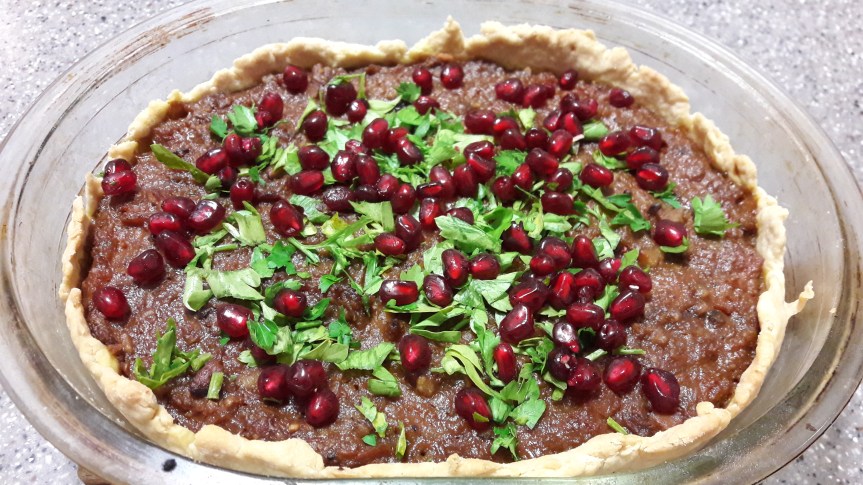
KCC’s Fesenjan Tart
Usually served as a thick stew with rice, we’ve decided to put it in a pie case to make a tasty walnut and pomegranate infused tart. Making this stew can be quite labour-intensive – shelling the walnuts, toasting them, crushing them, extracting the pomegranate seeds and so on, but the end result makes it well worth all the effort.
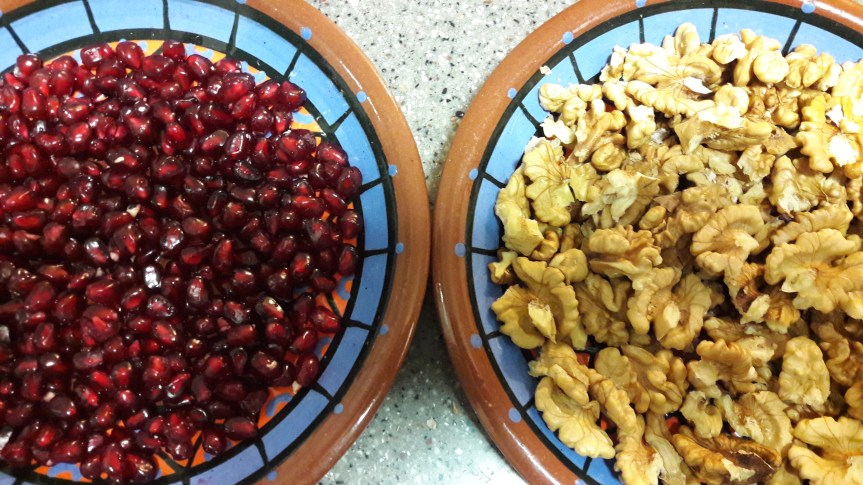
Can’t get much fresher than this!
Look out for Nar Ekşisi (pomegranate syrup)or the sweeter Nar Ekşili Sos (pomegranate sauce) in your local Middle-Eastern shop or make your own. If using Nar Ekşisi, add a teaspoon or two of honey to the stew to make it a bit sweeter.
To save time you can use shop-bought pastry, but we think it tastes better with a homemade pie crust. To keep it vegan, we’ve used olive oil instead of butter to make our shortcrust pastry.
Ingredients (serves 4)
125 g shelled walnuts
one medium onion
500 g pumpkin or butternut squash
300 ml vegetable stock
30 ml olive oil
2-3 tablespoons pomegranate syrup or sauce (Nar Ekşisi or Nar Ekşili Sos in Turkish)
0.5 teaspoon cumin seeds
0.25 teaspoon cinnamon and turmeric
Black pepper
Handful of pomegranate seeds
Bunch of fresh parsley
200 g shortcrust pastry
Method
Toast the walnuts for 10 minutes over a low heat and then mince in a blender. Heat the olive oil and fry the onion in a heavy-based pan over a medium heat for ten minutes. Add the spices and then add the cubed pumpkin and stir to cover.
Pour over the vegetable stock, add the pomegranate molasses and the minced walnuts and cook over a medium heat for 30 minutes until the pumpkin is cooked. Make sure the sauce is quite thick – if it’s runny, boil it until it starts to thicken.
Roll out the pastry and place it in a greased baking tray. Bake blind for ten minutes at 180c and then put the filling into the pie case. Cook for 40 minutes or so until the pastry starts to go golden brown.
Garnish the tart with chopped parsley and pomegranate seeds and serve with saffron rice and a green salad.
Happy 2018 to all our readers! Just when you thought the festive season was over, here’s a quick reminder that in some parts of the world Christmas is still to come. In Russia and parts of eastern Europe, the Orthodox church uses the Julian calendar, leaving a 13-day lag between the two Christmases.
To mark the big day we’re making our version of borsch – a dish that varies considerably across eastern Europe and the former Soviet Union. The spelling also varies with both borshch and borscht in use.
In Ukraine, borsch forms an integral part of the Christmas Eve table, and it’s often veggie-friendly as this day is also the end of a period of fasting – meat and dairy products are not consumed in the run up to Christmas.
We’ve added some dried mushrooms to the beetrooty mix to give the stock more depth and put a bread topping over the pot to have something handy to tear up and dip into the borsch.
Ingredients (makes 3-4 servings)
500 g beetroot
1 medium- sized onion
1 garlic clove
200 g potato
200 g carrot
250 g red or white cabbage
50 ml olive oil
50 ml tomato puree
5 dried mushrooms
1 litre vegetable stock
2 bay leaves
Juice of one lemon
1 teaspoon red chilli flakes
50 g fresh parsley
For the bread top:
150 g flour
100 ml warm water
15 ml olive oil
Pinch of salt
Method
Clean the beetroot, wrap in tin foil and bake in an oven pre-heated to 180 c for one hour. Pour boiling water over the mushrooms and allow to stand for 30 minutes.
While the beetroot is cooking, heat the olive oil in a heavy-based pan and fry the chopped onion and garlic on a medium heat for ten minutes. Add the bay leaves and chilli flakes and then add the sliced mushrooms. Cook for five more minutes then add the tomato puree and the vegetable stock.
Bring to the boil and then add the diced potato and carrot and cook for 15 – 20 minutes over a low heat. After the beetroot has cooled, peel it and then dice it and add to the soup. Add the finely sliced cabbage, chopped parsley and lemon juice and cook for another 15 minutes.
Prepare the bread topping by combining the flour, water and oil and knead until you have an elastic mixture. Cover with cling film and leave to stand for 30 minutes.
Pour the borsch into individual serving bowls, place a disc of rolled out bread over the top of the bowl and cook in an oven pre-heated to 200 c until the bread is cooked and starting to go brown on top.
For non-vegans, add a dollop of sour cream after breaking through the bread cover. Use the bread to mop up the borsch.
Knidos Cookery Club recently entertained Professor Fox, that doyen of the Christchurch Antiquarians, who came over to Turkey to check out the ruins of Knidos and some archaeological sites in the Datça area such as Burgaz (Old Knidos).
Here’s a slideshow of our visit to Knidos:
This slideshow requires JavaScript.
After the trip we needed something quick and filling so this time round on Knidos Cookery Club we’ll be cooking pasta in a tasty sauce using only one pan.
KCC’s one pot wonder in progress
This one pot wonder saves time, energy and washing up, both important considerations in the world of KCC after a busy day on the archaeological trail.
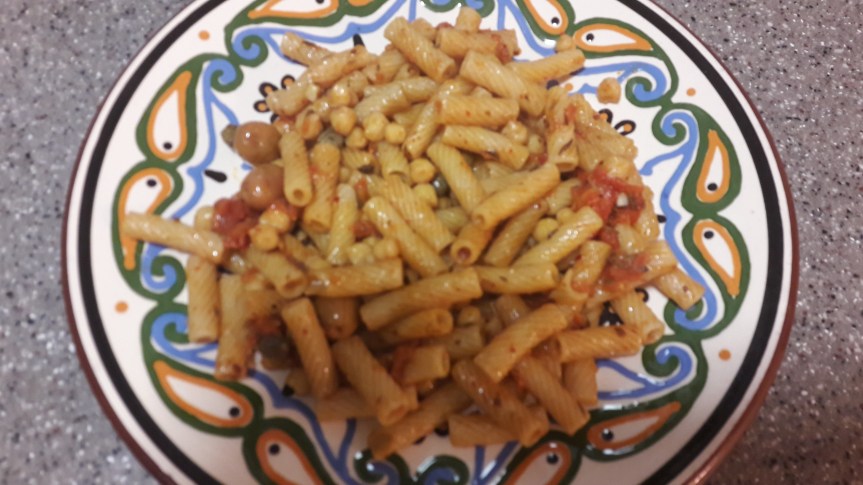
KCC’s one pot wonder – the finished product
Ingredients (serves 2-3)
Three medium-sized tomatoes (approx 150 g)
50 g olives (any you have handy will do, we used some green ones)
150 g cooked chick peas
200 g pasta (penne, fusilli or spaghetti works well)
500 ml hot water
15 g capers
One garlic clove
25 ml olive oil
One teaspoon dried thyme
One teaspoon sumac
One teaspoon chilli flakes
Method
Chop the tomatoes into quarters and add to a large, heavy-based pan with the olives, chick peas, minced garlic, olive oil, thyme, sumac and chilli flakes. Pour the water over the top, add the pasta, stir and bring to a boil.
Cook the pasta as per the instructions on the pack over a medium to high heat – you need to keep it bubbling away and stir occasionally. Keep cooking until the most of the liquid is boiled off, leaving the cooked pasta in the sauce.
The type of pasta we used took around 15 minutes to cook – try it as you go to get the type of taste you prefer. Don’t forget to stir in the washed capers to the pasta and sauce when it is cooked.
Serve straight from the pan and garnish, if you want, with shavings of Parmigiano-Reggiano (Parmesan) cheese.
Welcome to the 60th post on Knidos Cookery Club – to celebrate we took a tour to Datça’s very own vineyard to check out some of the local vintages on offer.
The vineyard is located on a hilltop on the main road into Datça and has a reserve range of delicious reds, going under the name of Cnidus, an alternative spelling of Knidos, and some excellent red and white blends along with a superb blush wine.
This slideshow requires JavaScript.
It has been in its present site since 2011 and has both south and north-facing rows of vines to take advantage of the sun’s rays from both sides. Look out for the round brick windmill on a hillside on the left as you drive into Datça – the vineyard’s on the main road just before the turn off to the town.
This boutique vineyard produces around 40 – 50,000 bottles of wine a year – using Cabernet Sauvignon, Merlot, Syrah (Shiraz) and the indigenous Öküzgözü and Boğazkere grape varieties to produce red wines and a blush, and Chardonnay, Sauvignon Blanc and the local Sultaniye grape to make white wine.
You can taste the wines in the windmill or in the beautiful garden with its spectacular views over the Mediterranean Sea and Greek islands on the horizon. You can also take a tour of the vineyard and buy wine in the shop at competitive prices.
Datça Vineyard’s wines are on sale in some restaurants in town and in two supermarkets – Erdi on the harbour front, and Dilge on the road to the town’s Saturday market.
Green beans roasted with walnuts
With all this wine tasting to do, something simple was called for so this week we’re going to make a a quick pasta dish with roasted green beans and walnuts. It’s really easy to cook and there’s not much washing up either, leaving more time to enjoy the fruits of Datça’s vineyard!
Ingredients (serves 2-3)
250 g green beans
50 g walnuts
200 g pasta (penne, fusilli or spaghetti works well here)
One garlic clove
25 ml olive oil
One teaspoon dried thyme
Method
Top and tail the green beans and cut into 3-4 cm slices. Put the beans in an oven dish, crush the walnuts and mince the garlic and scatter over the beans and then add the thyme and olive oil. Stir well and then put the dish in a pre-heated oven and cook for 30 minutes at 180 c.
While the beans are roasting, cook your favourite pasta as per the instruction on the pack. When cooked to your taste, drain and mix with the roasted beans and walnut and serve immediately on warmed plates with shavings of Parmigiano-Reggiano (Parmesan), if you’re a cheese fan.
As for the wine pairing, we’d recommend either a Silenus Chardonnay or a Silenus Blush – in Greek mythology Silenus was the god of wine making and drunkenness and the foster-father of Dionysos, the god of wine, vegetation, pleasure, festivity, madness and wild frenzy – enjoy!







 Knidos Cookery Club