Over the next few weeks on KCC, we’ll be looking at some dishes inspired by a recent visit to Crete, Greece’s largest island.
Avocado Tzatziki – with love from Crete!
Crete has dishes not commonly found in other parts of Greece, including hortapitakia, small pies filled with leafy greens and fresh herbs picked from the slopes of the island’s plentiful mountains and a tzatziki made with avocado – check the recipe for this dish below.
KCC spent some time this summer in Myrtos on the south-east coast of Crete. A favourite taverna was O Platanos, which had some imaginative takes on some Greek classics, such as avocado tzatzikl, beetroot hummus, fried manouri cheese with honey and sesame seeds and a moussaka made with sweet potato.
Avocado Tzatziki à la Platanos, Myrtos, Crete
Ingredients (makes four servings)
200 ml Greek yogurt
75 g avocado
75 g cucumber
One garlic clove
Add fresh basil, oregano or dill (to your taste)
Simply smash the avocado, grate the cucumber and mix with the yogurt and then add crushed garlic if using and the herbs of your choice. Hey presto, your tzatziki is ready! Serve with warm pita bread.
There were signs this week of life slowly beginning to return to some sort of normal. Cafes and terraces are set to open once again in Almaty from next week and the streets are busier. We’re not planning on changing too much at the moment and, in the meantime, we’re content to continue our armchair culinary travels.
Half-way there – assembling the briam…
Greece has been in the headlines this week with the news that its beaches are reopening and it’s preparing to open its borders to tourists next month. This news brought back memories of holidays in the Greek islands and the great food in the tavernas. One of our favourite dishes is briam (pronounced bree-AM) – a delicious stew of oven-roasted seasonal vegetables.
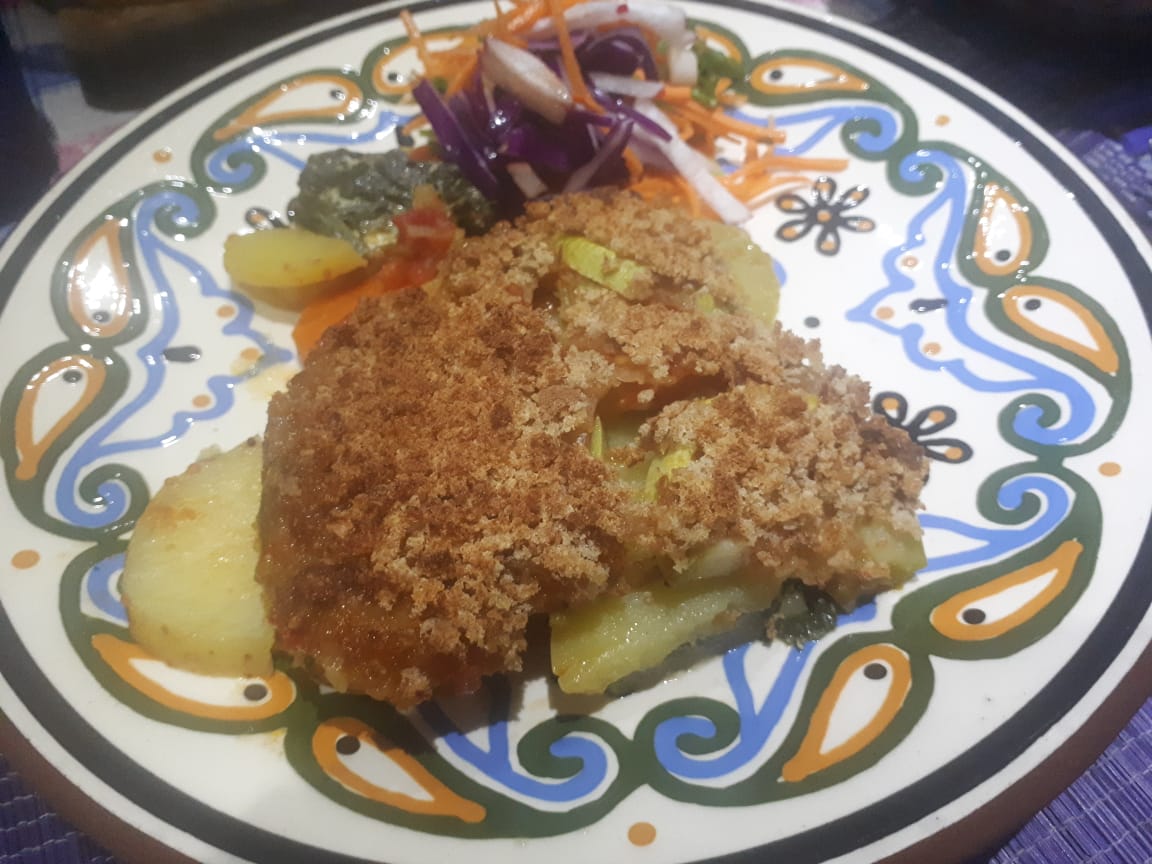
Briam – good enough to eat
As usual, we’ve taken a few liberties with the recipe, omitting aubergines (usually a key ingredient) as they are not quite in season in Almaty yet, so foodie purists please look away. We’ve added carrot and spinach to the usual potatoes and courgettes and then cooked it slowly in a tomato sauce. We’ve also topped it with some breadcrumbs to enclose our briam.
The name briam has an interesting history – it is a borrowed word – there is no letter ‘b’ in the Greek alphabet, instead this sound is represented by combining the letters ‘μ’ (m) and ‘π’ (p) – ‘μπ’. Many Greeks call this casserole tourlou tourlou (all mixed-up), so briam could have come from Greeks who lived in Anatolia until the mass population exchanges in the early 20th century.
Briam and salad
In the Ottoman era, there was a word biryan, spelt büryan in modern Turkish, which refers to a side of lamb cooked slowly over charcoal in a pit in the ground – a speciality of Siirt in the Kurdish area on the borders with Iraq and Syria. This in turn could come from Persian, where biryan means roasted (notice the similarity with India’s biriyani). Whatever the name’s origin, it tastes great!
Ingredients (serves 4)
For the bake:
Two courgettes (approx 300 g)
Four potatoes (approx 300 g)
One carrot (approx 100 g)
200 g spinach
75 g breadcrumbs
For the tomato sauce:
One red onion
250 g tomatoes
One bunch of parsley
20 capers
25 ml olive oil
One teaspoon mustard seeds
250 ml vegetable stock or water
Method
Make the tomato sauce first. Heat the oil in a heavy based pan, add the mustard seeds and when they start to pop add the chopped onions and cook over a medium heat, stirring occasionally. After five minutes reduce the heat and add the chopped tomatoes. Stir and simmer for ten minutes then add the stock, chopped parsley and capers. Cook until the liquid has reduced by half.
Cook the spinach for a few minutes until it is beginning to wilt and then set aside. Cut the potato, courgette and carrot into 1 mm slices and put a layer of potatoes, then courgettes and then carrots into a greased baking dish. Add the spinach and pour half the tomato sauce over the vegetables. Add another layer of potatoes and courgettes and then pour the remainder of the tomato sauce over the layers. Spread the breadcrumbs over the top.
Cover with tin foil and bake in an oven at 180 c for around 1.5 hours. After an hour, remove the foil and cook for another 20-30 minutes until the breadcrumbs go start to go a golden brown colour. Keep an eye on it to make sure the breadcrumbs aren’t burning. Serve immediately with a fresh salad – it’s also great when it’s cooled down a bit.
This time round on Knidos Cookery Club we’re stuffing again to make one of favourite summertime snacks – dolma (stuffed vine leaves).
These stuffed vine leaves are great as part of a barbecue spread or to add some rice oomph to a selection of dips and mezes.
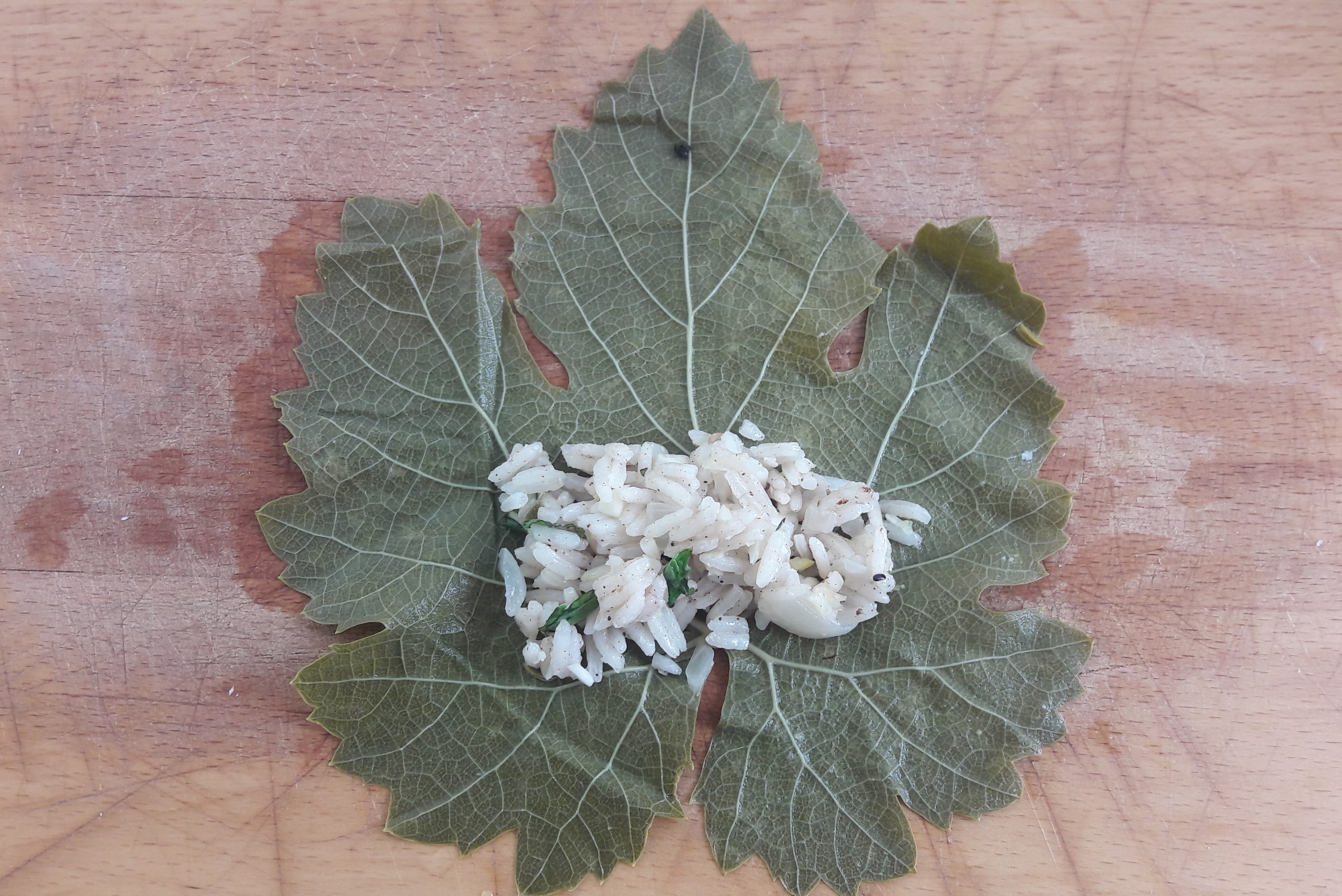
Ready to roll…
Rolling the leaves can be a bit fiddly at first, but you’ll soon find yourself getting into the rhythm. it’s best to make a big batch of these little stuffed marvels so you’ve got some ready-made snacks giving your more time at the beach.
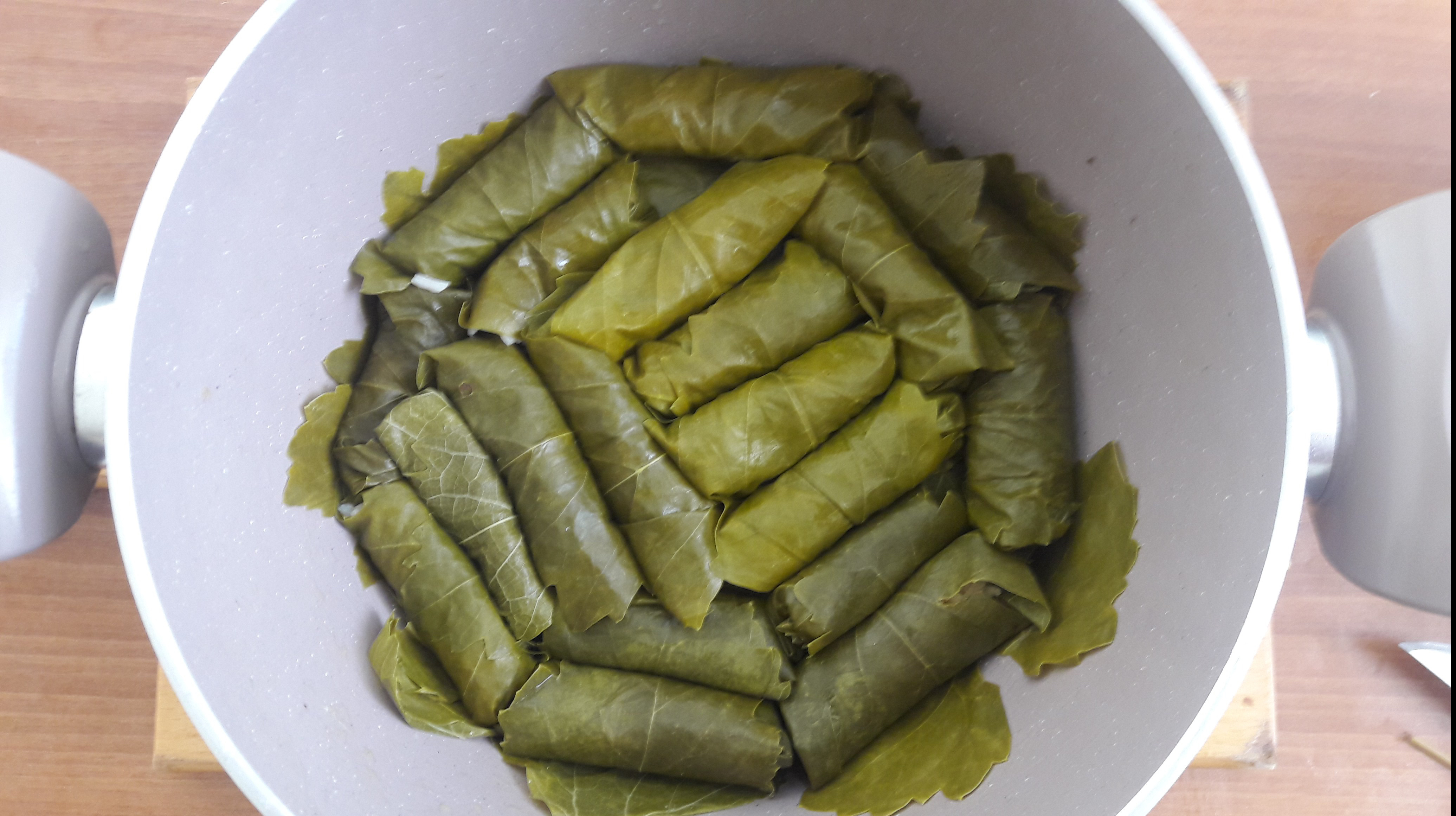
Layer the cylinders tightly in the pan
If you have any vine leaves left over, then hang on to them as we’ll be featuring another vine leaf recipe next time round on KCC.
Ingredients (makes 48 dolmas)
One onion
200 g long grain rice
50 ml olive oil
750 ml water
One lemon (zested and juiced)
50 g chopped almonds
two teaspoons dried thyme
one teaspoon cinnamon
one teaspoon cumin
10 g fresh mint
Pack of preserved vine leaves (or fresh leaves if you can get them)
Method
Fry the finely chopped onion in 25 ml of oil for five minute over a medium heat. While this is cooking, wash the rice until the water runs clear. Now soak the vine leaves for 30 minutes and then rinse well to remove any taste of brine or other preserving agents.
Add the thyme, cinnamon and cumin to the onion and stir. Now add the rice, mixing well to coat the grains. Cover with 375 ml of water and cook until the water is absorbed. The rice does not need to be fully cooked at this stage. When ready, add the chopped almonds, lemon zest and mint and mix well.
Now it’s time to stuff. Take a vine leaf, cut off the stalk and place a teaspoonful of rice mix on the leaf (see picture above). Tuck in the sides of the leaf and roll into a tight cylinder.
Put a layer of unstuffed vine leaves on the bottom of the pan to stop the stuffed ones sticking to the bottom. Layer the dolmas tightly in a heavy-based pan, putting another layer on top if you run out of space. Pour 25 ml of olive oil, the juice of the lemon and 375 ml of water over the vine leaf parcels.
Put a plate on top of the vine leaves and then put the lid on the pan and cook over a low heat for 45 minutes or until all the liquid is absorbed. Allow to cool before serving. If left in the fridge for a few hours, the stiffed vine leaves will firm up nicely.




 Knidos Cookery Club