Haydari Stuffed Potato Balls

6 July 2017

Welcome to Knidos Cookery Club’s 50th post! To mark this momentous milestone, we’ve recreated a dish we discovered while visiting Ovabükü, a quiet beach on the Knidos peninsula – stuffed potato balls.

20170627_205032
Spicy potato balls stuffed with haydari

If you’ve enjoyed reading Knidos Cookery Club as much as we’ve enjoyed producing it, then could we ask a favour – please nominate us in the Saveur Blog Awards for 2017. This is a special award for food blogs and if you could spare a couple of minutes to nominate then enter our URL – https://knidoscookeryclub.wordpress.com – and choose the Best New Voice category. Your support would be much appreciated – thanks in advance!

20170627_132117
Haydari with walnuts

For Knidos Cookery Club one of the most enjoyable things about the local food scene is finding a new restaurant and checking out the dishes in the vitrine. There are always some surprise dishes lurking in the glass display cabinets that are made from fresh, seasonal ingredients.

In Ovabükü one of the dishes on the mixed meze plate was the aforementioned potato ball stuffed with cream cheese. We’ve put some delicious haydari, made from mint and strained yogurt, in our version, and spiced up the potato balls with some chilli flakes. Strained yogurt is thicker than normal yogurt as the liquid whey and lactose has been strained off – it’s also known as Greek style yogurt in the UK.

Haydari

  • 200 ml strained yogurt
  • 20 g crumbly white cheese
  • 1 garlic clove
  • 3 teaspoons dried mint
  • 1 teaspoon red chili flakes
  • 2 walnuts

Mix the yogurt, cheese, garlic and mint together and leave in the fridge for a couple of hours. Decorate the haydari with walnut pieces and dust with chilli flakes before serving.

Spicy Potato Balls

  • 500 g baked or boiled potatoes
  • Handful of fresh parsley
  • 1 teaspoon red chili flakes
  • Black pepper
  • 50 ml unstrained yogurt

Mash the potato and mix in the other ingredients. Form into round, golf ball-sized shapes, make an indentation in the top with a teaspoon and fill the gap with haydari and top with a walnut half.

A Passion for Pkhali

20 April 2017

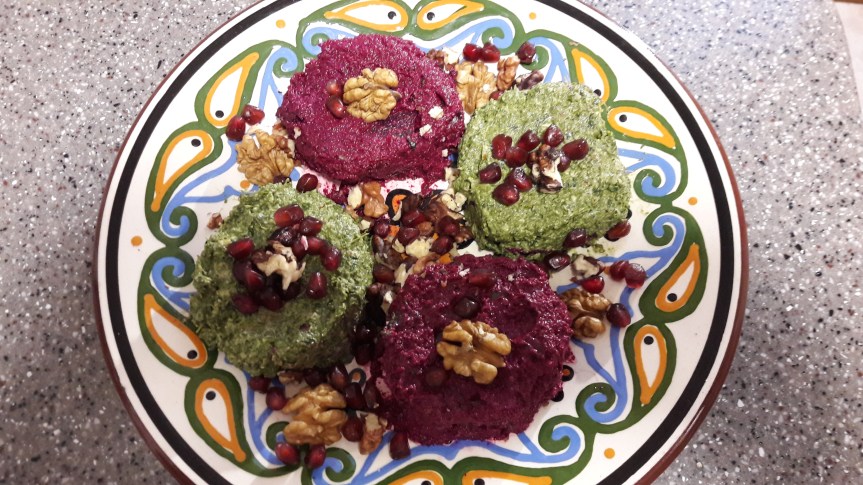
This time round on Knidos Cookery Club we’re returning to Georgia for some culinary inspiration in the form of pkhali, a type of starter made from walnuts, herbs, spices and whatever vegetable happens to be in season, such as spinach, beetroot, aubergine, cabbage or carrot.

20170415_200229

Walnuts are widely used in Georgian cooking – besides pkhali, they can be turned into  satsivi, a thick paste similar to hummus, and  bazhe, a sauce made with the holy trinity of Georgian herbs – blue fenugreek, ground coriander (cilantro) and crushed marigold flowers. These combos can be mixed with fresh cucumbers and tomatoes as a salad dressing or stuffed into tongues of fried aubergine (eggplant).

IMG-20170415-WA0000

Staying on the walnut theme, on a recent visit to the former home of famous Kazakh writer Mukhtar Auezov in Almaty, Kazakhstan, the guide gave me a handful of walnuts from the gnarled old tree in the garden of the writer’s house. These nuts were used in the making  of today’s pkhali recipe.

Auezov was famous in Soviet times for writing The Path of Abai, an epic historical novel based on the life and teachings of Kazakhstan’s most famous poet and composer Abai Qunanbayuli, who had been a neighbour and friend of Auezov’s grandfather.

It was said in the Soviet era that all were equal, but some were more equal than others – and this was certainly the case for Auezov after he won the Lenin Prize in 1959 for his four-volume epic novel about Abai.

The prize came with a sackful of roubles which he invested in a two-storey house, which is now a museum dedicated to his life and work. The house was lavish by the standards of the time and was designed by the architect who designed Almaty’s Abai Opera Theatre.

Ingredients (Makes around four generous servings of each pkhali – see photo above)

For the beetroot pkhali

  • 300 g cooked beetroot
  • 100 g walnuts
  • One garlic clove
  • 5 g fresh parsley
  • 5 g fresh coriander
  • One teaspoon blue fenugreek powder
  • One teaspoon black pepper
  • 20 ml wine vinegar
  • A scattering of pomegranate seeds and walnuts


For the spinach pkhali

  • 250 g fresh spinach
  • 100 g walnuts
  • One small onion (around 75 g)
  • One garlic clove
  • 5 g fresh parsley
  • 5 g fresh coriander
  • One teaspoon blue fenugreek powder
  • One teaspoon black pepper
  • 20 ml wine vinegar
  • A scattering of pomegranate seeds and walnuts


Method

  • For the beetroot pkhali:
  • Boil the beetroot for 30 minutes or so until you can pierce it with a knife easily.
  • Leave to cool and then peel and chop into small chunks.
  • Toast the walnuts over a low heat for 5-10 minutes and then add to the garlic and herbs and spices in a bowl. Add the vinegar and use a blender to make a smooth paste. Add the beetroot chunks and keep blending until you have a gloopy mixture.
  • Leave overnight in the fridge and then serve with a scattering of pomegranate seeds and walnuts.

Method

  • For the spinach pkhali:
  • Cook the spinach in boiling water for 5 minutes until it begins to wilt. Remove and place in cold water and then drain.
  • Finely chop the onion and put it in a mixing bowl with the garlic, herbs and spices. Toast the walnuts over a low heat for 5-10 minutes and then add to the bowl. Add the vinegar and use a blender to make a smooth paste. Add the spinach and keep blending until you have a gloopy mixture.
  • Leave overnight in the fridge and then serve with a scattering of pomegranate seeds and walnuts.


Avocado + Egg = Brunch Heaven

9 February 2017

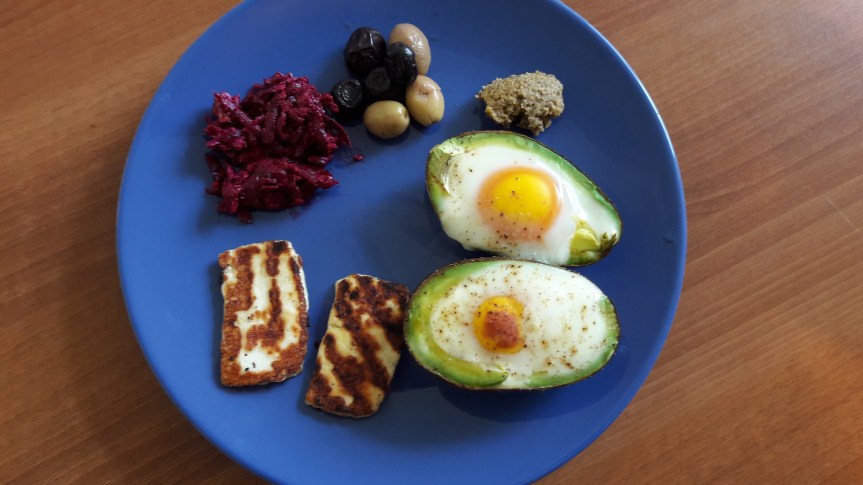
This week at Knidos Cookery Club we have a guest post that combines two of our all-time fave foods: avocado and egg, dished up with olives, beetroot with walnuts and halloumi cheese.

20170115_143020

Avocados love the mild winters of the Knidos region as the shores of the Mediterranean Sea provide ideal growing conditions for this large green fruit that’s packed with nutritious vitamins and healthy fats.

Our guest chef Jasha, who has worked in the hospitality industry in the UK, has kindly agreed to share her favourite way of combining eggs with avocado. Served up with pan-seared halloumi, olives and grated beetroot with walnut, this great dish sent us into brunch heaven!

Ingredients 

One avocado per person

Two eggs per person

250 g pack halloumi cheese cut into four slices (enough for two people)

Black and green olives

A few scoops of olive paste

One grated large beetroot (raw or cooked) mixed with 50 g crushed walnuts and two teaspoons of sour cream or natural yogurt

Black pepper and red chili flakes

Method

Slice the avocados in half and remove the stone. Be careful not to stab yourself in the hand as I once did – it’s apparently quite a common kitchen injury. Scoop out some of the flesh to leave a hollow space for the egg.

Place the avocado halves in a baking dish, round side down, and pour an egg into the scooped out shell. Grind some black pepper over each egg and bake the avocados in an oven pre-heated to to 200 c /gas mark 6 for 20 minutes or until the underside of the eggs are cooked. Finish the eggs off under a grill and then season with some red chili flakes and a grind of black pepper.

While the eggs are cooking, fry the halloumi slices in a non-stick or heavy-based frying pan until browned on both sides.

Serve the avocados immediately with the pan-seared halloumi, beetroot and walnuts, olive paste and olives and some doorsteps of fresh bread.